
Building Credit
If you are currently in college, or have recently graduated from college, you know how difficult it is to get a credit card due to a lack of credit history. For those of us who are a little older, this may seem unbelievable, because when we were in school, credit card offers would literally pour out of our mailboxes.
In the past, credit companies would practically beg college students to sign up for low-balance student cards, but thanks to the credit collapse of 2008, that story has drastically changed. It is now nearly impossible to get accepted for a credit card if you have no previous credit history, and this is really hurting a lot of young adults who are trying to get on their feet.
Why You Need to Build Credit
It is a giant “Catch 22” You need a Credit History in order to Build a Credit History
 Building Credit History—natloans (Flickr.com)You have to have credit history in order to buy or lease a car… buy a home…be considered for a loan…
And when do people usually first need loans? Two to three years after graduating from college. Without a credit card, college students can’t build the credit they need to do these things, and this is why it is important for parents to start helping their kids build their credit starting their freshman year.
How Parents Can Help Build Your Credit
Parents can help their children build credit by opening a joint account with them; with parents as the owners and the child as the authorized user. Have one card designated as the “credit-builder card.” Only use it to buy things like school textbooks or supplies, and pay it off as soon as you make purchases. This will teach your children good credit spending habits and slowly build their responsibility. It will require parents to constantly monitor the card’s use and stay on the child about making payments, but if the student is mindful, there shouldn’t be any problems.
If a parent is concerned that [Read more…] about The Importance of Building Credit as a Young Adult
 Even contract labor requires certain documentation. If a company pays a contractor more than $600 over the course of the year, a 1099 must be filed. Keeping track of the various tax amounts for various employees as well as which contracted employees earned how much can easily become a full-time job. Small business owners have plenty of other details to manage without adding that to their plates. If only for personnel purposes, an accountant will save time as well as headaches.
 Today’s chart compares the total nonfarm payrolls (blue line) to its two components Private sector job market (gold line) and Government sector job market (red line). But rather than showing total jobs it shows the percentage change in total nonfarm payrolls (blue line) since the declared end of the Great Recession in 2009 (the vertical line). So at that point it is zero. Prior to that point private sector jobs were as high as 7% higher while public sector (government) jobs were 2% lower (i.e. the government increased its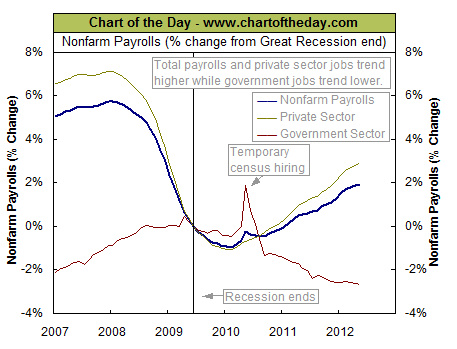



 As a result, smart companies are shifting a part of their marketing dollars to social media. Large companies like Proctor & Gamble, Taco Bell, and Pepsi are budgeting huge amounts of money to manage brand perception and promote their products via social media. And in the process, they are creating the demand for thousands of Social Media Managers and Marketing Consultants.