• Skip to primary navigation
  • Skip to main content
  • Skip to primary sidebar
  • Home
  • Contact us
  • Related Sites
    • InflationData.com
    • Financial Trend Forecaster
    • Your Family Finances
    • Elliott Wave University
    • Optio Money
  • About
    • Terms of Use
    • Disclaimer & Disclosure
    • Privacy Statement
  • Sitemap
    • 2009-2010 Posts
    • 2011 Posts

UnemploymentData.com

Your Source for Employment and Unemployment Data

Unemployment
  • Charts
    • Current Unemployment Rate Chart
    • Current Employment (Chart and Data)
    • Current Employment vs Unemployment Chart
    • Historical Employment Data
    • Employment Population Ratio
    • Misery Index
  • Unemployment
    • Historical Unemployment Rate Tables
    • What Is U-6 Unemployment?
    • Unadjusted vs. Seasonally Adjusted U-3 Unemployment Rate
    • BLS vs. Gallup Unemployment Numbers
    • Current U-6 Unemployment Rate
    • What is the Labor Force Participation Rate?
    • What is the Real Unemployment Rate?
  • Employment
    • Current Employment (Chart and Data)
    • Historical Employment Data
    • Contacting a Live Person at the State Employment Commission
      • How to Talk to a Live Person at the Virginia Unemployment Commission
      • Florida’s FLUID Unemployment Program
    • Benefits
      • Insurance
      • Retirement
    • Careers
    • Employment Costs
    • Experience
    • Government
    • Job Hunting
      • Interview
      • Resume
  • Find Articles
  • Education
    • Skills
  • General
    • Small Business
      • Outsourcing
    • Success
You are here: Home / Archives for Tim McMahon

Tim McMahon, Editor of UnemploymentData.com

My grandfather lived through the Hyperinflation in Weimar, Germany--to say he was an original “gold bug” would be an understatement. I began reading his “hard money” newsletters at the age of 16 and the dividends from gold stocks helped put me through college. I began publishing the Financial Trend Forecaster paper newsletter in 1995 upon the death of James Moore editor of Your Window into the Future and the creator of the Moore Inflation Predictor©. FTF specializes in trends in the stock market, gold, inflation and bonds. In January of 2003, I began publishing InflationData.com to specialize in all forms of information about the nature of Inflation. In 2009, we added Elliott Wave University to help teach you the principles of Elliott Wave analysis. In January 2013, we began publishing OptioMoney. Connect with Tim on Google+.

About Tim McMahon

Work by editor and author, Tim McMahon, has been featured in Bloomberg, CBS News, Wall Street Journal, Christian Science Monitor, Forbes, Washington Post, Drudge Report, The Atlantic, Business Insider, American Thinker, Lew Rockwell, Huffington Post, Rolling Stone, Oakland Press, Free Republic, Education World, Realty Trac, Reason, Coin News, and Council for Economic Education. Connect with Tim on Google+

BLS Releases May 2026 Jobs Report

June 6, 2026 by Tim McMahon Leave a Comment

The U.S. Bureau of Labor Statistics (BLS) released its May
employment / unemployment report
on June 5th, 2026.

Employment / Unemployment 

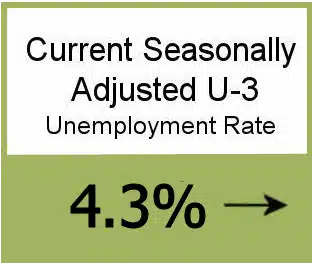
Adj U3 Icon 4-3 unchanged

  • Seasonally Adjusted U-3 is 4.3% Unchanged
  • Unadjusted U-3 is 4.1% up from 4.0%
  • Unadjusted U-6 is 7.7% Unchanged
  • Labor Force Participation is 61.8% Unchanged
  • Unadjusted Employment rose from 158.726 million to 159.467 million
  • Next Update: July 2nd, 2026


Summary:
The jobs report came in much higher than expected, with an uncharacteristic adjustment upward for the previous month’s numbers (April). The biggest gainer was Leisure and hospitality, gaining 70,000 jobs. Job losses occurred in insurance carriers and related activities (-11,000) and commercial banking (-3,000).

According to the Commissioner of the U.S. Bureau of Labor Statistics:

“Total nonfarm payroll employment increased by 172,000 in May, and the unemployment rate was unchanged at 4.3 percent, the U.S. Bureau of Labor Statistics reported today. Job gains occurred in leisure and hospitality, local government, and health care. Employment in financial activities declined…

The number of people jobless less than 5 weeks declined by 286,000 to 2.2 million in May, largely offsetting an increase in the prior month. The number of long-term unemployed (those jobless for 27 weeks or more) was little changed over the month at 2.0 million but is up by 524,000 over the year. The long-term unemployed accounted for 27.5 percent of all unemployed people in May.”

So, despite declines in Government employment, overall employment still increased.

As usual, they are talking about “Seasonally Adjusted Jobs”.

Looking at the Unadjusted Establishment Survey report we see…
Originally, the BLS reported employment of 158.695 million for April, which they have since adjusted upward to 158.726 million, an increase of 31,000. Current May numbers are 159.467 million for an increase of 741,000 jobs based on their current numbers or +772,000 based on the original numbers.

Note: According to Politifact, “The federal workforce grew by about 4.8% during Biden’s term, increasing from 2.89 million in January 2021 to 3.02 million in January 2025.” 

So, Trump has reduced the federal payroll by more than twice what it gained under Biden. Although this does reduce budget pressure, it also puts pressure on the job market for those who are seeking other employment. It is estimated that between 30-40% of these workers retired, while perhaps 10-15% were working spouses who chose to stay home rather than seek other employment.

[Read more…] about BLS Releases May 2026 Jobs Report

Filed Under: BLS Tagged With: BLS, employment, jobs, May 2026, unemployment

May Jobs Report for April 2026

May 9, 2026 by Tim McMahon

The U.S. Bureau of Labor Statistics (BLS) released its April
employment / unemployment report
on May 8th, 2026.

Employment / Unemployment 

Adj U3 Icon 4-3 unchanged

  • Seasonally Adjusted U-3 is 4.3% Unchanged
  • Unadjusted U-3 is 4.0% down from 4.3%
  • Unadjusted U-6 is 7.7% down from  8.0%
  • Labor Force Participation is 61.8% down from 61.9%
  • Unadjusted Employment rose from 157.769 million to 158.695 million
  • Next Update: June 5th, 2026


Summary:
The jobs report came in higher than expected, with only a minor adjustment downward for the previous month’s numbers (March). The biggest gainer was Education and Health, gaining 46,000 jobs. The biggest loser was Information, with a loss of -13,000 jobs, and with only three sectors declining.

According to the Commissioner of the U.S. Bureau of Labor Statistics:

“Total nonfarm payroll employment edged up by 115,000 in April, and the unemployment rate was unchanged at 4.3 percent, the U.S. Bureau of Labor Statistics reported today. Job gains occurred in health care, transportation and warehousing, and retail trade… Federal government employment continued to decline in April (-9,000). Since reaching a peak in October 2024, federal government employment is down by 348,000, or 11.5 percent”.

So, despite declines in Government employment, overall employment still increased.

As usual, they are talking about “Seasonally Adjusted Jobs”.

Looking at the Unadjusted Establishment Survey report we see…
Originally, the BLS reported employment of 157.775 million for March, which they have now adjusted to 157.769 million. Current April numbers are 158.695 million for an increase of 926,000 jobs based on their current numbers or +920,000 based on the original numbers.

Note: According to Politifact, “The federal workforce grew by about 4.8% during Biden’s term, increasing from 2.89 million in January 2021 to 3.02 million in January 2025.” 

So, Trump has reduced the federal payroll by more than twice what it gained under Biden. Although this does reduce budget pressure, it also puts pressure on the job market for those who are seeking other employment. It is estimated that between 30-40% of these workers retired, while perhaps 10-15% were working spouses who chose to stay home rather than seek other employment.

[Read more…] about May Jobs Report for April 2026

Filed Under: BLS Tagged With: 2026, April Jobs, BLS, employment, unemployment

Inflation vs Unemployment Challenge FED’s Resolve

April 13, 2026 by Tim McMahon

Inflation vs Unemployment
Image by Meta AI

Inflation jumped to 3.3% in the latest CPI report, up sharply from 2.4% the prior month. This rapid increase comes on top of the gradual rise in unemployment since its 2023 lows. This leaves the Federal Reserve with no easy options.

The FED’s Dual Mandate

This situation is making it increasingly difficult for the Federal Reserve to manage both sides of its dual mandate. The Fed is legally required to pursue two often competing goals: keeping inflation low and stable, and maintaining maximum employment. In normal times, these goals are two sides of a “see-saw”. Increasing the money supply reduces unemployment but increases inflation, and vice versa.

But when inflation surges at the same time the labor market begins to weaken, the Fed finds itself pulled in opposite directions with no clean policy solution. Economists have a word for this combination of stagnating growth, rising unemployment, and persistent inflation: stagflation. It is widely considered one of the most difficult economic environments for policymakers to navigate, as the tools used to fight inflation typically make unemployment worse. That is precisely where we find ourselves today.

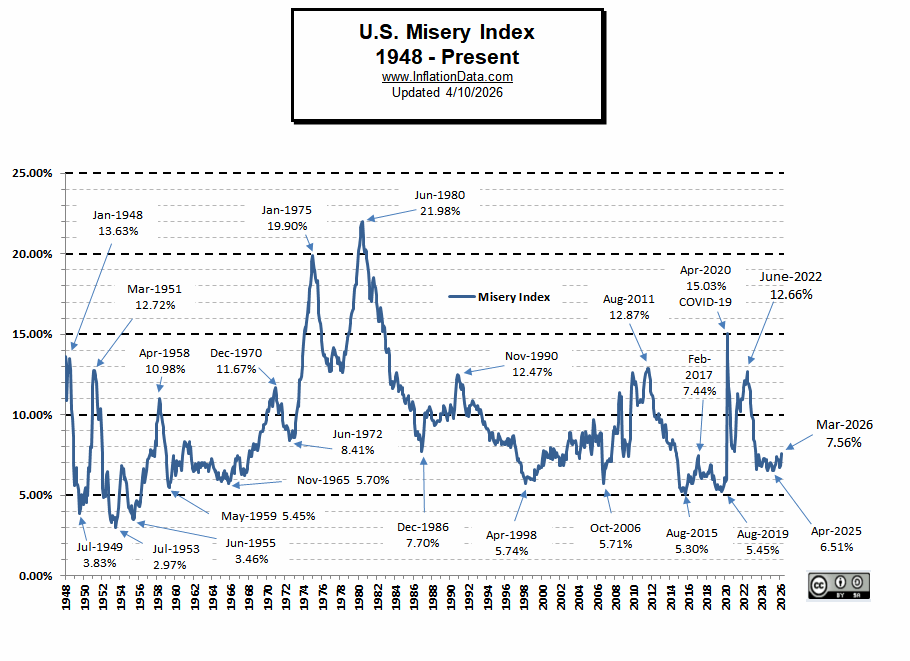
Misery Index Jumps to 7.56%

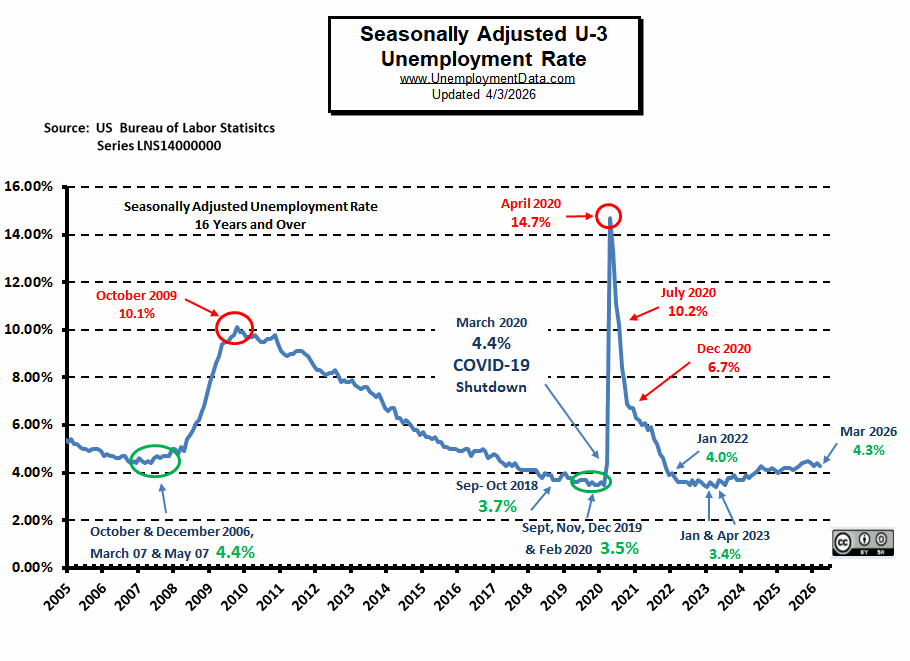
The human cost of rising inflation shows up clearly in the Misery Index, which simply adds the unemployment rate to the inflation rate to measure everyday economic stress. In March 2026, the Misery Index rose sharply from 6.81% to 7.56%, driven entirely by the surge in inflation. With unemployment at 4.30% and inflation at 3.26%, Americans are feeling the squeeze from both directions — higher prices at the same time the job market is quietly softening.

Misery Index- Mar 2026The Fed’s Impossible Position

Because the Federal Reserve is responsible for both goals, when inflation rises, the Fed raises rates. When unemployment rises, the Fed cuts rates. The problem facing policymakers right now is that both metrics are moving in the wrong direction at the same time.

Markets are currently pricing in a 98% chance that the Fed holds rates steady in late April, with over a 90% probability that no rate cuts arrive until October at the earliest. Cutting into rising energy prices would risk reigniting inflation, while holding rates high too long risks allowing a weakening labor market to deteriorate further.

Labor Market Weakness Hiding in Plain Sight

On the surface, the unemployment rate appears relatively stable. But beneath that headline number, the data tells a more concerning story. Hiring is falling, job openings are declining, and the conditions for a more significant rise in unemployment are quietly building, in part due to increasing productivity created by AI. The one bright spot is the Deflationary forces created by AI.

Historically, it is falling asset prices that trigger layoffs — not the other way around. Once layoffs begin to pick up in an environment where hiring has already slowed, the unemployment rate can rise quickly and in a nonlinear fashion. That cycle has not yet been triggered, but the underlying conditions are moving in that direction.
Current Unemployment for Mar 26

A Late Business Cycle Warning

The combination of supply-driven inflation and a softening labor market is a hallmark of late business cycle environments. Energy prices, constrained by geopolitical supply pressures rather than surging demand, are pushing inflation higher at precisely the moment the economy can least afford it.

In past business cycles, this dynamic has preceded recessions. The Fed finds itself unable to ease policy to support employment without risking another inflation surge — a position that historically has made it difficult to avoid a meaningful rise in unemployment once the labor market begins to crack.

What to Watch

The unemployment rate remains the key indicator to monitor in the months ahead. If layoffs accelerate while hiring remains depressed, the unemployment rate could rise faster than many expect. The Fed’s ability to respond will be constrained as long as inflation remains elevated, meaning the labor market may bear the brunt of a policy environment that has run out of easy options.

You might also like:

  • Deflationary forces created by AI.
  • The Misery Index,
  • What is Stagflation

Filed Under: General Tagged With: business cycle, CPI, dual mandate, energy prices, Federal Reserve, Inflation, interest rates, Labor Market, Misery Index, recession, stagflation, unemployment

Jobs AI Can’t Destroy: Careers for 2026 and Beyond

April 13, 2026 by Tim McMahon

AI proof Jobs
Image by Meta AI

Summary:
The jobs most resilient to AI automation share four qualities: physical presence, emotional intelligence, ethical accountability, and creative judgment. Careers that require all four — including nurse practitioners, lawyers, electricians, and cybersecurity analysts are expanding even as AI eliminates routine administrative and clerical roles. The key distinction is not whether AI touches a job, but whether the core value of that job depends on something AI can’t replicate.

Artificial intelligence is no longer a pipedream or sweat-producing nightmare (depending on your perspective). It is affecting the U.S. labor market in real time, reshaping roles and creating entirely new categories of work that didn’t exist a decade ago. For workers trying to plan their next move, and for those entering the workforce for the first time, the central question has shifted from “Will AI affect my job?” to “How do I build a lasting career despite AI?”

The data offers some clear insights. While AI is expected to displace a vast number of routine jobs over the coming decade, it is also projected to create even more new roles in emerging fields we can’t even imagine yet.

AI-proof careers in 2026 require human judgment, physical presence, ethical accountability, and genuine emotional connection. These traits will remain in demand for years to come. Here are a few of those careers, from skilled trades to professional services… these careers thrive where automation fails.

Why Some Careers Endure While Others Disappear

The U.S. Bureau of Labor Statistics Occupational Outlook Handbook projects that occupations like cashiers, office assistants, bookkeepers, and payroll clerks will lose hundreds of thousands of positions by 2034. Administrative-related roles account for six of the top twenty largest projected job declines. These are not bad workers in bad industries — they are roles where the core tasks happen to be rule-based, repetitive, and well-suited to software.

The careers that hold up share a different profile. Research consistently identifies four qualities that protect against automation.

Physical presence and dexterity. Tasks that require hands-on work in unpredictable environments — responding to the unique configuration of a job site, operating in spaces too small or dangerous for machines, adapting in real time to conditions that no two jobs share — remain beyond current robotics.

Emotional intelligence and trust. Genuine human connection is not a soft benefit; it is the core product in healthcare, therapy, education, and client-facing financial services. AI can simulate language, but cannot form authentic bonds.

Ethical accountability. In law, medicine, engineering, and leadership, someone with a license and a name must be responsible for outcomes. That accountability cannot be automated away.

Creative and strategic judgment. The ability to generate genuinely novel ideas, read cultural context, make unexpected connections, and adapt strategy to ambiguous situations remains a domain where human judgment outperforms AI assistance.

Careers that require multiple of these qualities at once are the most durable. The workers who thrive long-term will not be those who avoid AI, but those who use it as a tool while bringing something to the table that AI can’t reproduce. [Read more…] about Jobs AI Can’t Destroy: Careers for 2026 and Beyond

Filed Under: AI Tagged With: AI and jobs, AI automation, AI-proof careers, automation risk, jobs AI can't replace, Jobs AI cannot replace, jobs safe from automation

Why February 2026’s Jobs Report Was an Anomaly, Not a Trend

April 6, 2026 by Tim McMahon

February 2026 jobs report anomaly

Image created by Bing AI

When the Bureau of Labor Statistics released the February 2026 employment report, the headline number sent a jolt through financial markets: nonfarm payrolls had dropped by 92,000, a dramatic reversal from January’s solid gain. Economists and commentators rushed to declare the labor market was cracking. They were wrong — or at least, they were telling the wrong story.

February was a perfect storm of one-time disruptions stacking on top of each other. When you look closer, the underlying labor market looks nothing like the headline number suggests.

January Was Stronger Than It First Appeared

Let’s start with the baseline. The original January payroll figure of +126,000 was subsequently revised upward by 34,000 to +160,000. That’s a meaningfully strong month, representing solid underlying demand for workers. The February weakness has to be understood against that backdrop, not against a weaker starting point. [Read more…] about Why February 2026’s Jobs Report Was an Anomaly, Not a Trend

Filed Under: Employment Tagged With: 2026, Construction, DOGE, employment, Employment Data, February 2026, federal employment, Jobs Report, Kaiser Permanente strike, Labor Market, winter storm

April Employment Report for March 2026

April 4, 2026 by Tim McMahon

The U.S. Bureau of Labor Statistics (BLS) released its March
employment / unemployment report
on April 3rd, 2026.

Employment / Unemployment 

4.3%

  • Seasonally Adjusted U-3 is 4.3% down from 4.4%
  • Unadjusted U-3 is also 4.3% down from 4.7%
  • Unadjusted U-6 is 8.0% it was 8.3%
  • Labor Force Participation is 61.9% it was 62.0%
  • Unadjusted Employment rose from 157.204 million to 157.775 million 
  • Next Update: May 8th, 2026

Summary:
The BLS adjusted its February employment numbers downward by 82,000 this month, from 157.286 million to 157.204 million. But the March numbers are still up to 157.775 million. The Census numbers are also a bit unusual this month, in that the U.S. Census Population Clock said 343,369,720 last month, and now it says: 342,414,097. For a decrease of almost 956,000. Since the clock is just an automated estimate, the Census Bureau adjusts it annually to better reflect current population estimates.

According to the Commissioner of the U.S. Bureau of Labor Statistics:

“Total nonfarm payroll employment increased by 178,000 in March, and the unemployment rate changed little at 4.3 percent, the U.S. Bureau of Labor Statistics reported today. Job gains occurred in health care, in construction, and in transportation and warehousing. Federal government employment continued to decline.” 

So, despite declines in Government employment, overall employment still increased.

Note: According to Politifact, “The federal workforce grew by about 4.8% during Biden’s term, increasing from 2.89 million in January 2021 to 3.02 million in January 2025.”  According to the Economic Policy Institute, “Federal employment has declined by 352,000 jobs since January 2025.”

As usual, they are talking about “Seasonally Adjusted Jobs”.

Looking at the Unadjusted Establishment Survey report we see…
Originally, the BLS reported employment of 156.714 million for January, which they adjusted slightly to 156.723 million in February and up again to 156.728 million this month.

They originally reported 157.286 million jobs for February, which they adjusted down to 157.204 million this month.

Current March numbers are 157.775 million for an increase of 571,000 jobs based on their current numbers or +489,000 based on the original numbers.


[Read more…] about April Employment Report for March 2026

Filed Under: BLS Tagged With: 2026, ADP, BLS, employment, March, unemployment

Department of Labor Creates Free AI Training

March 26, 2026 by Tim McMahon

Lame AI image created by DOL

Calling it the ‘Make America AI-Ready’ initiative, the U.S. Department of Labor (DOL) has created a free program to educate Americans on how to best use all the A.I. that is being created. According to the DOL’s news release, it helps “to equip American workers with foundational AI skills needed to succeed in an AI-driven economy.” 

Its method of delivery might be considered a bit strange, but it is designed to be delivered via text message so that it is accessible to everyone, even if you don’t have regular access to a computer. Of course, if you don’t have access to a computer, I’m not sure what good A.I. is going to do you. And if the “thank-you for signing up” image to the left is any indication of the quality of the course, it will be another example of something DOGE should look into.

Deputy Secretary of Labor Keith Sonderling said. “We are seeing AI create new jobs, new levels of productivity, and new forms of entrepreneurship, and we want to make sure all Americans have the skills to share in that prosperity.” So perhaps the program will help at least eliminate the fear of AI for those without computers as they enter the workforce.

According to the DOL, the course covers:

  • Understand AI Principles: Understanding AI’s core concepts, capabilities, and limitations, creating the foundation for effective use.
  • Explore AI Uses: Directly exploring different AI tools and relevant use cases, and how AI can complement human expertise.
  • Direct AI Effectively: Understanding how to provide the right context to AI and how to create clear prompts that produce effective outputs.
  • Evaluate AI Outposts: Assessing AI-generated results for accuracy and relevance.
  • Use AI Responsibly: Using AI in ethical and secure ways, protecting critical information, and ensuring accountability for outcomes.

You can check out the course for yourself  here: AI-Ready

I have signed up for the course and will keep you updated on how well the DOL did creating the course. They say it is “A free, 1-week AI literacy course for every American worker” designed to take 10 minutes per day so, I’m not expecting much. Personally, I think, if you’ve never used AI, the best way to learn is to start using it. [Read more…] about Department of Labor Creates Free AI Training

Filed Under: AI Tagged With: A.I., AI, Course, Department of Labor

March Employment Report for February 2026

March 7, 2026 by Tim McMahon

The U.S. Bureau of Labor Statistics (BLS) released its February
employment / unemployment report
on March 6th, 2026.

Employment / Unemployment 

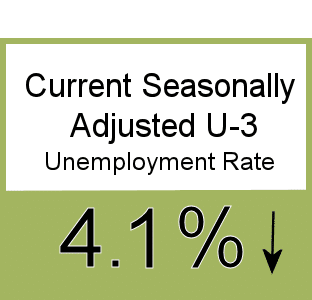
Adj U3 4.4 percent

  • Seasonally Adjusted U-3 was 4.4% up from 4.3%
  • Unadjusted U-3 was 4.7%
  • Unadjusted U-6 was 8.3%
  • Labor Force Participation was 62.0%
  • Unadjusted Employment rose from 156.723 million to 157.286 million
  • 30,000 of the Job losses are temporary due to a strike
  • ADP is reporting 63,000 Jobs added in February, saying “Hiring jumped in February, delivering the best showing for job gains since November 2025″
  • Next Update: April 3rd, 2026

Summary:

The BLS adjusted many of its numbers this month. According to the BLS “January 2026 estimates were revised to incorporate updated population controls.” January’s UnAdjusted U-6 was increased from 8.7% to 8.8%, UnAdjusted U3 was increased from 4.6% to 4.7%, but the Seasonally Adjusted U3 remained the same at 4.3%. The changes were based on the adjustment of the Civilian population from 274.982 million to 274.676 million.

According to the Commissioner of the U.S. Bureau of Labor Statistics:

“Total nonfarm payroll employment edged down by 92,000 in February, and the unemployment rate changed little at 4.4 percent, the U.S. Bureau of Labor Statistics reported today. Employment in health care decreased, reflecting strike activity. Employment in information and federal government continued to trend down… Both the unemployment rate, at 4.4 percent, and the number of unemployed people, at 7.6 million, changed little in February.”

You can read the full BLS report here.

As usual, they are talking about “Seasonally Adjusted Jobs,” and there was a major strike of Healthcare workers in California and Hawaii that accounted for 30,000 of those lost jobs, which will be back shortly.

Looking at the Unadjusted Establishment Survey report we see…
Originally, the BLS reported employment of 156.714 million for January, which they adjusted slightly to 156.723 million this month.

They are currently reporting 157.286 million jobs for February which is actually an increase of 572,000 jobs based on their original numbers. The LFPR was originally 62.5% in January, but January’s numbers were adjusted down to 62.1% this month. February is said to be 62.0%.

AI Is an Easy Scapegoat for Layoffs

Several major companies across tech, finance, logistics, and consulting have publicly cited AI or “AI-driven efficiencies” as justification for layoffs. The most explicit examples include Block, Amazon, Salesforce, Accenture, and dozens more identified in aggregated reports. Some CEOs and analysts argue many firms are using AI as a scapegoat for deeper business problems.

Block cut ~40% of its workforce (~4,000 jobs). CEO Jack Dorsey said AI “enables a significantly smaller team to do more and do it better.” But they were really inefficient to start with.

Amazon blamed AI for a 14,000-job reduction. Meta cited AI investments while cutting jobs; critics say the real cause was overexpansion. Google said layoffs linked to “AI-driven restructuring,” though OpenAI’s Sam Altman says AI is not the real driver. According to CNBC, many firms “significantly overhired” and are now using AI as a public-facing justification for layoffs.

Bottom line: Although AI is enabling some productivity gains and role consolidation, especially in customer support, basic coding, content production, and back-office workflows. But, announced “AI-related layoffs” are still a small share of total layoffs, and Macro productivity data doesn’t yet show a clear, AI-driven step-change. Many firms appear to be using AI as an excuse to impress investors, signal “modernization,” or cover overhiring and weak demand rather than reporting actual savings.

On Wednesday, the European Central Bank (“ECB”) contradicted the AI job loss narrative by saying:
“Companies that make significant use of AI are about 4% more likely to take on additional staff. In other words, AI-intensive firms tend, on average, to hire rather than fire. Much the same can be said of investment in AI: firms that invest in AI are nearly 2% more likely to hire additional staff than those that don’t.”

[Read more…] about March Employment Report for February 2026

Filed Under: BLS Tagged With: 2026, ADP, BLS, February

February Employment Report for January 2026

February 12, 2026 by Tim McMahon

The U.S. Bureau of Labor Statistics (BLS) released its delayed January
employment / unemployment report
on February 11th, 2026.

Employment / Unemployment 

  • Seasonally Adjusted U3-  4.3% in January 
  • Unadjusted U3- 4.6% up from 4.1% in December
  • Unadjusted U6- 8.7% up from 8.2% in December
  • Labor Force Participation Rate- 62.5%
  • Employment- 156.714 million in January
  • December Adjusted Employment #: 159.448 million
  • Originally Released Employment- 160.448 million in December
  • Average BLS January Adjustment since 2000: -2.8 million
  • Next data release March 6, 2026

Summary:

Every February, the BLS adjusts its employment numbers. The average adjustment since 2000 has been a reduction of -2.8 million previously reported jobs. This year was no exception with a reduction of -3.7 million based on the originally released numbers.

Here is the BLS Commissioner’s explanation:
“In accordance with annual practice, the establishment survey data released today have been benchmarked to reflect comprehensive counts of payroll jobs for March 2025. These counts are derived principally from the Quarterly Census of Employment and Wages (QCEW), which counts jobs covered by the Unemployment Insurance (UI) tax system. The benchmark process results in revisions to not seasonally adjusted data from April 2024 forward. Seasonally adjusted data from January 2021 forward are subject to revision. In addition, data for some series prior to 2021, both seasonally adjusted and unadjusted, incorporate other revisions.”

Despite the massive annual adjustment in employment, and the rise of Unadjusted U3 from 4.1% to 4.6%  the Commissioner reported:

“Total nonfarm payroll employment rose by 130,000 in January, and the unemployment rate changed little at 4.3 percent, the U.S. Bureau of Labor Statistics reported today. Job gains occurred in health care, social assistance, and construction, while federal government and financial activities lost jobs…

Both the unemployment rate, at 4.3 percent, and the number of unemployed people, at 7.4 million, changed little in January. These measures are higher than a year earlier, when the jobless rate was 4.0 percent, and the number of unemployed people was 6.9 million.

Among the major worker groups, the unemployment rate for teenagers declined to 13.6 percent in January. The jobless rates for adult men (3.8 percent), adult women (4.0 percent), and people who are White (3.7 percent), Black (7.2 percent), Asian (4.1 percent), or Hispanic (4.7 percent) showed little change over the month.”

As always, the Commissioner is talking about adjusted “Household Survey” numbers. Establishment Survey numbers tell a different story. Typically, January is one of the highest unemployment months, which explains the large differential between the adjusted and unadjusted numbers.

[Read more…] about February Employment Report for January 2026

Filed Under: BLS Tagged With: Employment Report, January 2026, Unemployment Report

Unemployment Report for December 2025

January 10, 2026 by Tim McMahon

The U.S. Bureau of Labor Statistics (BLS) released its employment / unemployment report
for December
on January 9th, 2026.

Employment / Unemployment 

Adj U3 Icon 4.4% down

  • Seasonally Adjusted U3-  4.4% in December
  • Unadjusted U3- 4.1% down from 4.3% in November
  • Unadjusted U6- 8.2% down from 8.4% in November
  • Labor Force Participation Rate- 62.4%
  • Employment- 160.448 million in December
  • Employment- 160.640 million in November
  • Next data release February 6, 2026


Summary:

Despite Seasonally Adjusted  BLS statements, if we look at the Unadjusted Establishment Survey report, Total Employed decreased in December, but Unadjusted and Adjusted Unemployment also decreased. Labor Force Participation was also down slightly.

According to the Commissioner of the U.S. Bureau of Labor Statistics:

“Both total nonfarm payroll employment (+50,000) and the unemployment rate (4.4 percent) changed little in December, the U.S. Bureau of Labor Statistics reported today. Employment continued to trend up in food services and drinking places, health care, and social assistance. Retail trade lost jobs…

Since reaching a peak in January, federal government employment is down by 277,000, or 9.2 percent. (Employees on paid leave or receiving ongoing severance pay are counted as employed in the establishment survey.)… Over the past 12 months, average hourly earnings have increased by 3.8 percent. “

You can read the full BLS report here.

As usual, they are talking about “Seasonally Adjusted Jobs”.

Looking at the Unadjusted Establishment Survey report we see…
Originally, the BLS reported employment of 160.652 million for November, 
which they adjusted slightly to 160.640 million jobs for November.

They are currently reporting 160.448 million jobs for December, which is actually a decrease of -204,000 jobs based on their original numbers.

The LFPR was down from 62.5% in November to 62.4% in December. [Read more…] about Unemployment Report for December 2025

Filed Under: BLS Tagged With: BLS, December, unemployment

  • Page 1
  • Page 2
  • Page 3
  • Interim pages omitted …
  • Page 46
  • Go to Next Page »

Primary Sidebar

Rate Any Stock In Seconds

Get a detailed stock report showing its true value, safety score, and ideal timing to buy. Plus, receive a color coded Buy, Sell, or Hold recommendation.

Get Your Free Stock Analysis Here.

Recent Posts

  • BLS Releases May 2026 Jobs Report
  • May Jobs Report for April 2026
  • Inflation vs Unemployment Challenge FED’s Resolve
  • Jobs AI Can’t Destroy: Careers for 2026 and Beyond
  • Why February 2026’s Jobs Report Was an Anomaly, Not a Trend

Search Site

Resources

  • Bureau of Labor Statistics Current Population Survey Monthly survey of households conducted by the Bureau of Census for BLS. It provides data on the labor force, employment, unemployment, etc.
  • Capital Professional Services Providing web design and development and Internet marketing services
  • Elliott Wave University Using the Elliott Wave Principle to improve investment performance
  • Financial Trend Forecaster Featuring Moore Inflation Predictor, NYSE Rate of Change and NASDAQ Rate of change
  • InflationData.com Inflation calculators, databases, etc.
  • Intergalactic Web Designers Web design and development services

Articles by Category

Articles by Date

Disclaimer

At UnemploymentData.com we are not registered investment advisors and do not provide any individualized advice. Past performance is not necessarily indicative of future performance and future accuracy and profitable results cannot be guaranteed.

Privacy & Terms of Use

Privacy Statement & Terms of Use

Do Not Sell My Information

Copyright © 2026 · News Pro on Capital Professional Services, LLC. All rights reserved · Log in