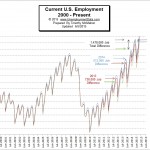
On Friday March 10th the U.S. Bureau of Labor Statistics released their Employment and Unemployment numbers for February 2017. The media was making a big deal about these numbers because they represent the “First full month since Trump took office”.
The numbers turned out to be moderately “Bullish” although the Commissioner’s statement said, “Total nonfarm payroll employment increased by 235,000 in February, and the unemployment rate was little changed at 4.7 percent. Employment gains occurred in construction, private educational services, manufacturing, health care, and mining.”
Now, I’m not complaining… gaining 235,000 jobs is certainly better than losing them but what’s the big deal? Well, first of all, the big deal is that [Read more…] about New Unemployment Numbers- February

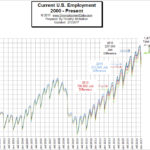 The number of Unadjusted jobs reported for January was
 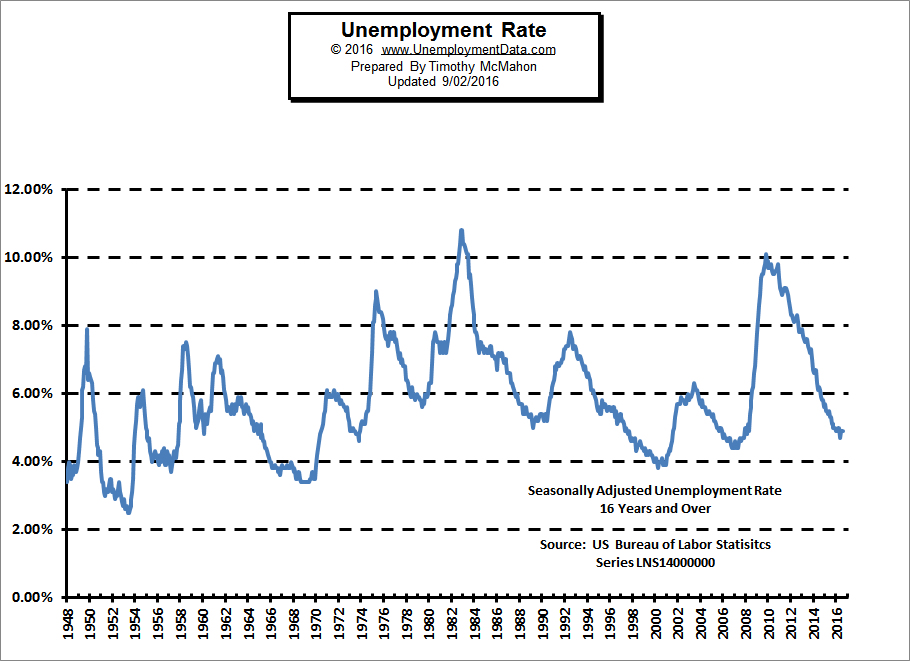 “Nonfarm payroll employment increased by [seasonally adjusted~ editor] 151,000 in August, and the unemployment rate remained at 4.9 percent. Employment continued to trend up in several service-providing industries. Incorporating revisions for June and July, which reduced nonfarm payroll employment by 1,000 on net, monthly job gains have averaged 232,000 over the past 3 months. In the 12 months prior to August, employment growth averaged 204,000 per month. Employment in food services and drinking places continued to trend up in August (+34,000). Over the year, the industry has added 312,000 jobs… Mining employment continued on a
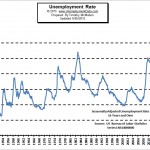
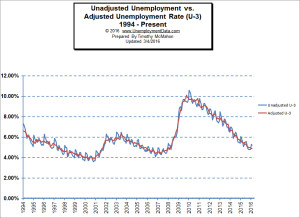
  On Friday July 8th, the U.S. Bureau of Labor Statistics (BLS) released their newest unemployment data for June 2016. According to the BLS, the current “Seasonally Adjusted” Unemployment Rate is 4.9% up from 4.7% for May. The current “Unadjusted” rate is 5.1% up from 4.5% in May.
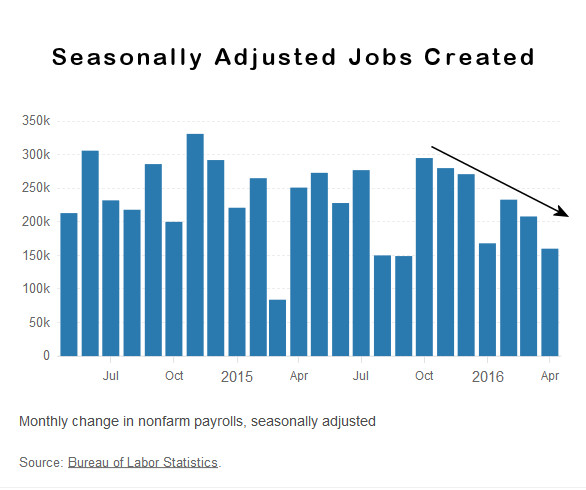 On a seasonally adjusted basis employment has fallen while on a non-adjusted basis the actual number of non-farm employed has increased from 142.887 Million to 143.944 million for a net increase of 1,057,000 jobs but since April traditionally sees a large increase in seasonal workers the seasonally adjusted number says that we were only 160,000 jobs better than what we would expect if there were zero jobs growth.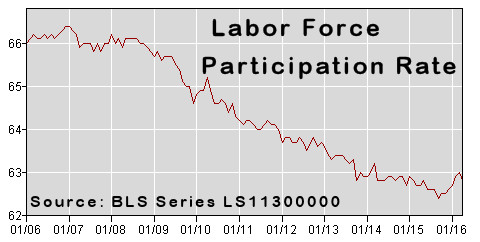

 According to the current Bureau of Labor Statistics data, the employment situation for the month of October 2015 was as follows: The number of Unadjusted jobs reported for October 2015 was 143.739 million. That was up from June’s previous peak of 142.836 million.
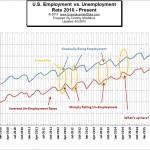
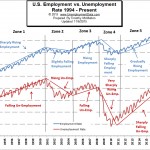 When looking at employment vs. unemployment you would think that they would simply be the inverse of each other. Flip one over and you have the other. But the U.S. Bureau of Labor Statistics (BLS) actually uses two entirely different surveys to calculate them. So by comparing them we can spot irregularities. See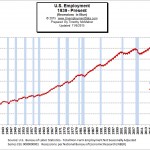
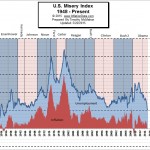 The misery index combines two factors that can make life difficult for people i.e. unemployment and inflation. High levels of price inflation (rapidly rising prices) will cause households to have difficulty affording the basic necessities while high unemployment will leave a high percentage of households without any income at all.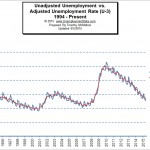
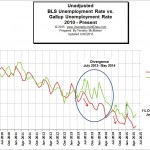
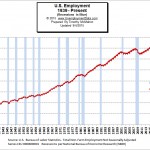 The BLS issued their “preliminary estimates” for the employment situation for the month of August 2015. The Commissioner’s report regarding the Seasonally Adjusted numbers says, “Nonfarm payroll employment increased by 173,000 in August, and the unemployment rate edged down to 5.1 percent. Employment rose in health care and social assistance and in financial activities, while manufacturing and mining employment declined.”
 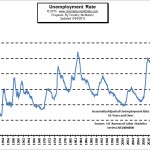 The U.S. Bureau of Labor Statistics (BLS) also released the newest unemployment data for August 2015 today. According to the BLS, the current “Seasonally Adjusted” Unemployment Rate for
 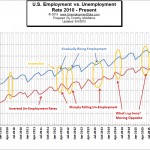 In our chart of employment vs. unemployment we compare them and although you would expect that employment and unemployment are simply the inverse of each other (i.e flip one over and you have the other) actually there are several anomalies in the data. Because the U.S. Bureau of Labor Statistics (BLS) uses two separate surveys to calculate the data it helps us see