
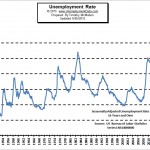
 The U.S. Bureau of Labor Statistics (BLS) released the newest unemployment data for May 2015 on Friday June 5th. According to the BLS, the current “Seasonally Adjusted” Unemployment Rate for May is 5.5% up from April’s 5.4%. The BLS reported the “Unadjusted” Unemployment Rate is 5.3% which is lower than October’s unadjusted 5.5% and January’s 6.1% but up from April’s 5.1%. See Current Unemployment Chart for more information.
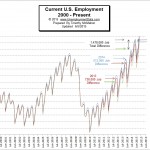 The BLS “preliminary estimates” for the employment situation for the month of May 2015 include 142.420 million jobs reported for May 2015. That was up 970,000 from April. But at the same time they revised the numbers for April down by 12,000. See Current Employment Commentary for more information.
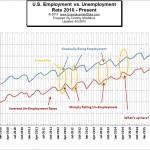 When looking at employment vs. unemployment you would think that they would simply be the inverse of each other. Flip one over and you have the other. But the U.S. Bureau of Labor Statistics (BLS) actually uses two entirely different surveys to calculate them. So by comparing them we can get a good idea of any anomalies in the data. See Current Employment vs. Unemployment Chart.
Employment Levels During Recessions
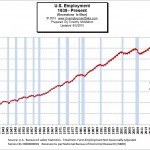 In this chart we can see the historical employment figures from 1939 through the present. But in addition to the number of jobs we can also see the recessions shaded blue as per the official description of a “recession” by the National Bureau of Economic Research (NBER). As you would expect, recessions correspond pretty well to the declines in employment (i.e. increased Unemployment) especially since unemployment is one of the factors NBER uses to determine whether there is an official recession. Although there are periods that are classified as official recessions where the number of people that are employed has not fallen significantly. See Employment During Recessions for more information.
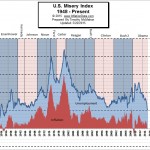 The misery index was created by economist Arthur Okun during the 1960’s at a time when the index was at historically low levels. The misery index is a combination of two simple factors that makes life difficult for the average citizen. These are inflation and unemployment. High levels of price inflation (rapidly rising prices) will cause households to have difficulty affording the basic necessities while high unemployment will leave a high percentage of households without any income at all. High combined levels will cause havoc throughout the economy and a high level of distress, discomfort and political unrest. See Misery Index.
Comparing U3 to U6
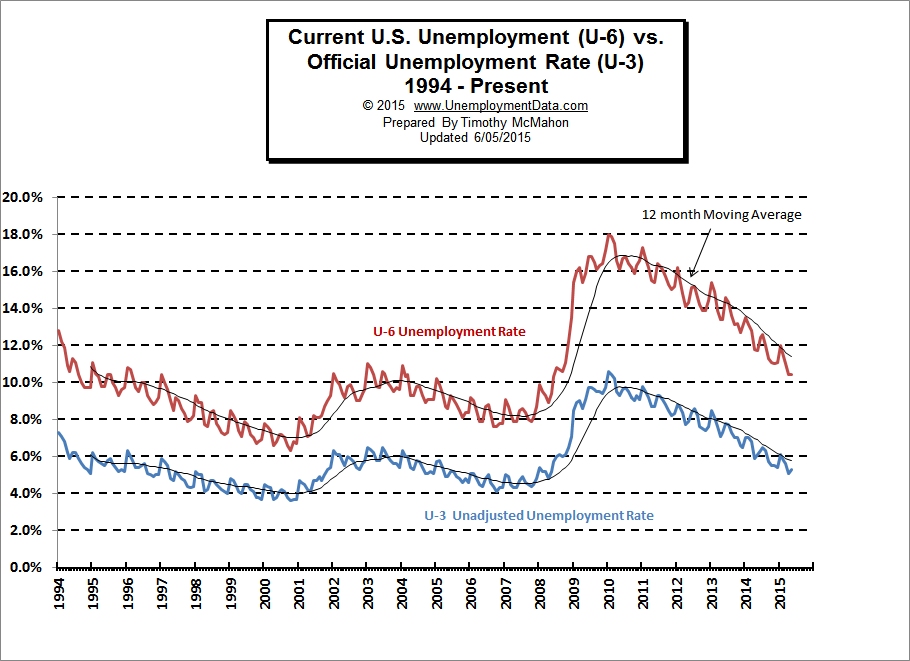 If you look at this chart you will see that the U-3 unemployment rate is always below the U-6 rate. But the gap between them varies. The chart is a comparison of the Official Unemployment Rate U-3 to the broader U-6 Unemployment rate.
You may also notice that when unemployment rises the gap between U-3 and U-6 generally increases. For instance, in October 2000, unemployment was at the lowest levels on this chart with U-3 at 3.6% and U-6 was at 6.3%. For a difference of only 2.7%. But at the peak of unemployment in January 2010 U-3 was at 10.6% but U-6 shot all the way up to 18% for a difference of 7.4%. More…
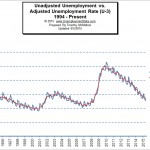 Seasonal adjustment is a statistical technique which eliminates the influences of weather, holidays, the opening and closing of schools, and other recurring seasonal events from economic time series. This permits easier observation and analysis of cyclical, trend, and other nonseasonal movements in the data.
So in theory removing these fluctuations makes the data easier to compare from month to month and in practice it looks somewhat like a moving average smoothing out the peaks and valleys. So let’s look at how seasonally adjusted data compares to unadjusted unemployment data on a chart.
Comparing Bureau of Labor Statistics numbers to an Independent Source
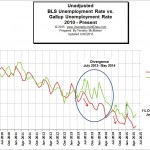 In an effort to determine the True Unemployment Rate the Gallup survey people began doing their own survey on unemployment rates back in 2010. So we can compare their results with the results the BLS publishes.
In this chart we can see that the Gallup numbers are occasionally higher than the BLS numbers but they are occasionally lower as well, so it is difficult to tell if the data is significantly different. At first glance they appear to track pretty well until July of 2013 when they start diverging drastically. See: BLS vs. Gallup Unemployment Rates.
See Also:
- Monthly Historical Unemployment Rates from 1948 through the present.
