
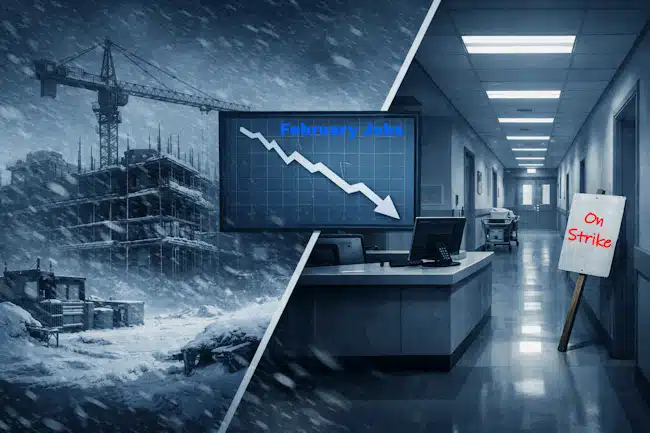
Image created by Bing AI
When the Bureau of Labor Statistics released the February 2026 employment report, the headline number sent a jolt through financial markets: nonfarm payrolls had dropped by 92,000, a dramatic reversal from January’s solid gain. Economists and commentators rushed to declare the labor market was cracking. They were wrong — or at least, they were telling the wrong story.
February was a perfect storm of one-time disruptions stacking on top of each other. When you look closer, the underlying labor market looks nothing like the headline number suggests.
January Was Stronger Than It First Appeared
Let’s start with the baseline. The original January payroll figure of +126,000 was subsequently revised upward by 34,000 to +160,000. That’s a meaningfully strong month, representing solid underlying demand for workers. The February weakness has to be understood against that backdrop, not against a weaker starting point.
The Kaiser Permanente Strike: A -30,000 Jobs Hit
The single biggest distortion in the February report was a labor strike at Kaiser Permanente — and it had nothing to do with the broader economy. Health care, which had been the primary growth engine in payrolls for at least the past year, saw a loss of 28,000 jobs in February, largely due to a strike at Kaiser Permanente that sidelined more than 30,000 workers in Hawaii and California.
Crucially, though the strike was subsequently resolved, it occurred during the BLS survey week — so it subtracted directly from the February jobs total. Health care had surged by +77,000 in January, then lost 28,000 in February, with offices of physicians shedding 37,000 jobs due to the strike activity.
This is a textbook statistical distortion. The workers didn’t lose their jobs permanently — they were on strike during the specific week the BLS conducts its payroll survey. The jobs were always coming back. And indeed, in March, offices of physicians added back 35,000 jobs as workers returned from the strike. Subtract this one-off event, and February’s headline number looks dramatically different.
A Winter for the Record Books
The second major distortion was the weather, and the 2025–2026 winter was anything but typical.
February saw not one but two major winter storm events hammer broad swaths of the country. Southeastern states like North Carolina, South Carolina, Tennessee, and Mississippi experienced heavy snow and crippling cold temperatures that suspended typical business operations for nearly 10 days from the end of January through the first week of February. This was an extraordinarily rare weather event for a region with little infrastructure for winter storms.
Then, just as those states were recovering, the Northeast got hit. From February 22–24, a powerful and historic blizzard dropped one to two feet of snow across a large swath of the megalopolis from Philadelphia to Boston, with up to three feet in southeastern New England. Extreme winds and heavy snow caused power outages for hundreds of thousands of customers, and several regions suspended transit service or issued travel bans amid treacherous conditions.
Severe winter weather hits the labor market hardest in construction, outdoor work, and transportation sectors, where employees simply cannot work when conditions are dangerous or job sites are inaccessible. The weather-sensitive construction industry lost 11,000 jobs in February after surging by 48,000 in January. That February construction drop and the January surge are essentially two sides of the same coin — unusually warm weather pulling activity into January, followed by unusually harsh weather shutting it back down in February.
Federal Government Cuts Added to the Noise
A third drag on the February numbers was the ongoing reduction in federal government employment — a structural trend tied to the DOGE-era workforce reduction initiative, not a cyclical signal about the broader economy. Since reaching a peak in October 2024, federal government employment is down by 355,000, or 11.8 percent. These ongoing declines weighed on February’s total as well, though they represent a deliberate policy shift rather than a reflection of private sector health.
The March Bounce Confirms the Anomaly
Perhaps the strongest evidence that February was a statistical aberration? March. Total nonfarm payroll employment increased by 178,000 in March, with job gains in health care, construction, and transportation and warehousing. That’s a clean snapback across the exact sectors that were hit hardest in February — healthcare workers returning from the strike, construction crews getting back on job sites, and transportation recovering after the storms.
Economists were not surprised. Jefferies economist Thomas Simons described the February payrolls drop as “a perfect storm of temporary drags coming together following an above-trend print in January.”
It’s also worth noting that the BLS’s own revisions told the same story. January’s figure was revised up by 34,000 (to +160,000) while February was revised down further (to -133,000) a volatile two-month swing that underscores just how much non-recurring noise was embedded in the data.
The Jobs Report Anomaly Bottom Line
The February jobs report was a confluence of non-recurring events: a major labor strike that fell squarely in the BLS survey week, historic winter storms that paralyzed construction and outdoor work across large regions of the country, and continued policy-driven reductions in federal headcount. None of these tells you much about where the underlying labor market is headed.
As San Francisco Fed President Mary Daly cautioned at the time, the labor market data has been volatile, and one month of data shouldn’t be over-interpreted in either direction. That’s the right framework. One month’s numbers — especially a month defined by strikes, blizzards, and bomb cyclones — is a snapshot, not a trend. The labor market’s true direction is better read across multiple months, and March’s strong rebound suggests the underlying picture is considerably more stable than February’s ugly headline implied.
Data sourced from the U.S. Bureau of Labor Statistics Employment Situation reports for February and March 2026.
Read More:
- April Employment Report for March 2026
- March Employment Report for February 2026
- February Employment Report for January 2026
- BLS April Release for March
- BLS March Release for February
