
• Skip to primary navigation
  • Skip to main content
  • Skip to primary sidebar
  • Home
  • Contact us
  • Related Sites
    • InflationData.com
    • Financial Trend Forecaster
    • Your Family Finances
    • Elliott Wave University
    • Optio Money
  • About
    • Terms of Use
    • Disclaimer & Disclosure
    • Privacy Statement
  • Sitemap
    • 2009-2010 Posts
    • 2011 Posts

UnemploymentData.com

Your Source for Employment and Unemployment Data

Unemployment
  • Charts
    • Current Unemployment Rate Chart
    • Current Employment (Chart and Data)
    • Current Employment vs Unemployment Chart
    • Historical Employment Data
    • Employment Population Ratio
    • Misery Index
  • Unemployment
    • Historical Unemployment Rate Tables
    • What Is U-6 Unemployment?
    • Unadjusted vs. Seasonally Adjusted U-3 Unemployment Rate
    • BLS vs. Gallup Unemployment Numbers
    • Current U-6 Unemployment Rate
    • What is the Labor Force Participation Rate?
    • What is the Real Unemployment Rate?
  • Employment
    • Current Employment (Chart and Data)
    • Historical Employment Data
    • Contacting a Live Person at the State Employment Commission
      • How to Talk to a Live Person at the Virginia Unemployment Commission
      • Florida’s FLUID Unemployment Program
    • Benefits
      • Insurance
      • Retirement
    • Careers
    • Employment Costs
    • Experience
    • Government
    • Job Hunting
      • Interview
      • Resume
  • Find Articles
  • Education
    • Skills
  • General
    • Small Business
      • Outsourcing
    • Success
You are here: Home / Archives for Labor Market

Labor Market

Inflation vs Unemployment Challenge FED’s Resolve

April 13, 2026 by Tim McMahon

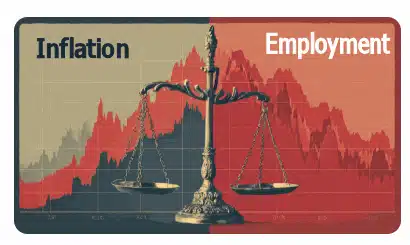
Inflation vs Unemployment
Image by Meta AI

Inflation jumped to 3.3% in the latest CPI report, up sharply from 2.4% the prior month. This rapid increase comes on top of the gradual rise in unemployment since its 2023 lows. This leaves the Federal Reserve with no easy options.

The FED’s Dual Mandate

This situation is making it increasingly difficult for the Federal Reserve to manage both sides of its dual mandate. The Fed is legally required to pursue two often competing goals: keeping inflation low and stable, and maintaining maximum employment. In normal times, these goals are two sides of a “see-saw”. Increasing the money supply reduces unemployment but increases inflation, and vice versa.

But when inflation surges at the same time the labor market begins to weaken, the Fed finds itself pulled in opposite directions with no clean policy solution. Economists have a word for this combination of stagnating growth, rising unemployment, and persistent inflation: stagflation. It is widely considered one of the most difficult economic environments for policymakers to navigate, as the tools used to fight inflation typically make unemployment worse. That is precisely where we find ourselves today.

Misery Index Jumps to 7.56%

The human cost of rising inflation shows up clearly in the Misery Index, which simply adds the unemployment rate to the inflation rate to measure everyday economic stress. In March 2026, the Misery Index rose sharply from 6.81% to 7.56%, driven entirely by the surge in inflation. With unemployment at 4.30% and inflation at 3.26%, Americans are feeling the squeeze from both directions — higher prices at the same time the job market is quietly softening.
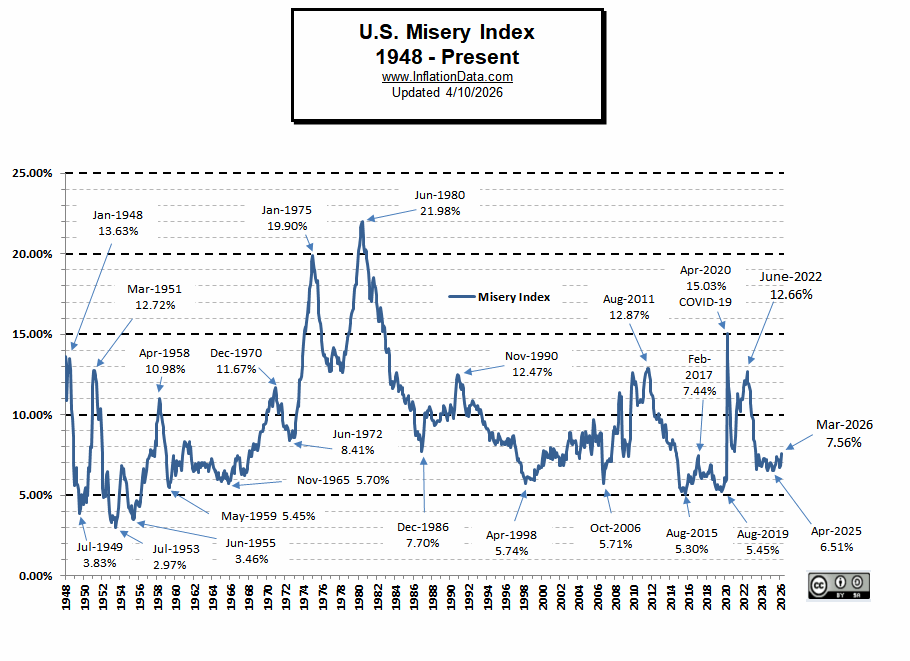
Misery Index- Mar 2026The Fed’s Impossible Position

Because the Federal Reserve is responsible for both goals, when inflation rises, the Fed raises rates. When unemployment rises, the Fed cuts rates. The problem facing policymakers right now is that both metrics are moving in the wrong direction at the same time.

Markets are currently pricing in a 98% chance that the Fed holds rates steady in late April, with over a 90% probability that no rate cuts arrive until October at the earliest. Cutting into rising energy prices would risk reigniting inflation, while holding rates high too long risks allowing a weakening labor market to deteriorate further.

Labor Market Weakness Hiding in Plain Sight

On the surface, the unemployment rate appears relatively stable. But beneath that headline number, the data tells a more concerning story. Hiring is falling, job openings are declining, and the conditions for a more significant rise in unemployment are quietly building, in part due to increasing productivity created by AI. The one bright spot is the Deflationary forces created by AI.

Historically, it is falling asset prices that trigger layoffs — not the other way around. Once layoffs begin to pick up in an environment where hiring has already slowed, the unemployment rate can rise quickly and in a nonlinear fashion. That cycle has not yet been triggered, but the underlying conditions are moving in that direction.
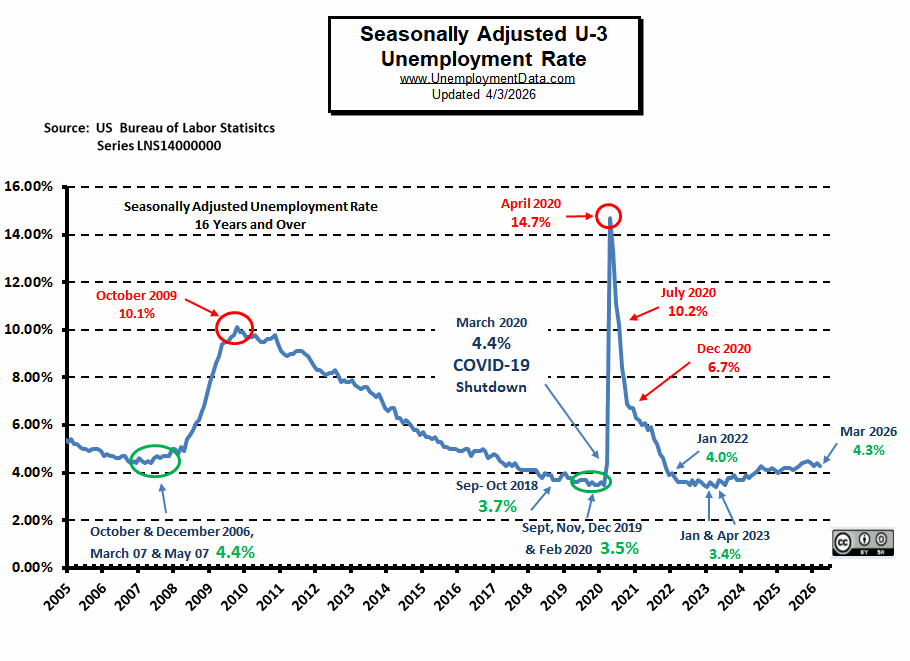
Current Unemployment for Mar 26

A Late Business Cycle Warning

The combination of supply-driven inflation and a softening labor market is a hallmark of late business cycle environments. Energy prices, constrained by geopolitical supply pressures rather than surging demand, are pushing inflation higher at precisely the moment the economy can least afford it.

In past business cycles, this dynamic has preceded recessions. The Fed finds itself unable to ease policy to support employment without risking another inflation surge — a position that historically has made it difficult to avoid a meaningful rise in unemployment once the labor market begins to crack.

What to Watch

The unemployment rate remains the key indicator to monitor in the months ahead. If layoffs accelerate while hiring remains depressed, the unemployment rate could rise faster than many expect. The Fed’s ability to respond will be constrained as long as inflation remains elevated, meaning the labor market may bear the brunt of a policy environment that has run out of easy options.

You might also like:
  • Deflationary forces created by AI.
  • The Misery Index,
  • What is Stagflation

Filed Under: General Tagged With: business cycle, CPI, dual mandate, energy prices, Federal Reserve, Inflation, interest rates, Labor Market, Misery Index, recession, stagflation, unemployment

Why February 2026’s Jobs Report Was an Anomaly, Not a Trend

April 6, 2026 by Tim McMahon

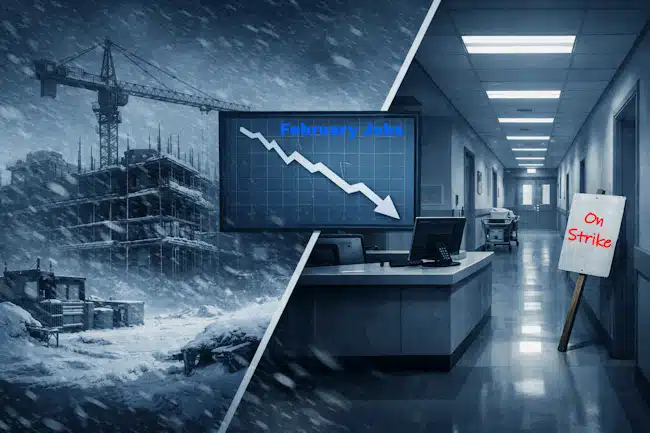
February 2026 jobs report anomaly

Image created by Bing AI

When the Bureau of Labor Statistics released the February 2026 employment report, the headline number sent a jolt through financial markets: nonfarm payrolls had dropped by 92,000, a dramatic reversal from January’s solid gain. Economists and commentators rushed to declare the labor market was cracking. They were wrong — or at least, they were telling the wrong story.

February was a perfect storm of one-time disruptions stacking on top of each other. When you look closer, the underlying labor market looks nothing like the headline number suggests.

January Was Stronger Than It First Appeared

Let’s start with the baseline. The original January payroll figure of +126,000 was subsequently revised upward by 34,000 to +160,000. That’s a meaningfully strong month, representing solid underlying demand for workers. The February weakness has to be understood against that backdrop, not against a weaker starting point. [Read more…] about Why February 2026’s Jobs Report Was an Anomaly, Not a Trend

Filed Under: Employment Tagged With: 2026, Construction, DOGE, employment, Employment Data, February 2026, federal employment, Jobs Report, Kaiser Permanente strike, Labor Market, winter storm

The American Labor Market: Fact vs. Fiction

May 18, 2024 by JacobSwartz

The American Labor MarketBy Jacob Swartz

When we consider markets, we typically think of commerce – the buying and selling of goods and services, international trade, investing, supply and demand. Markets are the backbone of our economy. Almost everything has a market – food, medical care, toys, films and entertainment, weapons, drugs, stocks. But there is one market that surpasses them all in importance, without which no other market could exist – the labor market.

Labor is crucial for commerce. Without people to produce goods and services, commerce would cease to exist. Businesses rely on labor to function, creating a demand similar to that for material goods and services. In other words, the labor market is the foundation on which all other markets depend.

In an age where everyone feels the need to have an opinion on just about everything, many people consider themselves “economic experts.” However, when everyone has an opinion on a complex issue, most of those opinions are bound to be wrong. Economics is a prime example of this, filled with false consensuses. With that in mind, let’s go ahead and debunk some common myths about the history of the American labor market, from the Industrial Revolution to the present. [Read more…] about The American Labor Market: Fact vs. Fiction

Filed Under: Employment Tagged With: economy, Industrial, Labor Market, Myths, Unions

Primary Sidebar

Rate Any Stock In Seconds

Get a detailed stock report showing its true value, safety score, and ideal timing to buy. Plus, receive a color coded Buy, Sell, or Hold recommendation.

Get Your Free Stock Analysis Here.

Recent Posts

  • BLS Releases May 2026 Jobs Report
  • May Jobs Report for April 2026
  • Inflation vs Unemployment Challenge FED’s Resolve
  • Jobs AI Can’t Destroy: Careers for 2026 and Beyond
  • Why February 2026’s Jobs Report Was an Anomaly, Not a Trend

Search Site

Resources

  • Bureau of Labor Statistics Current Population Survey Monthly survey of households conducted by the Bureau of Census for BLS. It provides data on the labor force, employment, unemployment, etc.
  • Capital Professional Services Providing web design and development and Internet marketing services
  • Elliott Wave University Using the Elliott Wave Principle to improve investment performance
  • Financial Trend Forecaster Featuring Moore Inflation Predictor, NYSE Rate of Change and NASDAQ Rate of change
  • InflationData.com Inflation calculators, databases, etc.
  • Intergalactic Web Designers Web design and development services

Articles by Category

Articles by Date

Disclaimer

At UnemploymentData.com we are not registered investment advisors and do not provide any individualized advice. Past performance is not necessarily indicative of future performance and future accuracy and profitable results cannot be guaranteed.

Privacy & Terms of Use

Privacy Statement & Terms of Use

Do Not Sell My Information

Copyright © 2026 · News Pro on Capital Professional Services, LLC. All rights reserved · Log in