A Small Home-Based Business
In today’s economy, there are definitely a lot of people that are struggling to find jobs, who don’t know where to turn. Instead of sitting around waiting for their unemployment benefits to run out or for someone to offer them a job, they are using the grace period of unemployment checks to start a small home-based business. A small home based business allows you to take control of your own financial situation, instead of having to rely on anyone else. In a small business, education and experience aren’t as important as the ability to get the job done. Having your own business also entitles you to a variety of tax benefits. If you are interested in starting a home-based business, here are a few things that you’ll need to do in order to be successful.
Handle the Business Formalities

A Small home based business is not a hobby or a lark it is serious business. So just like with a large business, you’ll need to handle some formalities when starting your business. These ensure that you are doing everything legitimately, and that you will not be in violation of any local laws. When getting started, most localities require you to get a business license.
To get a business license, you’ll need to go to the local court house and pay a fee and possibly answer a few questions. Some localities regulate the types of business you can run from your home. Most allow work done on a home computer or over the internet but some may have zoning restrictions if you are going to store chemicals or have customers visiting your home office.
Most of the time, you’ll also want to set up some kind of business entities so that you do not have to put any of your personal assets at risk. Setting up a corporation or an LLC is pretty simple, and can usually be done by filling out a few more forms and paying a state filing fee. Filing fees for an LLC vary by state and can range from $50 per year to $1000 or more depending on whether you are in a state like Delaware or California.
[Read more…] about The Basics of Starting a Small Home-Based Business

 You on the other hand will be concerned with these factors:
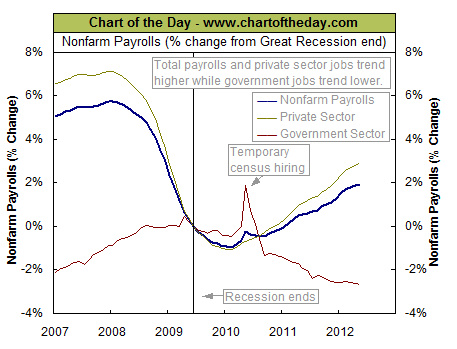
 Today’s chart compares the total nonfarm payrolls (blue line) to its two components Private sector job market (gold line) and Government sector job market (red line). But rather than showing total jobs it shows the percentage change in total nonfarm payrolls (blue line) since the declared end of the Great Recession in 2009 (the vertical line). So at that point it is zero. Prior to that point private sector jobs were as high as 7% higher while public sector (government) jobs were 2% lower (i.e. the government increased its