Small Business Accountant
Many people who start their own small businesses do so as a means of determining their own destiny. They are their own boss, operating the business their own way and planning for the future with their own ideas. There are, however, certain laws and regulations legislating aspects of any business. For this reason, and more, it is a good idea for any small business to have an accountant.
Small Business Accountants Can Handle Payroll
Small business owners often wear many hats: boss, lease negotiator, inventory specialist, decision-maker, payroll, shipping and receiving, IT, HR, and occasionally even custodian. In the midst of all of that, they also manage employees, even if those employees are contracted. State and national law dictate what forms those employees need to fill out, how much of their paycheck is deducted for taxes, benefits, and Social Security. Business owners are forced to either learn the tax laws (and the changes to said laws each year) or hire an accountant to help. Just managing payroll can be time-consuming, as an owner your time is valuable and should be spent growing your business.
Small Business Accountants Can Handle Taxes
 Even contract labor requires certain documentation. If a company pays a contractor more than $600 over the course of the year, a 1099 must be filed. Keeping track of the various tax amounts for various employees as well as which contracted employees earned how much can easily become a full-time job. Small business owners have plenty of other details to manage without adding that to their plates. If only for personnel purposes, an accountant will save time as well as headaches.
In addition to managing tax issues for employees, a small business accountant will help navigate tax concerns for the business itself. Capital improvements, profits, loss, depreciation, and potential write-offs may exist. Some small businesses pay taxes quarterly rather than annually, requiring an ability to understand and follow additional tax laws. An accountant can save you money by avoiding government penalties and late fees but also by pointing out deductions, monitoring for “slippage” or missing funds, and other ways to save money. [Read more…] about Why Your Small Business Needs an Accountant



 You on the other hand will be concerned with these factors:
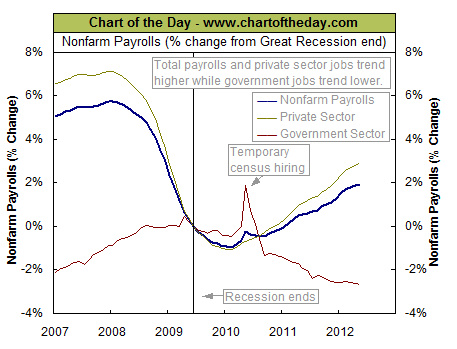
 Today’s chart compares the total nonfarm payrolls (blue line) to its two components Private sector job market (gold line) and Government sector job market (red line). But rather than showing total jobs it shows the percentage change in total nonfarm payrolls (blue line) since the declared end of the Great Recession in 2009 (the vertical line). So at that point it is zero. Prior to that point private sector jobs were as high as 7% higher while public sector (government) jobs were 2% lower (i.e. the government increased its