
The U.S. Bureau of Labor Statistics (BLS) released its revised estimate of productivity and costs for the first quarter of 2014. According to this report productivity in the “Non-farm” sector fell drastically. “The decrease in productivity was the largest since the first quarter of 2008 (-3.9 percent).”
Productivity is a measure of how much stuff is produced per hour of labor (not including farming). It is “annualized” based on “seasonally adjusted” numbers.

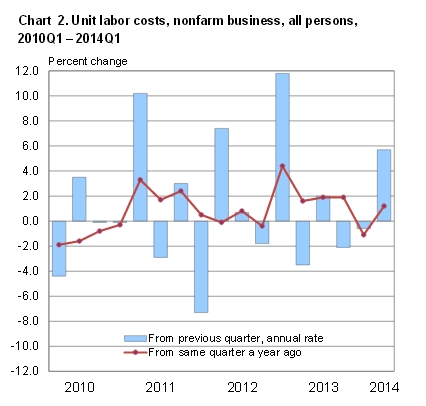
Due in part to the drastic drop in productivity, businesses suffered a massive increase in labor costs as they increased 5.7% on an annual basis.
Manufacturing Productivity Up
Even though Non-farm productivity was down drastically (-3.5%) the decrease was limited to the “Business” sector with “manufacturing” productivity actually up 3.8% and it’s subset durable manufacturing up 4.1%. Durable goods are things that do not wear out quickly such as household appliances, cars, consumer electronics, furniture, sports equipment, firearms, and toys.
Business sector output does not include government, non-profit institutions or private households but even so it makes up 76% of the entire Gross Domestic Product (GDP).
So although business productivity was down manufacturing productivity was actually up.
 There are many different types of welds for different types of welding jobs. The most common types are arc, electroslag, flux-cored, gas metal-Arc, gas tungsten-arc, metal inert gas (MIG), plasma arc, shielded-metal arc, submerged arc, and tungsten inert gas (TIG) welding. Arc welding refers to the use of an electric current that is transmitted from a welding device to a surface that is being welded. The amp of arc welding first came into existence in 1802 and is the lowest costing welding process. An electroslag is used for angles, while flux-core welding is seen as an alternative to stick welding.
 Technical schools–also known as vocational schools, trade schools or career colleges–prepare students for specific jobs that they can pursue after graduation. Occupations taught at technical schools include electronics technician, automotive technician, welder, paralegal, licensed practical nurse,
  At the high end, healthcare jobs require extensive education, including an undergraduate degrees, as well as one to three years in professional school, residency, and internship requirements.
  While it is true that some manufacturing jobs are relatively easy, others are not so laid back. At the very least most manufacturing jobs require standing for hours on end, but it may also entail the constant lifting of heavy objects and long hours. This can compound the health problems that factory workers often experience, such as fatigue, exhaustion, and


 Always prepare properly, don’t just turn up on the day of the interview and expect that you will be able to answer everything without any preparation. Go online and research the company that you have an interview for and you will be prepared to answer various things on what the company does.