
The U.S. Bureau of Labor Statistics (BLS) released its April
employment / unemployment report on May 8th, 2026.
Employment / Unemployment
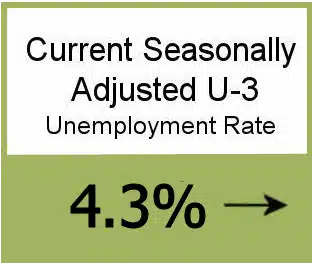
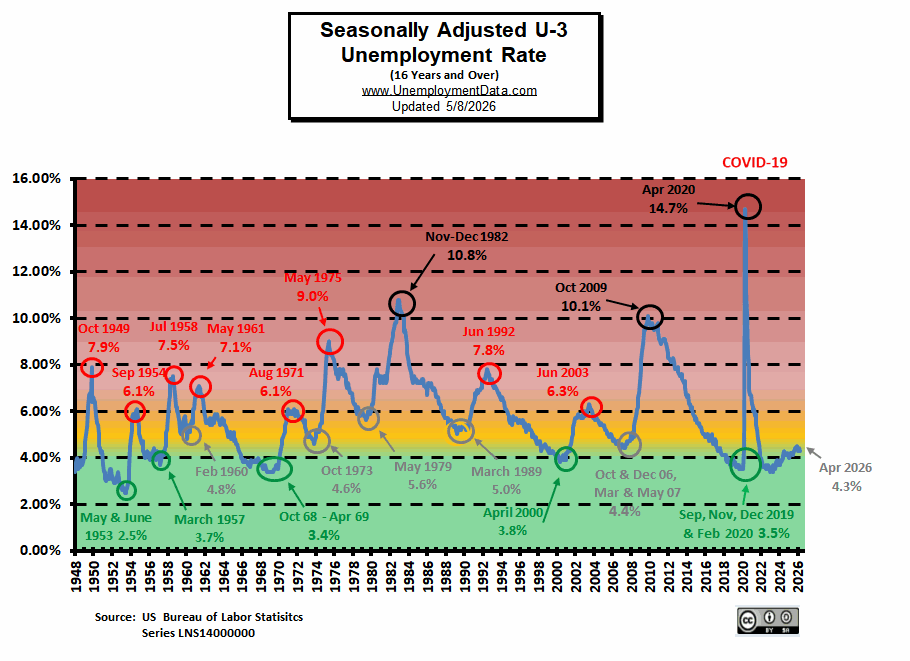
- Seasonally Adjusted U-3 is 4.3% Unchanged
- Unadjusted U-3 is 4.0% down from 4.3%
- Unadjusted U-6 is 7.7% down from 8.0%
- Labor Force Participation is 61.8% down from 61.9%
- Unadjusted Employment rose from 157.769 million to 158.695 million
- Next Update: June 5th, 2026
Summary:
The jobs report came in higher than expected, with only a minor adjustment downward for the previous month’s numbers (March). The biggest gainer was Education and Health, gaining 46,000 jobs. The biggest loser was Information, with a loss of -13,000 jobs, and with only three sectors declining.
According to the Commissioner of the U.S. Bureau of Labor Statistics:
“Total nonfarm payroll employment edged up by 115,000 in April, and the unemployment rate was unchanged at 4.3 percent, the U.S. Bureau of Labor Statistics reported today. Job gains occurred in health care, transportation and warehousing, and retail trade… Federal government employment continued to decline in April (-9,000). Since reaching a peak in October 2024, federal government employment is down by 348,000, or 11.5 percent”.
So, despite declines in Government employment, overall employment still increased.
As usual, they are talking about “Seasonally Adjusted Jobs”.
Looking at the Unadjusted Establishment Survey report we see…
Originally, the BLS reported employment of 157.775 million for March, which they have now adjusted to 157.769 million. Current April numbers are 158.695 million for an increase of 926,000 jobs based on their current numbers or +920,000 based on the original numbers.
Note: According to Politifact, “The federal workforce grew by about 4.8% during Biden’s term, increasing from 2.89 million in January 2021 to 3.02 million in January 2025.”
So, Trump has reduced the federal payroll by more than twice what it gained under Biden. Although this does reduce budget pressure, it also puts pressure on the job market for those who are seeking other employment. It is estimated that between 30-40% of these workers retired, while perhaps 10-15% were working spouses who chose to stay home rather than seek other employment.
Current Unemployment Rate Chart
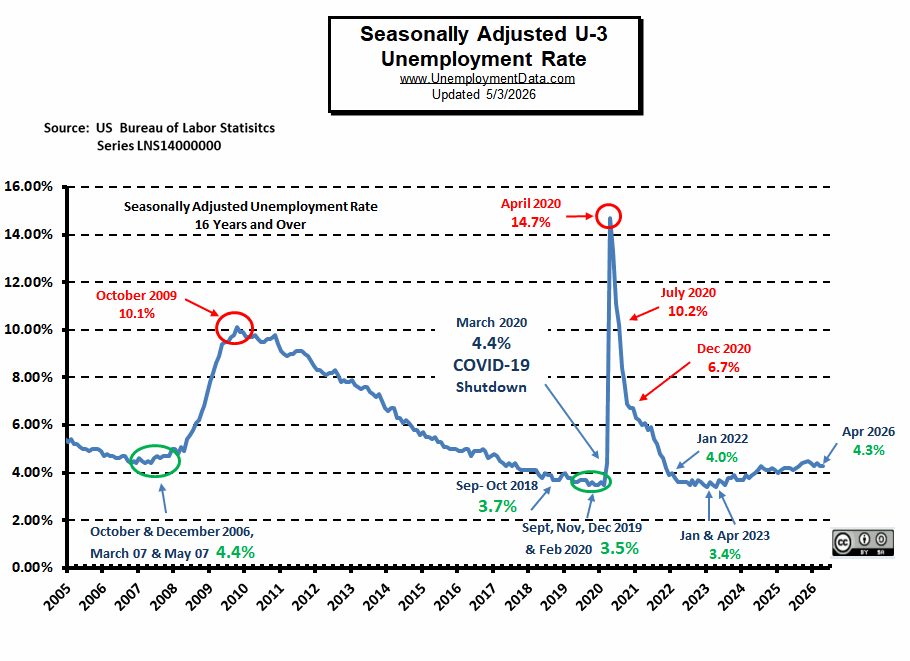 According to the BLS Commissioner’s report:
Household Survey Data: “The unemployment rate was unchanged at 4.3 percent in April, and the number of unemployed people changed little at 7.4 million… The number of long-term unemployed (those jobless for 27 weeks or more) was essentially unchanged at 1.8 million and accounted for 25.3 percent of all unemployed people.”
Establishment Survey Data: “Total nonfarm payroll employment edged up by 115,000 in April, after showing little net change over the prior 12 months. In April, job gains occurred in health care, transportation and warehousing, and retail trade. Federal government employment continued to decline.”
Current Employment Chart
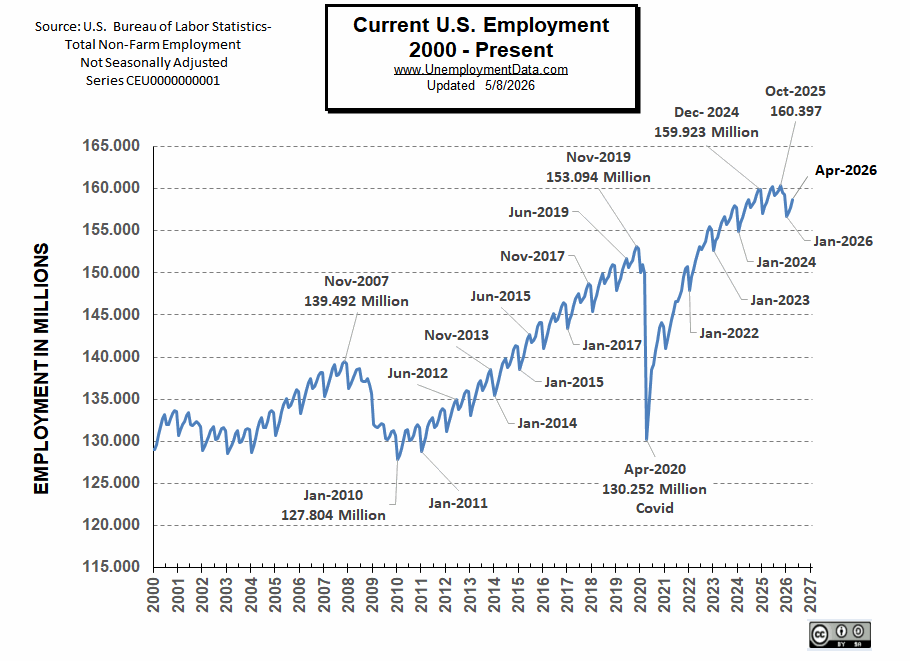
See Current Employment for more information.
BLS: April 2026 Employment by Sector
The BLS employment “bubble chart” based on the Establishment Survey Data gives us a good picture of the Seasonally Adjusted employment numbers.
The Bubble’s Size tells us the total Employment for that industry (i.e., larger bubbles mean more people are employed in that sector).
The bubble’s location on the chart tells us that there has been a change in Employment Levels over the most recent month… A bubble further to the right indicates larger job growth. A bubble’s vertical location on the chart shows the average industry salary.
Remember, these are Seasonally Adjusted Numbers, so they aren’t cumulative!
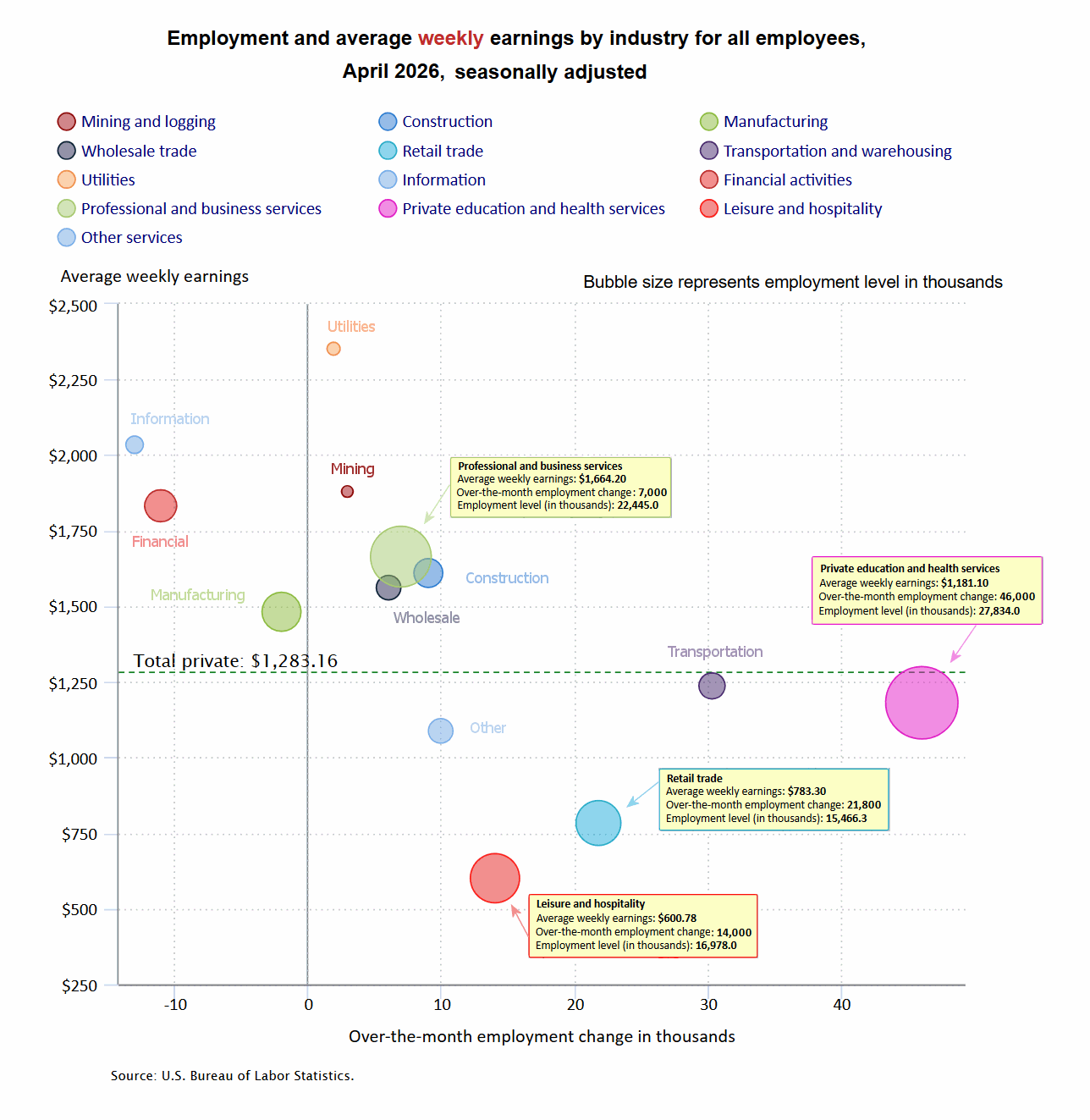 Looking at the above chart, we can see that only 3 sectors didn’t show employment growth in April, which is quite the opposite of February. Average weekly wages regained March’s losses and exceeded February’s highs.
BLS Average Weekly Wages
| Date | Average Weekly Wage |
| April 2026 | $1,283.16 |
| March 2026 | $1,278.40 |
| February 2026 | $1,280.08 |
| January 2026 | $1,274.93 |
| December 2025 | $1,266.08 |
| November 2025 | $1,264.30 |
| October 2025 | $1,258.90 |
| September 2025 | $1,253.43 |
| August 2025 | $1,249.33 |
| July 2025 | $1,249.89 |
| June 2025 | $1,241.46 |
| May 2025 | $1,243.03 |
| April 2025 | $1,236.86 |
| March 2025 | $1,231.20 |
| February 2025 | $1,225.21 |
| January 2025 | $1,223.17 |
| December 2024 | $1,224.17 |
| November 2024 | $1,221.42 |
| October 2024 | $1,216.28 |
| September 2024 | $1,209.31 |
| August 2024 | $1,207.70 |
| July 2024 | $1,199.39 |
| June 2024 | $1,200.50 |
| May 2024 | $1,197.41 |
| April 2024 | $1,191.93 |
| March 2024 | $1,193.34 |
| February 2024 | $1,185.75 |
| January 2024 | $1,178.16 |
| December 2023 | $1,175.46 |
| November 2023 | $1,173.04 |
| October 2023 | $1,166.20 |
| September 2023 | $1,165.47 |
| August 2023 | $1,163.41 |
| July 2023 | $1,157.28 |
| June 2023 | $1,155.15 |
| May 2023 | $1,146.99 |
| April 2023 | $1,147.58 |
| March 2023 | $1,141.34 |
| February 2023 | $1,141.61 |
| January 2023 | $1,146.14 |
| December 2022 | $1,125.73 |
| November 2022 | $1,129.01 |
| October 2022 | $1,124.01 |
| September 2022 | $1,119.87 |
| August 2022 | $1,116.42 |
| July 2022 | $1,116.54 |
| June 2022 | $1,106.76 |
| May 2022 | $1,105.47 |
| April 2022 | $1,102.01 |
| December 2021 | $1,086.46 |
BLS Employment Levels by Industry
April 2026, Seasonally Adjusted Employment
Note: The monthly increase is Seasonally Adjusted, so even though Construction was 8,330,000 in March and April was 8,321,000, which looks like a -9,000 decrease, the BLS reports it as a 9,000 increase. Conversely, Manufacturing went from 12,591,000 to 12,596,000 (a 5,000 gain) and the BLS reports it as -2,000.
| Industry | Monthly Increase | Ave. Weekly Earnings | April Employment Level | March Employment Level |
| Total Private Employment | 123,000 | $1,283.16 | 135,428,000 | 135,320,000 |
| Mining and Logging | 3,000 | $1,879.61 | 606,000 | 603,000 |
| Construction | 9,000 | $1,610.12 | 8,321,000 | 8,330,000 |
| Manufacturing | -2,000 | $1,481.87 | 12,596,000 | 12,591,000 |
| Wholesale trade | 6,000 | $1,561.73 | 6,065,500 | 6,054,600 |
| Retail trade | 21,800 | $783.30 | 15,466,300 | 15,427,900 |
| Transportation and Warehousing | 30,300 | $1,236.92 | 6,584,300 | 6,550,500 |
| Utilities | 1,900 | $2,351.92 | 607,600 | 605,000 |
| Information | -13,000 | $2,034.19 | 2,773,000 | 2,791,000 |
| Financial Activities | -11,000 | $1,832.23 | 9,119,000 | 9,134,000 |
| Professional and Business Services | 7,000 | $1,664.20 | 22,445,000 | 22,417,000 |
| Private Education and Health | 46,000 | $1,181.10 | 27,834,000 | 27,795,000 |
| Leisure and Hospitality | 14,000 | $600.78 | 16,978,000 | 16,999,000 |
| Other Services | 10,000 | $1,088.04 | 6,032,000 | 6,022,000 |
Source: BLS
ADP® National Employment Report
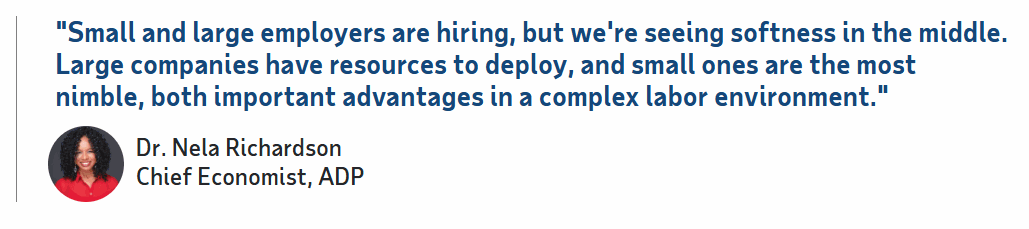
ADP provides an independent (non-government) estimate of private-sector employment and pay, based on data derived from ADP client payrolls. According to ADP®, In collaboration with Stanford Digital Economy Lab.
Note: The numbers are released a few days before the BLS numbers and are often quite different. This month however, they are quite close, BLS says +115,000 jobs, ADP says +109,000 jobs.
ADP: Private employers added 109,000 jobs in April
- Health care’s continued strength, along with a rebound in trade, transportation, and utilities, fueled last month’s acceleration in hiring. It was the fastest pace of job growth since January 2025.
Source: ADP®
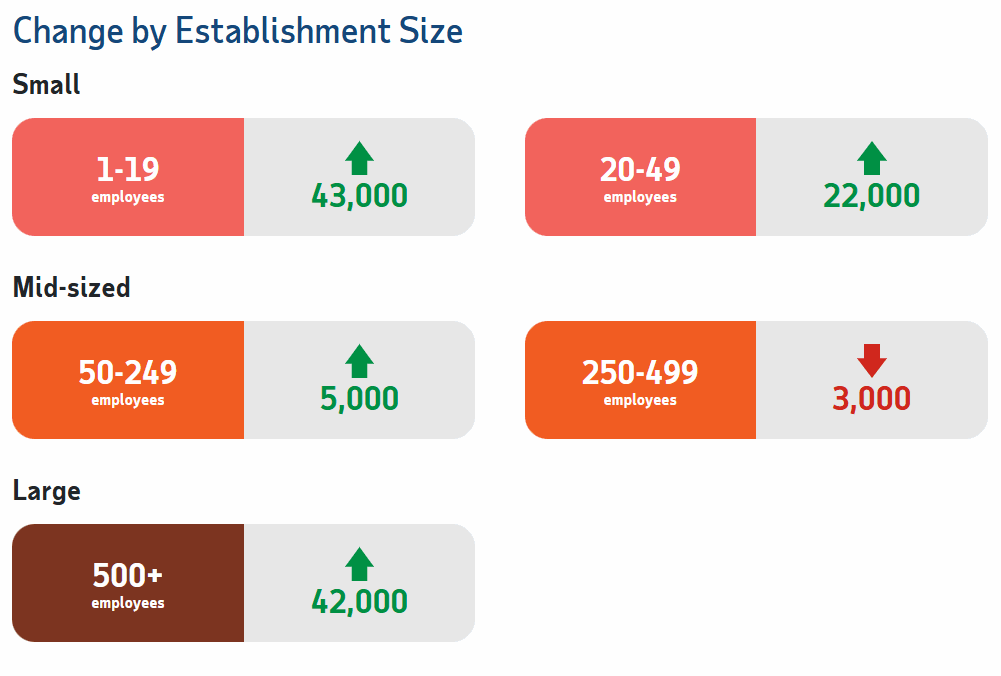
ADP Private Employment by Establishment Size
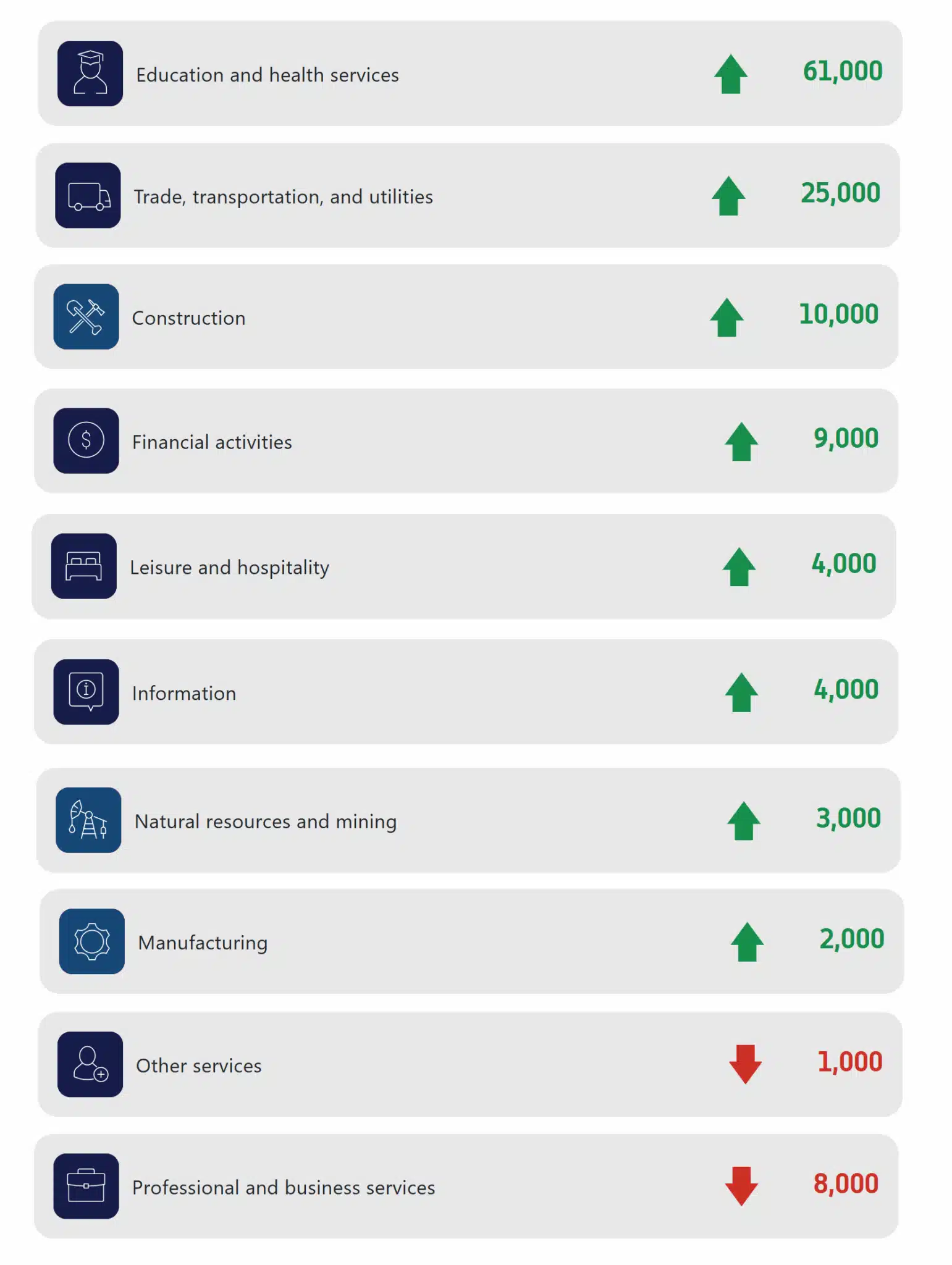
ADP Job Gainers / Losers
Most sectors showed gains, with only two losers.
Seasonally Adjusted Unemployment Rate Chart 1948-Present
Less Than Full Employment
This chart compares employment levels with the (inverted) unemployment rate.
Full Employment is when everyone who wants a job has one. It is generally considered to be around 3%. After the unemployment rate almost touched the magic full employment line in April 2023, it began moving away (i.e., higher unemployment).
Note: The Unemployment rate is inverted to track the employment rate. Neither is Seasonally Adjusted. For more information see Employment vs. Unemployment.
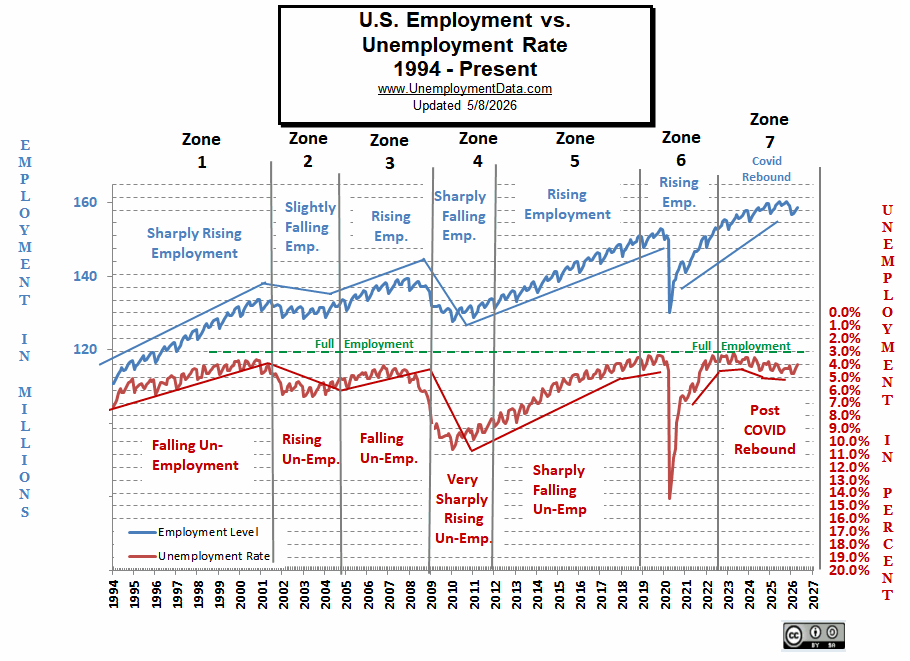
Note: Full employment is not considered to be at zero percent because even when employers are having difficulty finding employees, some people are still unemployed due to either:
- Structural unemployment (mismatch between worker skills and job requirements, i.e., not enough training) or
- Frictional unemployment. There will always be people who have quit or have lost a seasonal job and are in the process of getting a new job. Or simply because they quit their job, knowing it would be easy to find another (hopefully better) job.
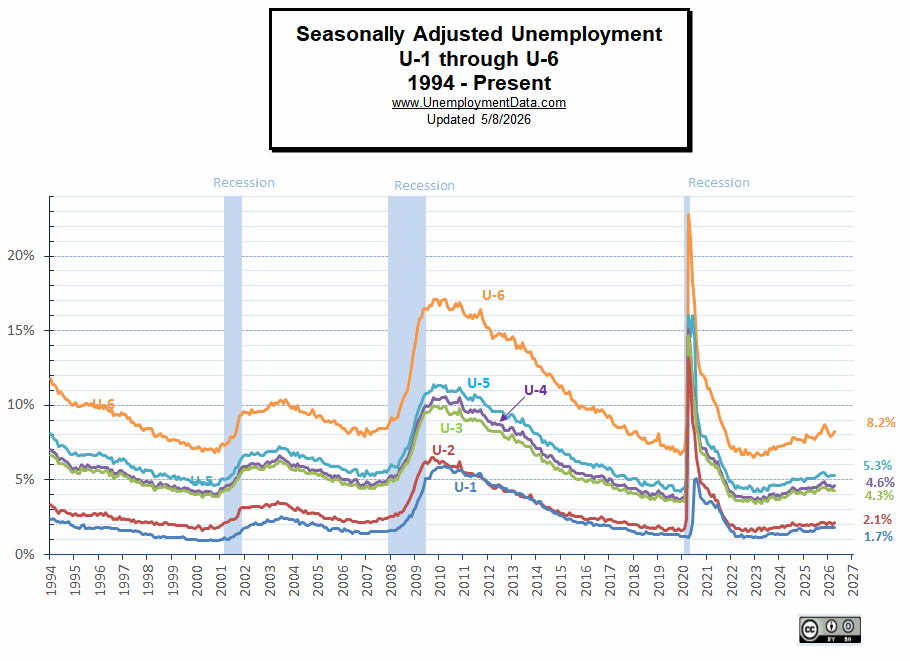
Seasonally Adjusted U1 through U6 Unemployment Rates
Labor Force Participation Rate
The LFPR fell slightly from 61.9% in March to 61.8% in April. There has been a downward trend since the November 2023 peak. This may be partially explained by an aging population retiring.
Note: A rising LFPR means that a greater portion of the Non-Institutional population is in the Labor Force.
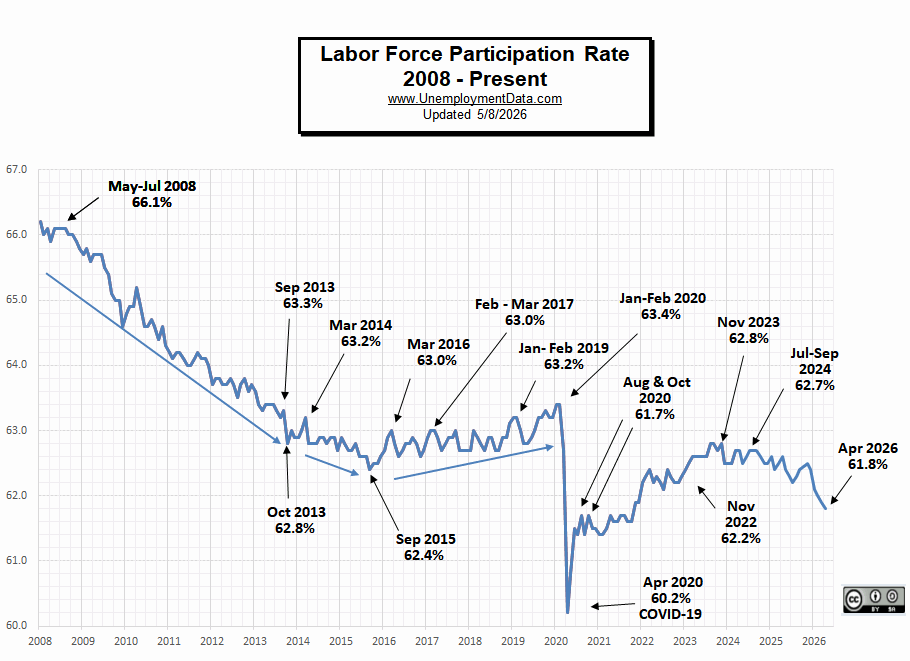
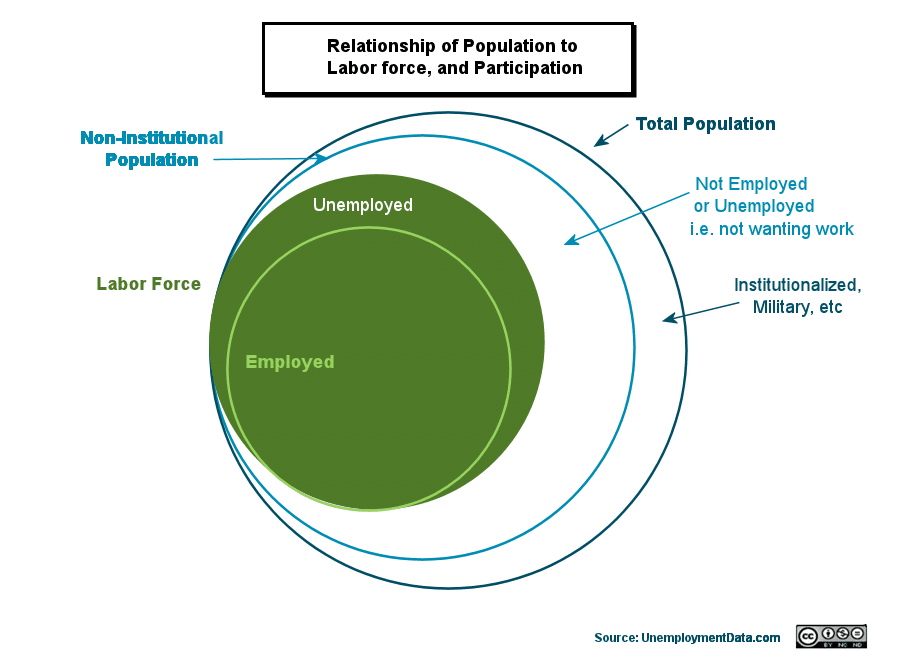
The Labor Force Participation Rate is the percentage of the Non-Institutional Population that makes up the Labor Force.
And the Employment – Population Ratio is the percentage of the Total Population that is Employed. We created a chart to help explain the difference. The Employment–Population Ratio is the percentage of the largest circle to the smallest circle in this diagram. In contrast, the LFPR is the relationship of the 2nd largest circle to the 3rd largest circle (entire green circle).
Employment-Population Ratio
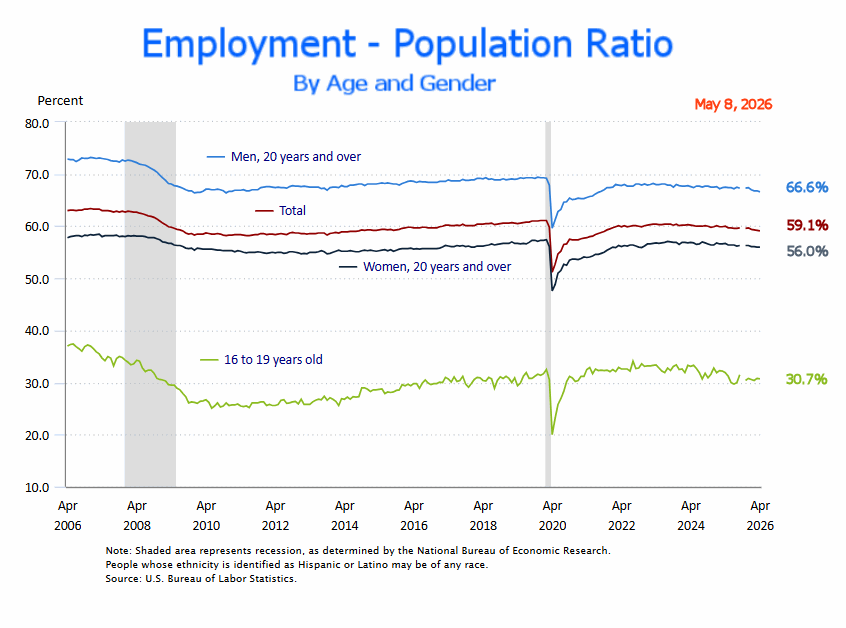
By Gender and Age
This chart shows the Employment-Population Ratio by Gender. Men make up a much larger portion of the workforce, i.e., 66.6% of men are employed, and only 56.0% of women are employed. But…
As you can see, 20 years ago, back in 2006, over 72% of men were working and 57.4% of women were working. In 2008, the Great Recession caused a massive decline in employment for both men and women. By December of 2009, only 66.4% of men were working and 55.4% of women. Over the next decade and a half, women workers rebounded to 56.4%, but men only rebounded to 67.4%.
Employment-Population Ratio by Race
This chart shows the Employment-Population Ratio by Race (including both Men and Women). As we can see, Hispanics and Asians have the highest percentage of their population employed.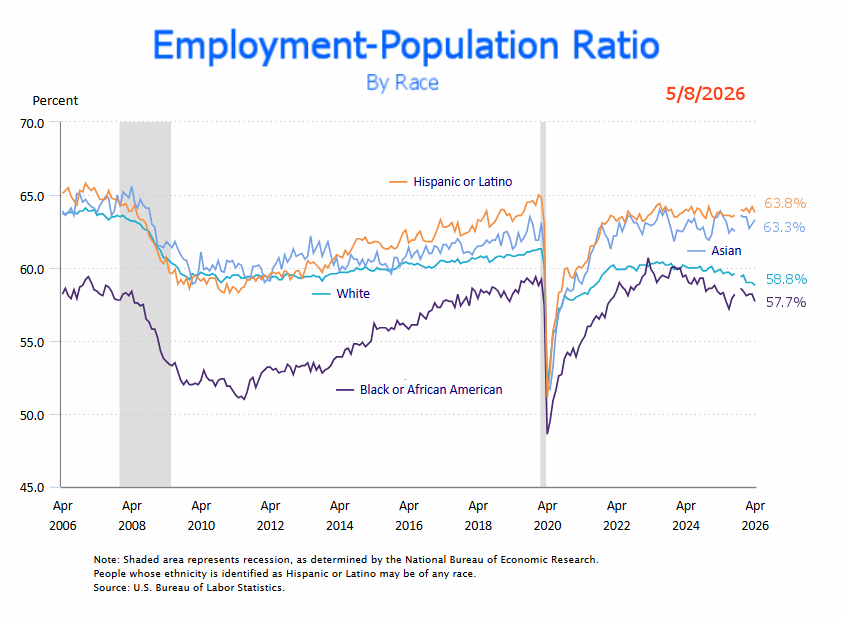
Percent Unemployed 27 weeks or Longer
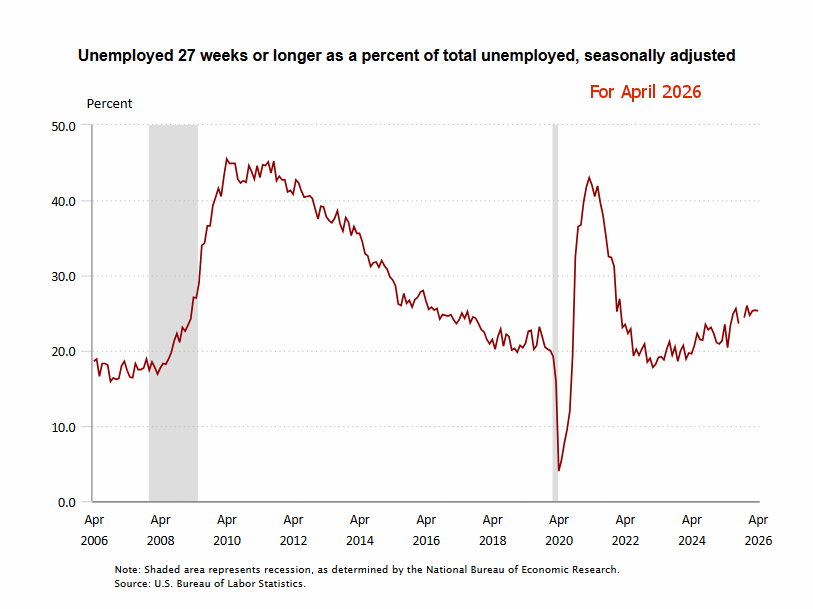
Roughly a quarter (25.4%) of those unemployed have been unemployed for 27 weeks or longer.
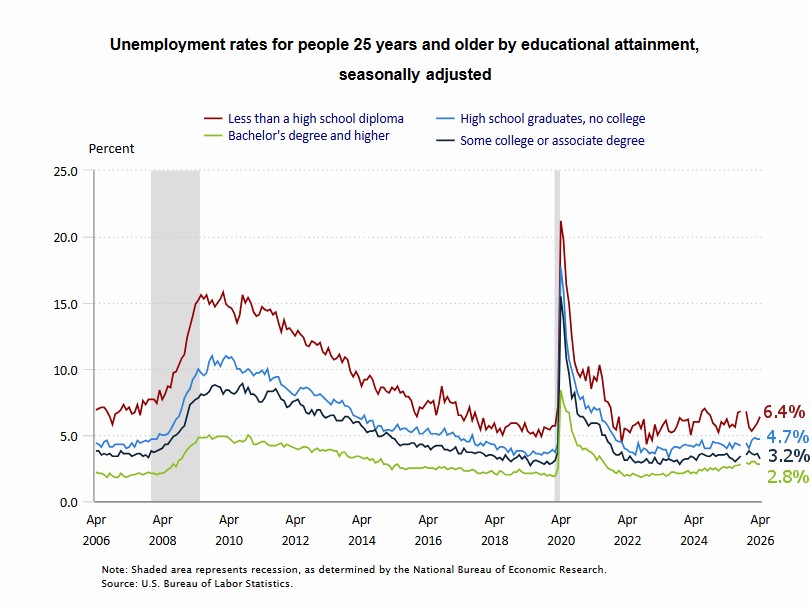
Unemployment by Education
Read more on UnemploymentData.com.
- Inflation vs Unemployment Challenge FED’s Resolve
- Jobs AI Can’t Destroy: Careers for 2026 and Beyond
- Why February 2026’s Jobs Report Was an Anomaly, Not a Trend
- April Employment Report for March 2026
- Department of Labor Creates Free AI Training
From InflationData.com
- How will FED Chairman Warsh affect Rates and Inflation?
- Ben Cowan: Is the Fed Heading Toward Checkmate?
- The Truth About Truflation vs. the BLS’s CPI
- Massive March 2026 Inflation Spike
- Is Gas Really More Expensive Than Ever?
From Financial Trend Forecaster
- Moore Inflation Predictor
- NYSE ROC
- NASDAQ ROC
- ETH and BTC ROC Signal
- Where the Markets Stand Based on ROC Analysis
- Will the Collapse of OPEC Result in Lower Oil Prices?
- The California Energy Crisis
- Energy Is Non-Fungible: Costing the World Billions
- Aluminum The Battery That Could Render Lithium Obsolete
- The Pipes of Global Finance Are Getting an Upgrade
- U.S. Dollar: What to expect in 2026
- Shiller Price Earnings Ratio 2nd Highest in History
- This Forecasting Tool Nailed the S&P Turns
- Warren Buffett isn’t buying — and that says a lot.
- Debt Ceiling Drama
From OptioMoney
