• Skip to primary navigation
  • Skip to main content
  • Skip to primary sidebar
  • Home
  • Contact us
  • Related Sites
    • InflationData.com
    • Financial Trend Forecaster
    • Your Family Finances
    • Elliott Wave University
    • Optio Money
  • About
    • Terms of Use
    • Disclaimer & Disclosure
    • Privacy Statement
  • Sitemap
    • 2009-2010 Posts
    • 2011 Posts

UnemploymentData.com

Your Source for Employment and Unemployment Data

Unemployment
  • Charts
    • Current Unemployment Rate Chart
    • Current Employment (Chart and Data)
    • Current Employment vs Unemployment Chart
    • Historical Employment Data
    • Employment Population Ratio
    • Misery Index
  • Unemployment
    • Historical Unemployment Rate Tables
    • What Is U-6 Unemployment?
    • Unadjusted vs. Seasonally Adjusted U-3 Unemployment Rate
    • BLS vs. Gallup Unemployment Numbers
    • Current U-6 Unemployment Rate
    • What is the Labor Force Participation Rate?
    • What is the Real Unemployment Rate?
  • Employment
    • Current Employment (Chart and Data)
    • Historical Employment Data
    • Contacting a Live Person at the State Employment Commission
      • How to Talk to a Live Person at the Virginia Unemployment Commission
      • Florida’s FLUID Unemployment Program
    • Benefits
      • Insurance
      • Retirement
    • Careers
    • Employment Costs
    • Experience
    • Government
    • Job Hunting
      • Interview
      • Resume
  • Find Articles
  • Education
    • Skills
  • General
    • Small Business
      • Outsourcing
    • Success
You are here: Home / Archives for employment

employment

Unemployment Rate Falls Contrary to Economist’s Projections

June 6, 2020 by Tim McMahon

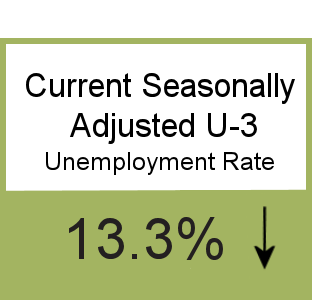
13.3% Unemployment

The U.S. Bureau of Labor Statistics (BLS) released its employment / unemployment report for May on June 5th.

COVID-19 Unemployment Decreases as People Return to Work

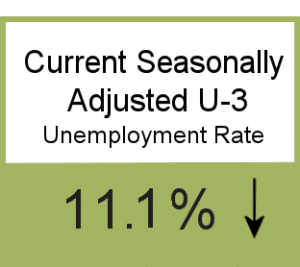
  • Unadjusted U-3 was Down from 14.4% to 13.0%.
  • Adjusted U-3 was Down from 14.7% to 13.3%.
  • Unadjusted U-6 was Down from 22.4% to 20.7%.
  • Labor Force Participation rose from 60.2% to 60.8%.
  • Unadjusted Employment rose by approx. 2.9 million jobs.

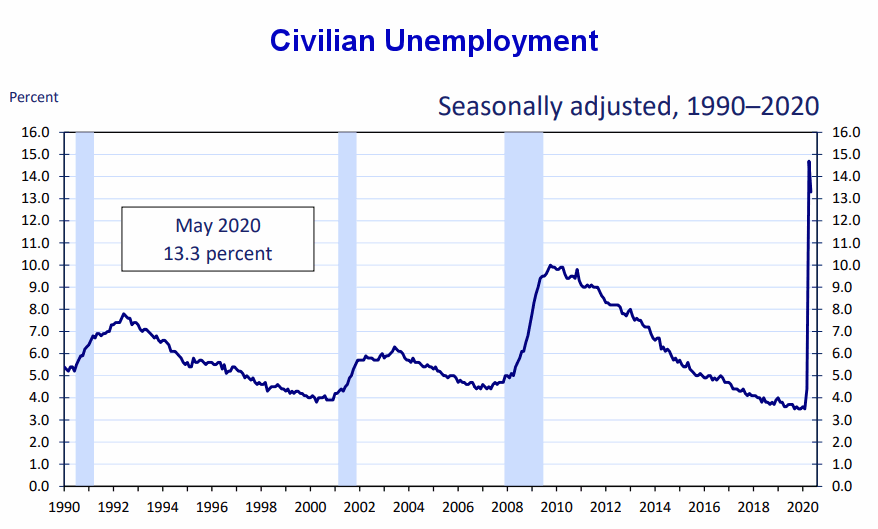
Civilian Unemployment

Economists were predicting another stairstep increase in unemployment in May. According to a CNBC article “Economists surveyed by Dow Jones had been expecting payrolls to drop by 8.33 million and the unemployment rate to rise to 19.5% from April’s 14.7%.”

Instead, Unemployment fell to 13.3% and payrolls rose by 2.9 million making the “experts” wrong by roughly 11 million.

Civilian Unemployment

According to the Commissioner of the U.S. Bureau of Labor Statistics:

“Nonfarm payroll employment increased by 2.5 million in May, and the unemployment rate declined by 1.4 percentage points to 13.3 percent. These improvements in the labor market reflected a limited resumption of economic activity that had been curtailed in March and April due to the coronavirus (COVID-19) pandemic and efforts to contain it.
      
In May, employment rose in several major industry sectors, with the largest gains in leisure and hospitality, construction, education and health services, and retail trade. By contrast, employment in government continued to decline sharply.”

Of course, he is talking about “Seasonally Adjusted Jobs” from the “Current Population Survey (CPS)”
rather than looking at the results reported by actual companies in their “Current Employment Statistics survey (CES)”

But looking at the CES report we see…
Originally the BLS reported 131.071 million jobs for April and then they subtracted 660,000 jobs from that estimate.
So currently they are saying 130.411 million jobs for April and 133.342 million jobs for May which is actually an increase of  2.271 million jobs compared to what they originally reported last month. Or 2.931 million jobs based on their current estimates of April’s employment.

[Read more…] about Unemployment Rate Falls Contrary to Economist’s Projections

Filed Under: BLS Tagged With: Age Group, Audiologist Degree, BLS, Bubble Chart, Coronavirus, COVID, COVID-19, employment, May 2020, Rebound, unemployment

Coronavirus Shutdown Causes 20 Million Job Losses

May 9, 2020 by Tim McMahon

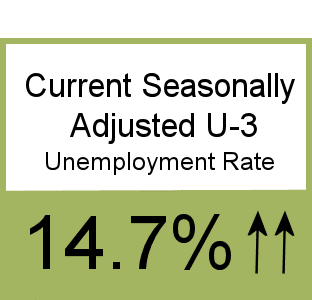
Unemployment 14.7%

The U.S. Bureau of Labor Statistics (BLS) released its employment / unemployment report for April on May 8th.

COVID-19 Shutdowns Send Unemployment Rate Soaring

  • Unadjusted U-3 was Up from 4.5% to 14.4%!
  • Adjusted U-3 was Up from 4.4% to 14.7%!
  • Unadjusted U-6 was Up from 8.9% to 22.4%!
  • Labor Force Participation fell from 62.7% to 60.2%.
  • Unadjusted Employment down by approx. -19.5 MILLION jobs.

Civilian Unemployment

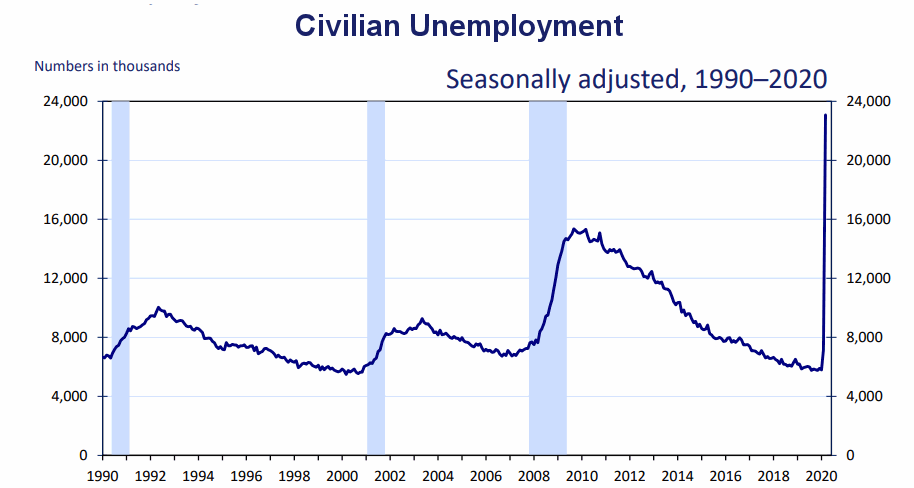
In April, the ranks of the unemployed swelled by almost 20 million bringing it up to approximately 23 million in total. Rather than looking at percentages, the following chart looks at the actual number of unemployed individuals. The current number of unemployed is considerably higher than at the peak of the 2008-2010 “great recession”.

Civilian Unemployment Chart

According to the Commissioner of the U.S. Bureau of Labor Statistics:

Nonfarm payroll employment declined by 20.5 million in April, and the unemployment rate increased to 14.7 percent, reflecting the widespread impact on the job market of the coronavirus (COVID-19) pandemic and efforts to contain it. Employment fell sharply in all major industry sectors, with a
particularly large decline in the leisure and hospitality sector.

The response rate for the household survey continued to be adversely affected by pandemic-related issues, while that for the establishment survey returned to a normal range in April. In addition, there were changes to the estimation methods for the establishment survey to better account for the historic number of temporary or permanent business closures in April. The impacts of the pandemic on the household and payroll surveys are detailed in the April Employment Situation news release and accompanying materials (available on the BLS website)). For both surveys, we were able to obtain estimates that met BLS standards for accuracy and reliability.

The substantial job declines related to the coronavirus pandemic started in March, as payroll employment declined by 870,000, as revised. Job losses accelerated in April, as an additional 20.5 million jobs were lost. These April losses were pervasive across all industry sectors, and brought nonfarm employment to its lowest level since February 2011.

Of course, he is talking about “Seasonally Adjusted Jobs” from the “Current Population Survey (CPS)”
rather than looking at the results reported by actual companies in their “Current Employment Statistics survey (CES)”

Looking at the CES report we see…
Originally the BLS reported 150.804 million jobs for March and then they subtracted 221,000 jobs from that estimate.
So currently they are saying 150.583 million jobs for March and 131.071 million jobs for April which is actually a decrease of  -19.733 million jobs compared to what they originally reported last month. Or -19.512 million jobs based on their current estimates of March’s employment.

[Read more…] about Coronavirus Shutdown Causes 20 Million Job Losses

Filed Under: General Tagged With: 20 Million, 2020, April, BLS, Commissioner, Coronavirus, COVID, COVID-19, employment, Hispanic, Peak, unemployment

February Jobs Report Smashes Expectations

March 7, 2020 by Tim McMahon

current unemployment rateThe U.S. Bureau of Labor Statistics (BLS) released its employment / unemployment report for February on March 6th.
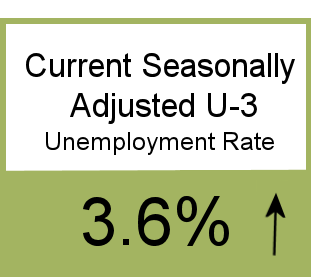
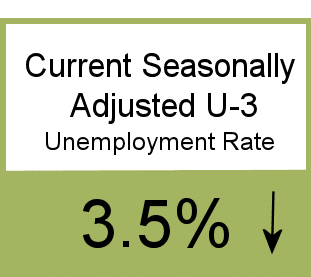
Unemployment returns to 50-year lows. The “Seasonally Adjusted” Unemployment Rate fell from 3.6% in January to 3.5% in February. Thus returning to the previous low levels of September, November, and December after increasing slightly in January.
We are still in record low territory and that won’t change overnight. Seasonally adjusted U-3 Unemployment notched up 1/10th of a percent in January and fell back the same amount in February. The Labor Force Participation Rate (LFPR) remains in territory that it hasn’t seen in years…

This is better than expected results and according to @AP News it shows that “the economy was in strong shape before the coronavirus began to sweep
through the U.S. “

The average monthly wage is up almost $130 over year-ago levels so two-income families are bringing in an average of at least $250 a month more. (See employment by Sector for more info).

This month we will also look at unemployment by Education level, and reasons for unemployment.

February Jobs Report Smashes Expectations

  • Unadjusted U-3 was down from 4.0% to 3.8%!
  • Adjusted U-3 was down slightly from 3.6% to 3.5%!
  • Unadjusted U-6 was down from 7.7% to 7.4%!
  • Labor Force Participation remains at the highest level since 2013.
  • Unadjusted Employment Up by approx. 880,000 jobs.


Seasonally Adjusted Unemployment Rate ChartAccording to the Commissioner of the U.S. Bureau of Labor Statistics:

 “Nonfarm payroll employment rose by 273,000 in February, and the unemployment rate was little changed at 3.5 percent.
Notable employment gains occurred in health care and social assistance, food services and drinking places, government, construction, professional and technical services, and financial activities.”

But, he is talking about “Seasonally Adjusted Jobs” from the “Current Population Survey (CPS)” rather than looking at the results reported by actual companies in their “Current Employment Statistics survey (CES)”

Looking at the CES report we see…

Originally the BLS reported 150.102 million jobs for January and then they added 15,000 jobs to that estimate.
So currently they are saying 150.117 million jobs for January and 150.997 million jobs for February
which is actually an increase of 895,000 jobs over what they originally reported last month and 880,000 more than current estimates for last month.

Of course, the Corona Virus scare is affecting the Stock Market as the AP news was quick to point out. So March numbers may be affected by that.

For more info see our Current Unemployment Chart and Current U.S. Employment Chart commentary.

[Read more…] about February Jobs Report Smashes Expectations

Filed Under: BLS Tagged With: BLS, employment, U-3, U-6, U3, U6, U6 minus U3, unemployment

January Employment Report- Maybe Not as Good?

February 8, 2020 by Tim McMahon

Adj U3 Icon 3-6 upThe U.S. Bureau of Labor Statistics (BLS) released its employment / unemployment report for January on February 7th.
Last month we told you that the employment report was not as bad as the media tried to paint it. This month The New York Times is saying “Job Growth Gives the Economy an Upbeat Start to the Year” while Marketwatch calls the Labor Market “Astounding” and once again we have a slightly different opinion.

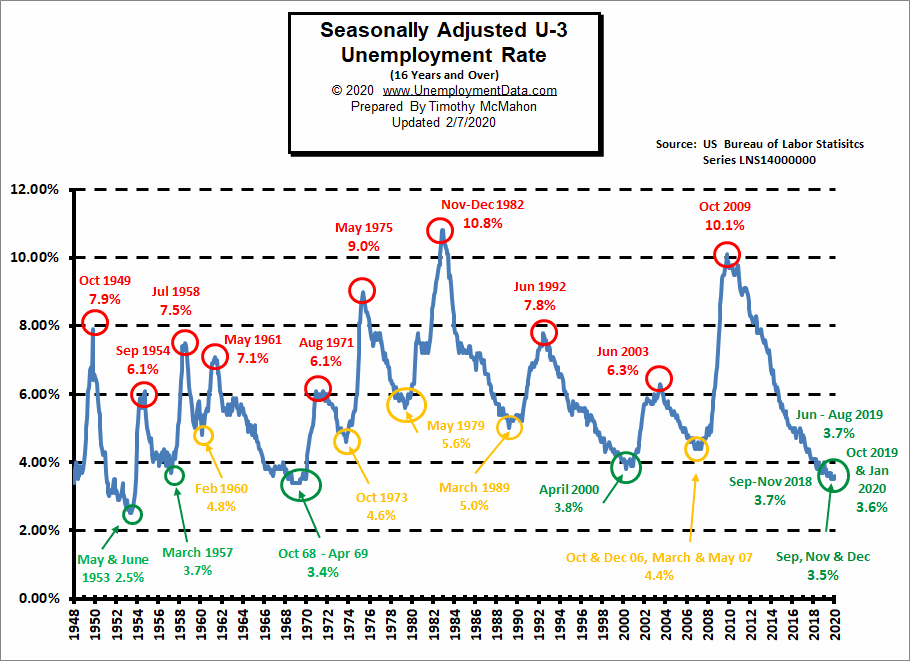
Yes, we are still in record low territory and that won’t change overnight. Seasonally adjusted Unemployment only notched up 1/10th of a percent and the Labor Force Participation Rate (LFPR) has entered territory that it hasn’t seen in years… BUT the unadjusted numbers jumped up significantly (as they do every year) and the BLS adjusted the Population numbers DOWN significantly. This adjustment is what the pundits are not seeing and what makes me think the numbers may not be quite as good as they appear i.e. lower population means a higher percentage appears to be working (even though the actual unadjusted employment fell). This could have given the LFPR the apparent boost and made the Adjusted U-3 increase by less than it would have without the population adjustment. This is still not a bad employment report just perhaps not as rosy as the media made it sound.

Key January Employment and Unemployment Numbers

  • Unadjusted U-3 Unemployment-  4.0% Up from December’s 3.5%… Typically up in January, it was 4.4% in January 2019.
  • Adjusted U-3 Unemployment-    3.6% Up from 3.5% in December.
  • Unadjusted U-6 Unemployment-  7.7% Up from 6.7% in December… was 8.8% in January 2019.
  • Unadjusted Employment (Establishment Survey)- 150.102 million down from 152,934 in December.
  • Labor Force Participation Rate- 63.4% Up from 63.2%.

According to the Commissioner of the U.S. Bureau of Labor Statistics:

Seasonally Adjusted U-3 Unemployment RateNonfarm payroll employment rose by 225,000 in January, and the unemployment rate was little changed at 3.6 percent.
Notable employment gains occurred in construction, in health care, and in transportation and warehousing.
In 2019, job growth averaged 175,000 per month.

Of course, he is talking about “Seasonally Adjusted Jobs” from the “Current Population Survey (CPS)”
rather than looking at the results reported by actual companies in their “Current Employment Statistics survey (CES)” which showed a non-adjusted drop of 2.8 million jobs.

For more info see our Current Unemployment Chart and Current U.S. Employment Chart commentary.

[Read more…] about January Employment Report- Maybe Not as Good?

Filed Under: BLS Tagged With: 2020, BLS, employment, January, Report, unemployment

The 10 Highest Paying Jobs in the Oil & Gas Industry

January 28, 2020 by Guest Contributor

Make no mistake: Oil and gas companies may be doing some serious cost-cutting and slimming-and-trimming to stay competitive after the shale boom binge, but when it comes to employment, it’s still one of the best industries to hit up for a job.

Jobs are booming, just as much as U.S. oil and gas production is.

US oil production has increased from 11.7 million Barrels per Day (BPD) at the start of 2019 to 12.6 million by the end of October, according to the Energy Information Administration (EIA). Natural gas production has risen as well, to 99.1 Bcf/d at the end of October—95 Bcf/d of which is from dry natural gas—up from 91.3 Bcf/d this time last year for total US natural gas production.

Those gains have translated into more oil and gas industry jobs.

US Oil and Gas Employment

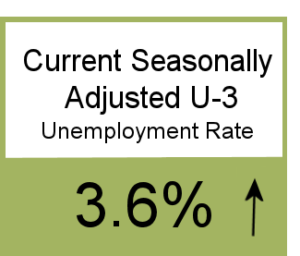
The United States Traditional Energy and Energy Efficiency Sectors in 2018 employed 6.7 million Americans in 2018, according to the US Energy and Employment Report 2019, with nearly 1.5 million directly employed by the oil and gas industry, and another 1.2 million workers employed by the power generation sector, which includes all types of power generation, including oil and gas.

Mining Employment

Employment in the oil and gas extraction and support services, specifically, was at its highest level in 2018 since the fall of 2014—the next most recent high.

And those jobs? None too shabby if you’re interested. [Read more…] about The 10 Highest Paying Jobs in the Oil & Gas Industry

Filed Under: Careers Tagged With: employment, Gas, jobs, Oil Careers, salaries

November Unemployment- Another Banner Month

December 7, 2019 by Tim McMahon

current unemployment rateThe U.S. Bureau of Labor Statistics (BLS) released its employment / unemployment report for November on December 6th.

Unemployment returns to 50-year lows. The “Seasonally Adjusted” Unemployment Rate for November fell from 3.6% in October to 3.5% despite the media’s narrative that many employers are either delaying hiring until a breakthrough in the U.S.-China trade war is reached.

November Jobs Report Smashes Expectations Again

  • Unadjusted U-3 was Unchanged at 3.3%!
  • Adjusted U-3 was down slightly from 3.6% to 3.5%!
  • Unadjusted U-6 was Unchanged at 6.5%!
  • Labor Force Participation retreated slightly from 63.3% to 63.2%.
  • Unadjusted Employment Up by approx. 660,000 jobs.

According to the Commissioner of the U.S. Bureau of Labor Statistics:

“Nonfarm payroll employment rose by 266,000 in November, and the unemployment rate, at 3.5 percent, was little changed. Notable job gains occurred in health care and in professional and technical services. Manufacturing employment increased as workers in motor vehicles and parts returned from a strike. Employment in health care increased by 45,000… Employment rose by 31,000 in professional and technical services…  Employment in leisure and hospitality +45,000… Employment in transportation and warehousing +16,000… Employment in financial activities +13,000…

Of course, he is talking about “Seasonally Adjusted Jobs” from the “Current Population Survey (CPS)”
rather than looking at the results reported by actual companies in their “Current Employment Statistics survey (CES)”
Originally the BLS reported 152,962 million jobs for October and they added 40,000 jobs to that estimate. Currently they are estimating 153.624 million jobs for November which is an increase of 662,000 jobs over what they originally reported last month. So what he is actually saying is that there were 266,000 more jobs created in November than is normal for this time of year!

Returning striking General Motors autoworkers added about 30,000 jobs in November, a one-time bounce-back that followed a 30,000 decline in October, when the GM strikers weren’t counted as employed. But even without that 30,000 Manufacturing still added 24,000 additional jobs! 

Just days ago, the media and Moody’s Chief Economist Mark Zandi were trying to paint a grim picture for the economy. Zandi told CNBC there was trouble brewing in the jobs market “Manufacturers, commodity producers and retailers are shedding jobs. Job openings are declining, and if job growth slows any further unemployment will increase.”
Instead of a Decrease in jobs we got a massive INCREASE. And the futures market spiked upward on the good news.

For more info see our Current Unemployment Chart and Current U.S. Employment Chart commentary.


[Read more…] about November Unemployment- Another Banner Month

Filed Under: BLS Tagged With: BLS, Charts, employment, Labor Force Participation Rate, LFPR, November, unemployment

October Unemployment- Jobs Much Better Than Expected

November 2, 2019 by Tim McMahon

Adj U3 Icon 3-6 upThe U.S. Bureau of Labor Statistics (BLS) released its employment / unemployment report for October on November 1st.
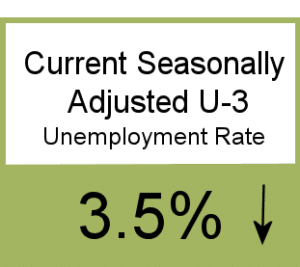
Unemployment is still near record lows. Although the “Seasonally Adjusted” Unemployment Rate for October ticked up from 3.5% in September to 3.6%. However, the unadjusted U-3 Unemployment rate was unchanged at 3.3%. This Jobs report was unexpectedly good despite counting 30,000 “unemployed” strikers at auto manufacturers.

According to the Commissioner of the U.S. Bureau of Labor Statistics:

“Nonfarm payroll employment increased by 128,000 in October, and the unemployment rate was little changed at 3.6 percent. Notable employment gains occurred in food services and drinking places, social assistance, and financial activities. Within manufacturing, employment declined in motor vehicles and parts due to strike activity. Federal government employment was down, reflecting a drop in the number of temporary jobs for the 2020 Census.”

Experts had been predicting that the economy would add no more than 75,000 jobs. In fact, MarketWatch on Thursday told readers that
the report would be “a big dud” due to the impact of the General Motors strike on the overall numbers.
If it hadn’t been for the strike the October numbers would have been even better.

Of course, the Commissioner is talking about “Seasonally Adjusted Jobs” from the “Current Population Survey (CPS)”
rather than looking at the results reported by actual companies in the BLS’ “Current Employment Statistics survey (CES)”
in reality, the BLS has done a lot of “Adjusting” over the last few months.
The original CES numbers the BLS reported for August was 151.517 million people employed in August
then later they adjusted it up to 151.607 million. And for September they originally reported there were 151.949 million employed
and currently they are reporting 152.962 million employed so that is an actual increase of 1.013 million NOT and adjusted increase of 128,000!
But in addition to “Seasonal Adjustment”, they adjusted September’s number up to 152.015 million
so the difference between September and October appears to be less than it actually was.

For more info see our Current Unemployment Chart and Current U.S. Employment Chart commentary:

October Jobs Report Smashes Expectations

  • Unadjusted U-3 was Unchanged at 3.3%!
  • Adjusted U-3 was up slightly from 3.5% to 3.6%!
  • Unadjusted U-6 was Unchanged at 6.5%!
  • Labor Force Participation hits levels not seen since 2013 at recent peak levels of 63.3%.
  • Unadjusted Employment Up
  • The unemployment rate for black Americans nudged lower to 5.4 percent, setting a new record,

Key factors in the BLS report were:
Employment in food services and drinking places rose by 48,000 over the month.
Financial activities employment rose by 15,000, with nearly half of the gain occurring in insurance carriers and related activities (+7,000).

Social assistance added 20,000 jobs in October, with most of the gain occurring in individual and family services.

Financial activities added 16,000 jobs.
Professional and business services added 22,000 jobs.

Health care added 15,000 jobs.

Manufacturing employment declined by 36,000 in October.
Employment in motor vehicles and parts manufacturing decreased
by 42,000, reflecting strike activity.

[Read more…] about October Unemployment- Jobs Much Better Than Expected

Filed Under: BLS Tagged With: BLS, Bureau of Labor Statistics, employment, jobs, Labor, Labor Force, Labor Force Participation Rate, Participation Rate, productivity, Sector, unemployment

September Unemployment Rate Hits 50-Year Low

October 5, 2019 by Tim McMahon

The U.S. Bureau of Labor Statistics (BLS) released its employment / unemployment report for September released on October 4th. Unemployment is at record lows. According to the BLS, the “Seasonally Adjusted” Unemployment Rate for September fell to 3.5% after spending 3 months at 3.7%. The last time unemployment was this low was in December 1969 almost exactly 50 years ago.

According to the Commissioner of the U.S. Bureau of Labor Statistics:

“The unemployment rate declined by 0.2 percentage point to 3.5 percent in September, and nonfarm payroll employment increased by 136,000. Employment continued to trend up in health
care and in professional and business services… Health care employment rose by +39,000 in September… employment continued to trend up in professional and business services +34,000… Employment in transportation and warehousing edged up by +16,000… Government employment also continued to trend up in September +22,000…”

Of course, he is talking about “Seasonally Adjusted Jobs” in reality last month the BLS reported there were 151.517 million people employed in August and this month they are reporting there are 151.949 million employed in September, so that is an increase of 432,000 jobs.

For more info see our Current Unemployment Chart and Current U.S. Employment Chart commentary:

Key September Employment and Unemployment Numbers

This month’s Unemployment report was full of positive news.

  • Adjusted U-3 Unemployment-    3.5% down from 3.7% June through August.
  • Unadjusted U-3 Unemployment-  3.3% down from 3.8% in August and 4.0% in July, it was 4.4% in January.
  • Unadjusted U-6 Unemployment-  6.5% down a whopping -0.8% from 7.3% in August.
  • Unadjusted Employment (Establishment Survey)- 151.949 up from the 151.517 million the BLS reported in August.
  • Labor Force Participation Rate- 63.2% unchanged from August but up from 63.0% in July, and 62.9% June.

Key factors in the BLS report were:

Health care employment increased by 39,000

Professional and business services increased by 34,000

Transportation and warehousing increased by 16,000

Government employment increased by 22,000 approximately 1,000 of those were related to the upcoming census.

Hispanic and African American unemployment are both at the lowest levels on record.


[Read more…] about September Unemployment Rate Hits 50-Year Low

Filed Under: General Tagged With: BLS, Bureau of Labor Statistics, education, employment, Labor, productivity, unemployment

August Unemployment Report

September 7, 2019 by Tim McMahon

Adjusted U3 3.7%The U.S. Bureau of Labor Statistics (BLS) released its employment / unemployment report for August on September 6th. Unemployment is still near record lows. According to the BLS, the “Seasonally Adjusted” Unemployment Rate for August is unchanged at 3.7% for the 3rd month in a row. But up from 3.6% in May and down from 3.8% in February and March.

According to the Commissioner of the U.S. Bureau of Labor Statistics:

“Total nonfarm payroll employment rose by 130,000 in August, and the unemployment rate was unchanged at 3.7 percent, the U.S. Bureau of Labor Statistics reported today. Employment in federal government rose, largely reflecting the hiring of temporary workers for the 2020 Census. Notable job gains also occurred in health care and financial activities, while mining lost jobs.”

Of course, he is talking about “Seasonally Adjusted Jobs” in reality there were 151.517 million people employed in August up from 151.169 million employed in July. Although the BLS originally reported 151.183 jobs for July.

For more info see our Current Unemployment Chart and Current U.S. Employment Chart commentary:

Key August Employment and Unemployment Numbers

This month’s Unemployment report was full of positive news.

  • Seasonally adjusted Unemployment remained at historically low levels. 
  • Unadjusted U-3 was Down.
  • Unadjusted U-6 remains good.
  • Labor Force Participation Up Again
  • Unadjusted Employment Up

Key factors in the BLS report were:

Health care employment increased by 24,000 and 392,000 over the past 12 months.

Financial activities employment rose by 15,000, with nearly half of the gain occurring in insurance carriers and related activities (+7,000). Financial activities has added 111,000 jobs over the year.

Not sure if this is good or bad but…

“Social assistance employment continued on an upward trend in August (+13,000). Within the industry, individual and family services added 17,000 jobs. Social assistance has added 100,000 jobs in the last 6 months.”

[Read more…] about August Unemployment Report

Filed Under: BLS Tagged With: August Unemployment, Bureau of Labor Statistics, employment

July Unemployment Unchanged But…

August 3, 2019 by Tim McMahon

Adjusted U3 3.7%The U.S. Bureau of Labor Statistics (BLS) released its monthly unemployment survey results for July on August 2nd. Unemployment is still near record lows but this month’s Unemployment report was a bit of a “mixed bag” with some positive news and some not quite so positive.

According to the Commissioner of the U.S. Bureau of Labor Statistics:

“Nonfarm payroll employment increased by 164,000 in July, and the unemployment rate was unchanged at 3.7 percent. Notable job gains occurred in professional and technical services, health care, social assistance, and financial activities.

The July increase in payroll employment was in line with the average monthly job gain in the first half of the year (+165,000), but below the average monthly job gain of 223,000 for 2018. (Incorporating revisions for May and June, which decreased employment by 41,000, monthly job gains have averaged 140,000 over the past 3 months.) ”

Of course he is talking about “Seasonally Adjusted Jobs” in reality there were 152.307 million people employed according to the BLS’ June report and then they adjusted it down to 152.242 million but in July there are only 151.183 million employed so there was either a decrease of -1.059 million jobs based on the new numbers or a decrease of -1.124 million based on the original numbers. But there were only 148.295 million employed in January so there about 2.88 million more people employed in July than in January.

For more info see our Current Unemployment Chart and Current U.S. Employment Chart commentary:

Key July Employment and Unemployment Numbers

  • Adjusted U-3 Unemployment-   3.7% Unchanged from June 
  • Unadjusted U-3 Unemployment-  4.0% Up from 3.8% in June and 3.4% in May but still below 4.1% in February, and 4.4% in January.
  • Unadjusted U-6 Unemployment-  7.3% down from 7.5% in June Up from 6.7% in May. It was 7.5% in March, 7.7% in February and 8.8% in January.
  • Unadjusted Employment (Establishment Survey)- 151.183 million down from 152.307 million in June up from 148.295 million in January.
  • Labor Force Participation Rate- 63.0% up from 62.9% June, 62.8% in April and May but unchanged from 63.0% in March and still below the peak of 63.2% in February.

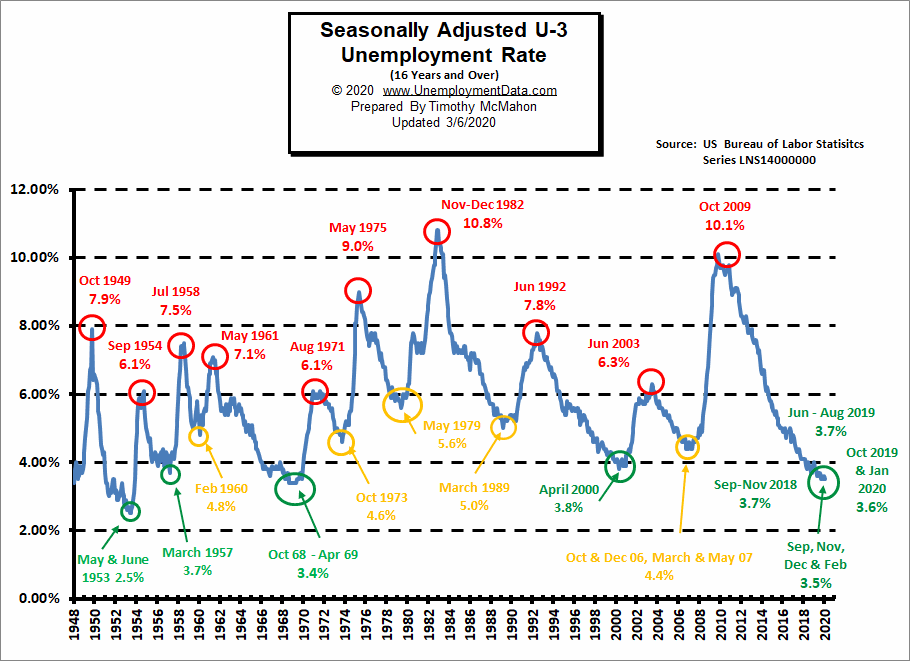
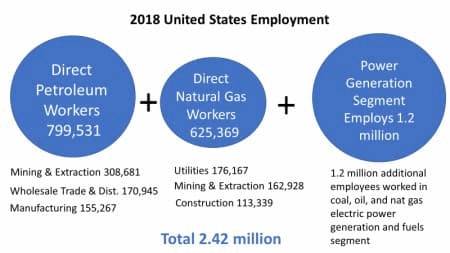
Although they rose a notch in June (and stayed there in July), current Seasonally Adjusted U-3 levels are still below the 3.8% lows of 2000. Prior to that, we have to go all the way back to 1969 to see better unemployment levels than we have currently. If we break below 3.4% we have to go all the way back to 1953 (during the Korean War) to find lower levels. And we must remember that there was a massive loss of the workforce due to the war, and a higher percentage of the population was not counted due to “farming”,  so we probably won’t see levels that low again. The 1969 lows occurred during the Vietnam war. Prior to 1969 was a low of 3.7% in 1957 so we are currently at that level. As we can see from the above chart we are in one of only 5 “green zones” where unemployment levels are below 4%. Not even the “boom” period 2006-2007 reached such low levels.

[Read more…] about July Unemployment Unchanged But…

Filed Under: General Tagged With: Charts, education, employment, Industry, Sectors, unemployment

  • « Go to Previous Page
  • Page 1
  • Interim pages omitted …
  • Page 4
  • Page 5
  • Page 6
  • Page 7
  • Page 8
  • Interim pages omitted …
  • Page 12
  • Go to Next Page »

Primary Sidebar

Rate Any Stock In Seconds

Get a detailed stock report showing its true value, safety score, and ideal timing to buy. Plus, receive a color coded Buy, Sell, or Hold recommendation.

Get Your Free Stock Analysis Here.

Recent Posts

  • BLS Releases May 2026 Jobs Report
  • May Jobs Report for April 2026
  • Inflation vs Unemployment Challenge FED’s Resolve
  • Jobs AI Can’t Destroy: Careers for 2026 and Beyond
  • Why February 2026’s Jobs Report Was an Anomaly, Not a Trend

Search Site

Resources

  • Bureau of Labor Statistics Current Population Survey Monthly survey of households conducted by the Bureau of Census for BLS. It provides data on the labor force, employment, unemployment, etc.
  • Capital Professional Services Providing web design and development and Internet marketing services
  • Elliott Wave University Using the Elliott Wave Principle to improve investment performance
  • Financial Trend Forecaster Featuring Moore Inflation Predictor, NYSE Rate of Change and NASDAQ Rate of change
  • InflationData.com Inflation calculators, databases, etc.
  • Intergalactic Web Designers Web design and development services

Articles by Category

Articles by Date

Disclaimer

At UnemploymentData.com we are not registered investment advisors and do not provide any individualized advice. Past performance is not necessarily indicative of future performance and future accuracy and profitable results cannot be guaranteed.

Privacy & Terms of Use

Privacy Statement & Terms of Use

Do Not Sell My Information

Copyright © 2026 · News Pro on Capital Professional Services, LLC. All rights reserved · Log in