• About WordPress
    • WordPress.org
    • Documentation
    • Learn WordPress
    • Support
    • Feedback
  • Log In
  • Skip to primary navigation
  • Skip to main content
  • Skip to primary sidebar
  • Home
  • Contact us
  • Related Sites
    • InflationData.com
    • Financial Trend Forecaster
    • Your Family Finances
    • Elliott Wave University
    • Optio Money
  • About
    • Terms of Use
    • Disclaimer & Disclosure
    • Privacy Statement
  • Sitemap
    • 2009-2010 Posts
    • 2011 Posts

UnemploymentData.com

Your Source for Employment and Unemployment Data

Unemployment
  • Charts
    • Current Unemployment Rate Chart
    • Current Employment (Chart and Data)
    • Current Employment vs Unemployment Chart
    • Historical Employment Data
    • Employment Population Ratio
    • Misery Index
  • Unemployment
    • Historical Unemployment Rate Tables
    • What Is U-6 Unemployment?
    • Unadjusted vs. Seasonally Adjusted U-3 Unemployment Rate
    • BLS vs. Gallup Unemployment Numbers
    • Current U-6 Unemployment Rate
    • What is the Labor Force Participation Rate?
    • What is the Real Unemployment Rate?
  • Employment
    • Current Employment (Chart and Data)
    • Historical Employment Data
    • Contacting a Live Person at the State Employment Commission
      • How to Talk to a Live Person at the Virginia Unemployment Commission
      • Florida’s FLUID Unemployment Program
    • Benefits
      • Insurance
      • Retirement
    • Careers
    • Employment Costs
    • Experience
    • Government
    • Job Hunting
      • Interview
      • Resume
  • Find Articles
  • Education
    • Skills
  • General
    • Small Business
      • Outsourcing
    • Success
You are here: Home / Archives for unemployment

unemployment

October Employment Hits New Record High

November 3, 2018 by Tim McMahon

Seasonally Adjusted U-3 UnemploymentThe U.S. Bureau of Labor Statistics (BLS) released their monthly unemployment survey results for October on November 2nd. Unadjusted U-3 and U-6 Unemployment is down again and “Seasonally Adjusted” Unemployment U-3 was 3.7% for the second month in a row. This is the lowest level since December 1969 when it was 3.5%. The lowest level reached in the 1968-1969 timeframe was 3.4% where it hovered from September 1968 through May 1969. The only other time that unemployment was this low since they began tracking unemployment in 1948 was briefly in 1948 and again in 1951-53.

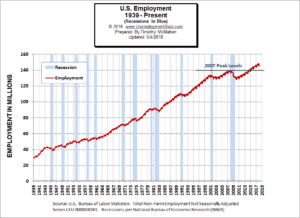
Employment is at an all time record 150.753 million the previous high was set in June 2018. Last month employment was 149.738 million so the actual increase in jobs was over 1 million, although the “Seasonally Adjusted” jobs increase was “only” 250,000. Even that was significantly higher than the projected 208,000.

Previous Record Low Unemployment

Jan Feb Mar Apr May Jun Jul Aug Sep Oct Nov Dec
1965 4.9% 5.1% 4.7% 4.8% 4.6% 4.6% 4.4% 4.4% 4.3% 4.2% 4.1% 4.0%
1966 4.0% 3.8% 3.8% 3.8% 3.9% 3.8% 3.8% 3.8% 3.7% 3.7% 3.6% 3.8%
1967 3.9% 3.8% 3.8% 3.8% 3.8% 3.9% 3.8% 3.8% 3.8% 4.0% 3.9% 3.8%
1968 3.7% 3.8% 3.7% 3.5% 3.5% 3.7% 3.7% 3.5% 3.4% 3.4% 3.4% 3.4%
1969 3.4% 3.4% 3.4% 3.4% 3.4% 3.5% 3.5% 3.5% 3.7% 3.7% 3.5% 3.5%
1970 3.9% 4.2% 4.4% 4.6% 4.8% 4.9% 5.0% 5.1% 5.4% 5.5% 5.9% 6.1%

Key October Employment and Unemployment Numbers

  • Adjusted U-3 Unemployment-   3.7% unchanged from September down from 3.9% in August.
  • Unadjusted U-3 Unemployment-  3.5% down from 3.6% in September and 3.9% in August and 4.1% in July and 4.2% in June.
  • Unadjusted U-6 Unemployment-  7.0% down from 7.1% in September and 7.4% in August and 7.9% in July, 8.1% in June.
  • Employment 150.753 million up from 149.741 million in September. (Yes over a Million more jobs!)
  • October Labor Force Participation Rate 62.9% up from 62.7% in September. (Higher is Better)

See Current Unemployment Chart for more info.

The Differential between U3 and U6 Remains Near September 2006 Lows

Last month the differential between the unadjusted U3 and U6 (reached by subtracting U3 from U6) was at 3.5% and remains there for the 3rd month in a row.
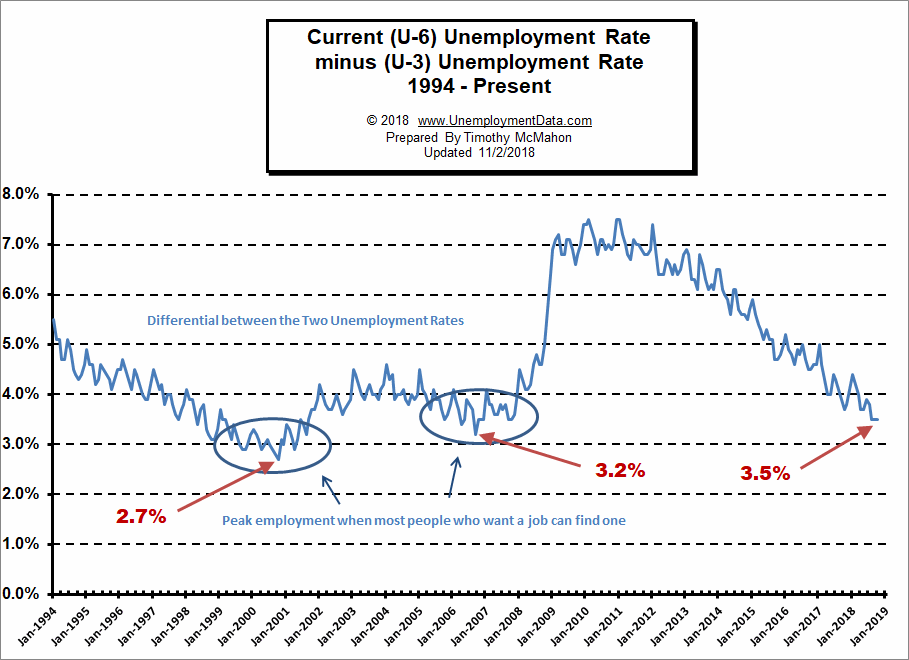
U6 minus U3 Unemployment 11-2-18


See Current U-6 Unemployment Rate for more info.

Employment by Sector

The employment “bubble chart” gives us a good representation of how each sector of the economy is doing (employment wise). As we can see from the chart below  [Read more…] about October Employment Hits New Record High
Filed Under: BLS, Employment Tagged With: 3.7%, BLS, Dec. 1969, lowest level, U-3, U-6, unemployment

Arkansas, California, Idaho, South Carolina, Texas and Washington Set New Unemployment Lows in September

October 20, 2018 by Tim McMahon

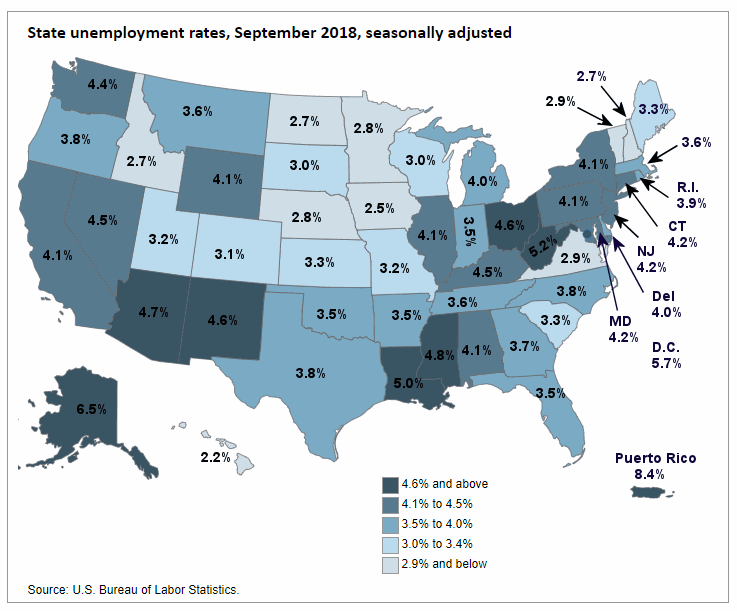
The U.S. Bureau of Labor Statistics reported on Unemployment rates by state on Friday October 19th. Seasonally adjusted unemployment rates for September fell over the previous month in 9 states, were higher in 4 states, and stable in 37 states and the District of Columbia.

Nonfarm payroll employment increased in 1 state, decreased in 9 states, and was stable in 37 states and D.C.

In the following map we can see the states with the lowest unemployment are light colored while the higher unemployment states are darker colored.


Unemployment by State Sept 2018

Unemployment

Arkansas, California, Idaho, South Carolina, Texas and Washington Set New Series Lows

Hawaii had the lowest seasonally adjusted unemployment rate in September, at 2.2%. Arkansas (3.5%), California (4.1%), Idaho (2.7%), South Carolina (3.3%), Texas (3.8%), and Washington (4.4%)  set a new series low since tracking began in 1976. At 6.5% Alaska had the highest jobless rate, not counting Puerto Rico’s 8.4% which is down 2.2% from year ago levels. In total, 13 states had unemployment rates lower than the U.S. figure of 3.7 percent, 12 states plus the District of Columbia and Puerto Rico had higher rates, and 25 states had [Read more…] about Arkansas, California, Idaho, South Carolina, Texas and Washington Set New Unemployment Lows in September

Filed Under: BLS Tagged With: Alaska, Arkansas, California, Florida, Idaho, Oklahoma, South Carolina, State, Texas, unemployment, Washington

Full Employment is Near – Differential between U3 and U6 reaches September 2006 Lows

September 8, 2018 by Tim McMahon

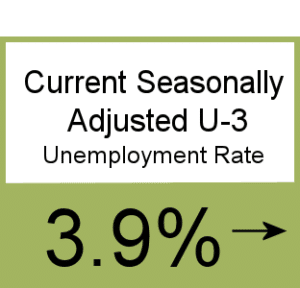
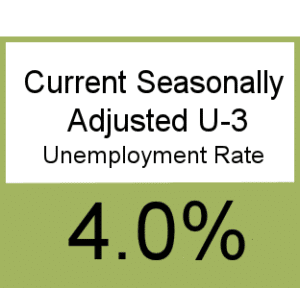
Adj U3 Icon 3-9 unchangedCorrection: The differential was only 3.5% in August 2018 and 3.2% in September 2006 so we are only nearing the 2006 level not at the 2006 level.

The U.S. Bureau of Labor Statistics (BLS) released their monthly employment survey results for the month of August on September 7th .

The current “Seasonally Adjusted” Unemployment Rate for August (released September 7th) is 3.9% unchanged from last month. 

Looking back, Seasonally Adjusted U-3 started 2017 at 4.8% then it bounced around between 4.3% and 4.4% from April through October 2017, then it was 4.1% from October 2017 through March 2018. It was 3.9% in April, 3.8% in May, 4.0% in June, and 3.9% in July.

Typically Unemployment levels are worse in June and July so seasonally adjusting takes that into consideration.


Unadjusted
U-3

Unadjusted
U-3
2017 2018
May 4.1% 3.6%
June 4.5% 4.2%
July 4.6% 4.1%
August 4.5% 3.9%


Key August Employment and Unemployment Numbers

  • Adjusted U-3 Unemployment-   3.9% unchanged from July, down from 4.0% in June but above the 3.8% in May, it was 3.9% in April but still Below the 4.1% October 2017 – March 2018.
  • Unadjusted U-3 Unemployment-  3.9% down from 4.1% in July and 4.2% in June but still above the 3.6% in May, and 3.7% in April below the 4.1% in March.
  • Unadjusted U-6 Unemployment-   7.4% down from 7.9% in July, 8.1% in June, up slightly from record lows of 7.3% in May, and 7.4% in April. Below the 8.1% in March and 8.6% in February.
  • Employment 149.226 million up from 148.901 million in July.
  • August Labor Force Participation Rate 62.7% down from July LFPR 62.9%  

See Current Unemployment Chart for more info.

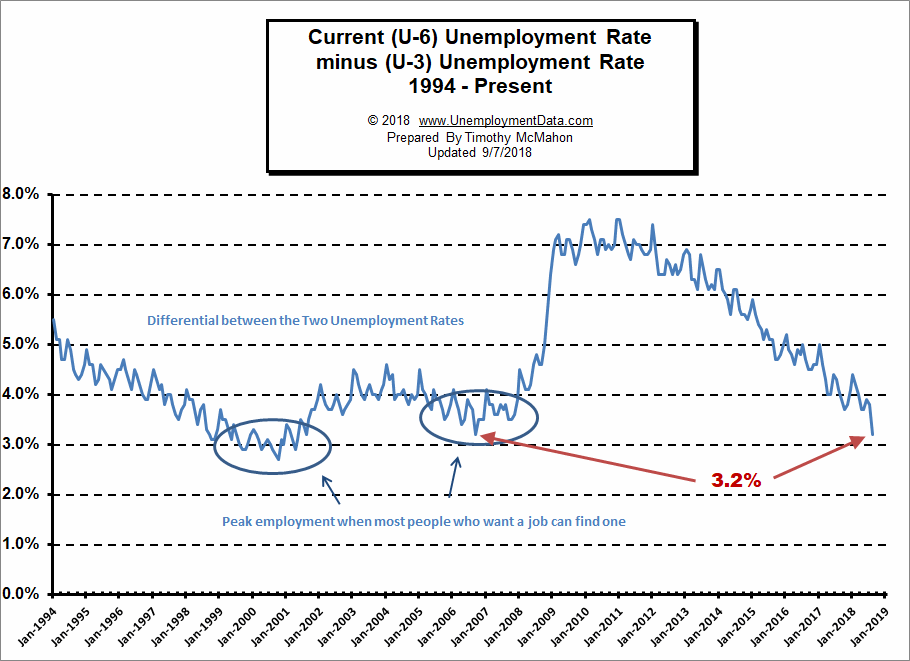
Full Employment is Near – Differential between U3 and U6 reaches September 2006 Lows

In August we saw a massive drop in the differential between U-3 and U-6 so perhaps we are getting closer to “full employment”  the lows on this chart are at 2.7% in October 2000 and 3.2% in September 2006. Since the current differential is once again 3.2% we have reached the lows of 2006. Back in January 2017 the media was saying that we were at “Full Employment” and we couldn’t expect anything better, manufacturing jobs would never come back etc. At that time I said we had a long way to go and that the differential between the U-6 and U-3 was nowhere near bottoming (the sign of full employment) at the time the differential was around 5%. See: Is the U.S. Really at “Full Employment”? But with the differential currently at 3.2% now we are at or very near that level. Since October 2000 reached a low of 2.7% we could still  go a bit lower.U6 minus U3 Unemployment

See Current U-6 Unemployment Rate for more info.

Employment by Sector

The employment “bubble chart” gives us a good representation of how each sector of the economy is doing (employment wise). As we can see from the chart below [Read more…] about Full Employment is Near – Differential between U3 and U6 reaches September 2006 Lows

Filed Under: BLS, Sector Tagged With: employment, Employment by Sector, full employment, Labor Force Participation Rate, LFPR, Sector, U-6 Unemployment, unemployment

Unemployment Rates by State July 2018

August 17, 2018 by Tim McMahon

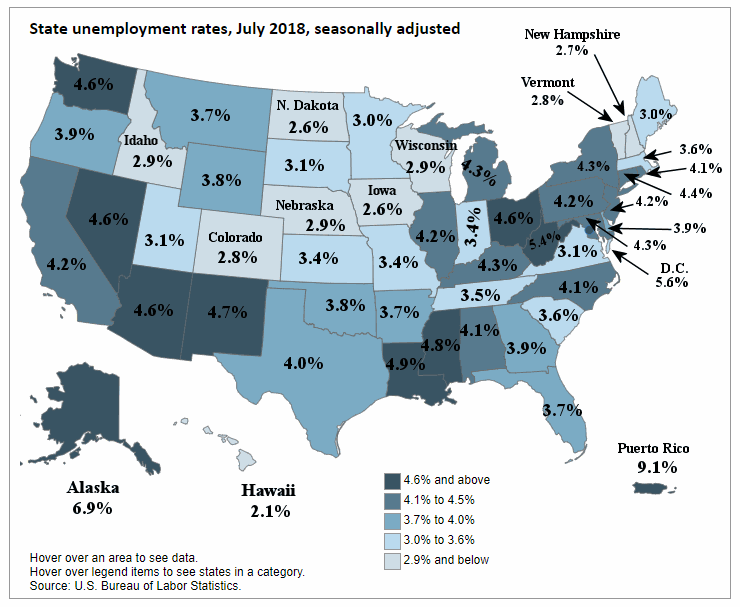
According to today’s U.S. Bureau of Labor Statistics report on Unemployment rates by state, Seasonally adjusted unemployment rates for July fell over the previous month in 11 states, were higher in 2 states, and stable in 37 states and the District of Columbia. Ten states saw jobless rate decreases from July 2017 levels and 40 states and D.C.  had little or no change.

Nonfarm payroll employment increased in 6 states in July 2018, decreased in 1 state, and was virtually unchanged in 43 states and D.C. Over the year, 34 states added nonfarm payroll jobs and 16 states and D.C. were essentially unchanged.

In the following map we can see the states with the lowest unemployment are light colored while the higher unemployment states are darker colored.

Unemployment by State July 2018

Unemployment

“Oregon lowest unemployment since 1976”

Hawaii had the lowest seasonally adjusted unemployment rate in July, at 2.1%. At 3.9% Oregon  set a new series low since tracking began in 1976. At 6.9% Alaska had the highest jobless rate, not counting Puerto Rico’s 9.1%. In total, 15 states had unemployment rates lower than the U.S. figure of 3.9 percent, 10 states plus the District of Columbia and Puerto Rico had higher rates, and 25 states had [Read more…] about Unemployment Rates by State July 2018

Filed Under: BLS Tagged With: BLS, State, unemployment

Key July Employment and Unemployment Numbers

August 4, 2018 by Tim McMahon

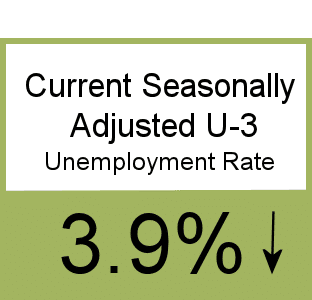
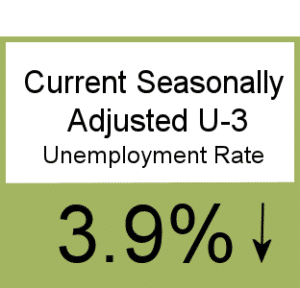
U-3 Unemployment 3.9%The U.S. Bureau of Labor Statistics (BLS) released their monthly employment survey results for the month of July on Friday August 3rd .
The current “Seasonally Adjusted” Unemployment Rate for July (released August 3rd) is 3.9% down from 4.0% last month. It was 3.8% in May and 3.9% in April. Unemployment was  4.1% from October 2017 through March 2018. Seasonally adjusted unemployment bounced around between 4.3% and 4.4% from April through October 2017, after declining from 4.8% in January 2017.

Typically Unemployment levels are worse in June and July so seasonally adjusting takes that into consideration. If we look at Unadjusted Unemployment we see that in 2017 it jumped from 4.1% in May to 4.5% in June at the same time the Seasonally Adjusted numbers simply went from 4.3% to 4.4%.

Key July Employment and Unemployment Numbers

  • Adjusted U-3 Unemployment-   3.9% down from 4.0% in June but up from the 3.8% in May, 3.9% in April but still Below the 4.1% October – March.
  • Unadjusted U-3 Unemployment-  4.1% down from 4.2% in June up from 3.6% in May, 3.7% in April and  4.1% in March.
  • Unadjusted U-6 Unemployment-   7.9% down from 8.1% in June, up from 7.3% in May, 7.4% in April and from 8.1% in March and 8.6% in February.
  • Employment 148.901 million. BLS adjusted June employment up from 148.912 million as released to 150.057 million.
  • NOTE: On 8/3/2018 with the release of the new July numbers the BLS adjusted the June LFPR down to 62.9% from a recent high of 63.4%

See Current Unemployment Chart for more info.

Employment by Sector

The employment “bubble chart” gives us a good representation of how each sector of the economy is doing (employment wise). As we can see from the chart below [Read more…] about Key July Employment and Unemployment Numbers

Filed Under: Unemployment Tagged With: employment, Employment / Population Ratio, Employment by Sector, Labor Force, LFPR, Participation Rate, unemployment

EU Unemployment Nearing Pre-Recession Levels

August 1, 2018 by Tim McMahon

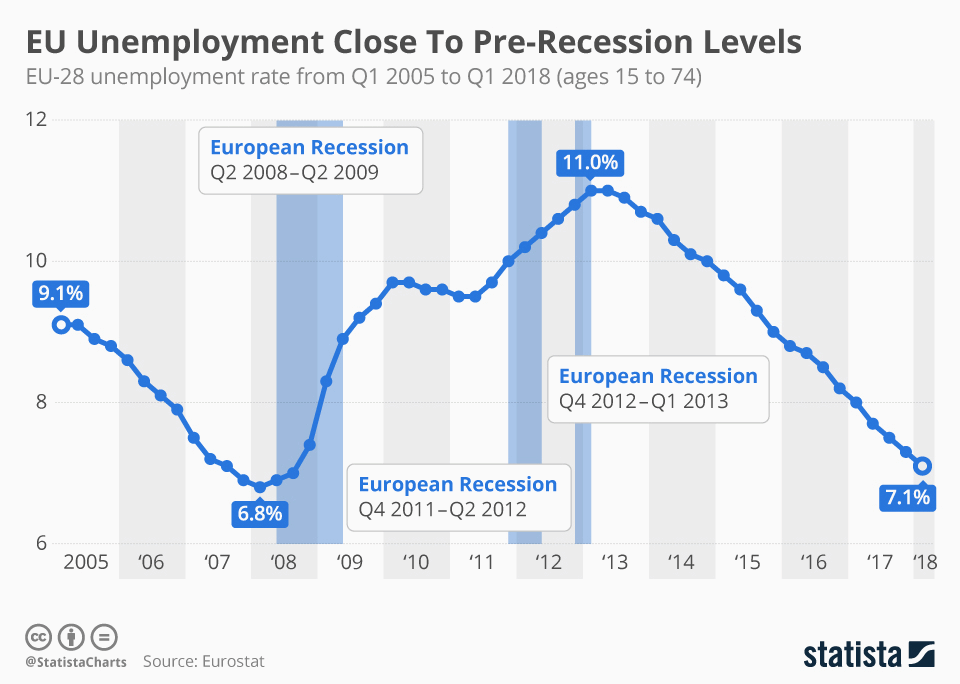
Way back in the first quarter of 2008 European Union (E.U.) unemployment bottomed at 6.8%. Then as the world slid into recession unemployment began climbing, ultimately peaking at 11.0% in the first half of 2013. From there it has gradually declined to 7.1% as we can see in this chart created by Statista.

EU Unemployment 2005-2018

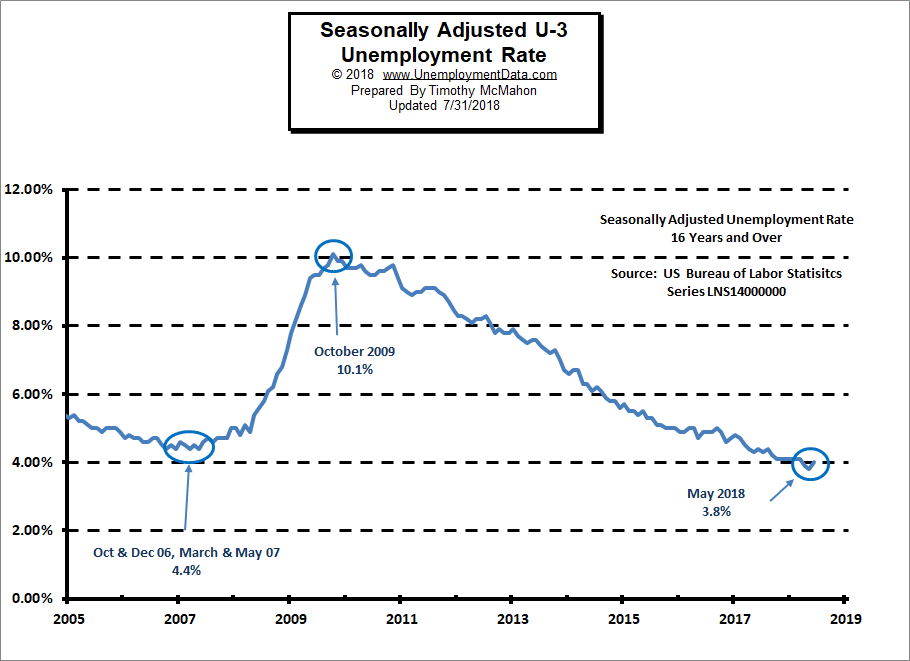
During the same period U.S. unemployment levels were considerably lower with a bottom of 4.4% (roughly 2/3rds the EU level) in October & December 2006 and again in March and May of 2007. And then we see that U.S. unemployment peaked earlier i.e. in October 2009 (compared to 2012-13 for the EU) and at a lower level 10.1% for the U.S. compared to 11.0% for the E.U. Interestingly the U.S. unemployment rate actually shot up faster in that it reached 10.1% in 2009 while the E.U. was still around 9% at that time. But then the U.S. rate turned down while the E.U. unemployment rate continued upward for another 3 years!

Currently the U.S. rate isbelow 2006-07 levels while the E.U. rate has not yet reached 2007 levels. And current U.S. levels are roughly 56% of E.U. levels.

US Unemployment 2005-2018

Why are E.U Unemployment Levels So Much Higher?

This makes us ask a few questions:

  • Why are U.S. unemployment levels consistently lower than E.U. levels?
  • Why did U.S. unemployment levels rise faster than E.U. levels?
  • Why did E.U. unemployment  levels take longer to fall? [Read more…] about EU Unemployment Nearing Pre-Recession Levels

Filed Under: Europe Tagged With: E.U., Europe, unemployment

June Employment Up AND Unemployment UP

July 7, 2018 by Tim McMahon

The U.S. Bureau of Labor Statistics (BLS) released their monthly employment survey results for the month of June on Friday July 6th .
According to the BLS, the current “Seasonally Adjusted” Unemployment Rate for June (released July 6th) is 4.0% up from 3.8% in May and 3.9% in April. It was  4.1% where it was stuck from October 2017 through March 2018. Prior to October it was bouncing around between 4.3% and 4.4% since April 2017, after declining from 4.8% in January 2017.

Typically Unemployment levels are worse in June and July, so even though 213,000 more people are employed, unemployment levels still went up. (Probably because students are swelling the labor force for the summer). Last year (2017) Unadjusted Unemployment jumped from 4.1% in May to 4.5% in June while Employment went from 146.937 million to 147.578 million. So even though more people are working more people are also looking for a job. This has driven the Labor Force Participation Rate at 63.4% to levels not seen in several years. NOTE: On 8/3/2018 with the release of the new July numbers the BLS adjusted the June LFPR down to 62.9%.

Key June Employment and Unemployment Numbers

  • Adjusted U-3 Unemployment-   4.0% Up from 3.8% in May, 3.9% in April but still Below the 4.1% October – March.
  • Unadjusted U-3 Unemployment-  4.2% up from 3.6% in May, 3.7% in April and  4.1% in March.
  • Unadjusted U-6 Unemployment-   8.1% up from 7.3% in May, 7.4% in April and from 8.1% in March and 8.6% in February.
  • Employment 149.980 million up from 149.334 million in May, 148.372 million in April and 147.384 million in March.
  • Gallup has discontinued publishing U-6 & U-3 numbers.

See Current Unemployment Chart for more info.

Employment by Sector

The employment “bubble chart” gives us a good representation of how each sector of the economy is doing (employment wise). As we can see from the chart below [Read more…] about June Employment Up AND Unemployment UP

Filed Under: BLS Tagged With: Bubble Chart, employment, Employment by Sector, June 2018, Labor Force Participation Rate, LFPR, unemployment

May Unemployment Lowest Since 2000

June 2, 2018 by Tim McMahon

Unemployment 3.8%

The U.S. Bureau of Labor Statistics (BLS) released their monthly employment survey results for the month of May on Friday June 1st .

According to the BLS the Seasonally Adjusted U-3 Unemployment Rate is at a new low. Unemployment has been falling and has now reached levels not seen since April of 2000. Current levels are even lower than during the boom of 2006. If they drop another 1/10th of a percent we will have to go all the way back to 1969 to find levels that low.

Many Experts consider this to be the new “Full Employment” level i.e. everyone who wants a job has found one however with the Labor Force Participation rate still well below the average that is debatable.  See Is the U.S. Really at “Full Employment”? for more information.

Key May Employment and Unemployment Numbers

  • Adjusted U-3 Unemployment-   May 3.8% Down from 3.9% in April and 4.1% October – March.
  • Unadjusted U-3 Unemployment-  May 3.6% down from 3.7% in April and  4.1% in March.
  • Unadjusted U-6 Unemployment-   May 7.3% Down from 7.4% in April and from 8.1% in March and 8.6% in February.
  • Employment 149.309 million up from 148.367 million in April and 147.369 million in March.
  • Gallup has discontinued publishing U-6 & U-3 numbers.

See Current Unemployment Chart for more info.

Employment by Sector

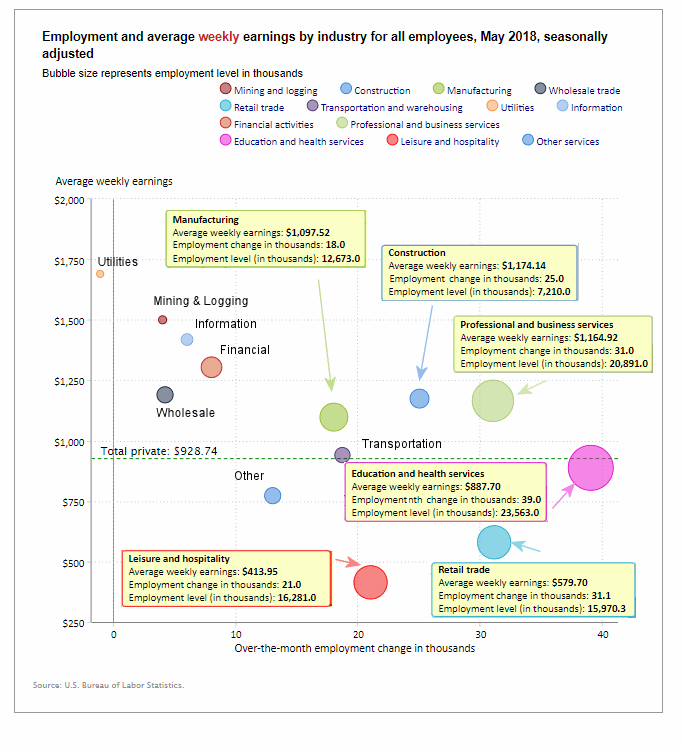
The employment “bubble chart” gives us a good representation of how each sector of the economy is doing (employment wise). As we can see from the chart below only one sector is to the left of the zero line this month indicating that all other sectors gained employees  except Utilities which lost -1,100 employees. The big gainers were Education and Health, Professional and business Services, Construction, Leisure and Manufacturing.

Employment by Sector Bubble Chart The biggest gainer was Education and Health Services (bubble furthest to the right) which added 39,000+ jobs, followed by Retail and Professional Services which each gained roughly 31,000 jobs, Leisure gained 21,000 jobs and manufacturing gained another 18,000 on top of consistently high gains for the last few months. Average weekly earnings for all industries increased to $928.74.

(See the table below the chart for average weekly earnings and other details.)

How to read this chart:

Bubbles location on the chart tell us two things:

  • Change in Employment Levels over the most recent month.
  • Average Weekly earnings.
  • The further to the right the bubble the larger the increase in the number of jobs.
  • The higher up on the chart the larger the average salary.

Bubble Size tells us:

  • Total Employment for the sector.
  • Larger bubbles mean more people are employed in that sector.

Employment and Average Weekly Earnings by Industry for All Employees

May  2018, Seasonally Adjusted

Industry Monthly Increase Average Weekly Earnings Employment Level
Total Private Employment 218,000 $928.74 126,336,000
Mining and Logging 4,000 $1,500.09 733,000
Construction 25,000 $1,174.14 7,210,000
Manufacturing 18,000 $1,097.52 12,673,000
Wholesale trade 4,200 $1,189.81 5,954,800
Retail trade 31,100 $579.70 15,970,300
Transportation and Warehousing 18,700 $940.41 5,309,300
Utilities -1,100 $1,689.89 554,400
Information 6,000 $1,418.40 2,775,000
Financial Activities 8,000 $1,303.88 8,559,000
Professional and Business Services 31,000 $1,164.92 20,891,000
Education and Health Services 39,000 $887.70 23,563,000
Leisure and Hospitality 21,000 $413.95 16,281,000
Other Services 13,000 $772.53 5,862,000

[Read more…] about May Unemployment Lowest Since 2000

Filed Under: BLS Tagged With: Bubble Chart, Employment / Population Ratio, Employment by Sector, Jobs Data, Labor Force Participation Rate, LFPR, May Unemployment, U-6, U6, unemployment

April Unemployment Lowest Level Since 2000

May 5, 2018 by Tim McMahon

U-3 Unemployment 3.9%

The U.S. Bureau of Labor Statistics (BLS) released their monthly employment survey results for the month of April on Friday May 4th .

At 3.9% the Seasonally Adjusted U-3 Unemployment Rate is at its lowest level since December 2000. The Unadjusted U-3 is at 3.7%.

Many Experts consider this to be the new “Full Employment” level i.e. everyone who wants a job has found one however with the Labor Force Participation rate still well below the average that is debatable.  See Is the U.S. Really at “Full Employment”? for more information.

Key April Employment and Unemployment Numbers

  • Adjusted U-3 Unemployment-   3.9% Down from 4.1% October – March.
  • Unadjusted U-3 Unemployment-  3.7% down from 4.1% in March.
  • Unadjusted U-6 Unemployment-   7.4% Down massively from 8.1% in March and 8.6% in February.
  • Employment 148.367 million up from 147.369 million in March but still below the 148.783 million in November.
  • Gallup has discontinued publishing U-6 & U-3 numbers.

See Current Unemployment Chart for more info.

Employment by Sector

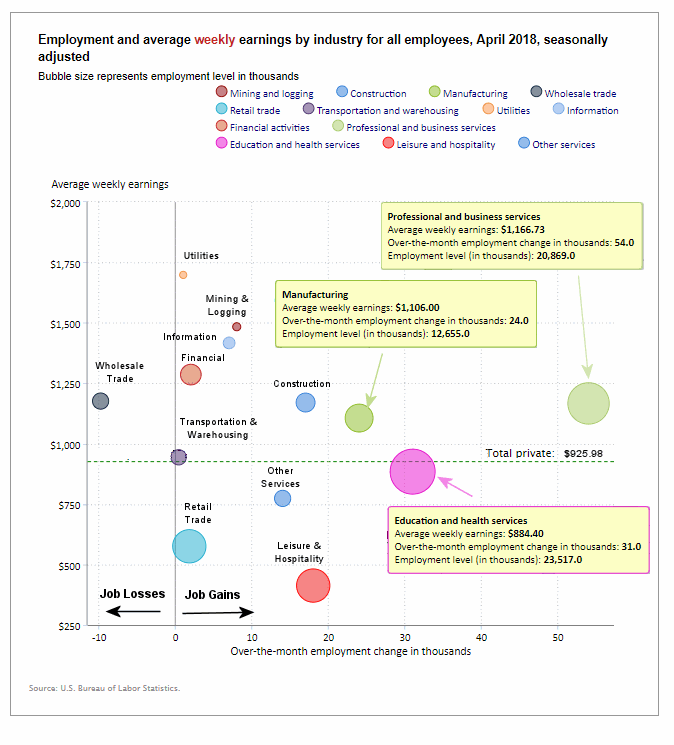
The employment “bubble chart” gives us a good representation of how each sector of the economy is doing (employment wise). As we can see from the chart below only one sector is to the left of the zero line this month indicating that all other sectors gained employees in April except Wholesale Trade which lost -9,800 employees on a “Seasonally Adjusted” basis.

Employment by Sector Bubble Chart April 2018The biggest gainers were Professional and Business Services (bubble furthest to the right) which added 54,000 jobs, followed by Education and Health Services which gained 31,000 jobs and Manufacturing which gained 24,000 jobs. Interestingly all three were the top gainers last month as well with similar gains. Average weekly earnings for all industries increased from $925.29 to $925.98.

(See the table below the chart for average weekly earnings and other details.)


How to read this chart:

Bubbles location on the chart tell us two things:

  • Change in Employment Levels over the most recent month.
  • Average Weekly earnings.
  • The further to the right the bubble the larger the increase in the number of jobs.
  • The higher up on the chart the larger the average salary.

Bubble Size tells us:

  • Total Employment for the sector.
  • Larger bubbles mean more people are employed in that sector.

Employment and Average Weekly Earnings by Industry for All Employees

April 2018, Seasonally Adjusted

Industry Monthly Increase Average Weekly Earnings Employment Level
Total Private Employment 168,000 $925.98 126,106,000
Mining and Logging 8,000 $1,483.82 730,000
Construction 17,000 $1,170.39 7,174,000
Manufacturing 24,000 $1,106.00 12,655,000
Wholesale trade -9,800 $1,176.34 5,952,700
Retail trade 1,800 $575.67 15,927,000
Transportation and Warehousing 400 $943.71 5,285,400
Utilities 1,000 $1,698.31 555,300
Information 7,000 $1,416.93 2,772,000
Financial Activities 2,000 $1,285.92 8,549,000
Professional and Business Services 54,000 $1,166.73 20,869,000
Education and Health Services 31,000 $884.40 23,517,000
Leisure and Hospitality 18,000 $413.16 16,272,000
Other Services 14,000 $773.69 5,848,000

U-6 Unemployment

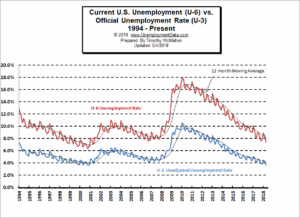
U3 vs U6 UnemploymentLooking at the broader measure of Unemployment which includes discouraged workers, we see that the U-6 unemployment rate fell steadily from 8.9% in January to 7.4% in April.

See Unadjusted U-6 unemployment for more info.

Employment

Historical Employment

Over the last month, the actual number of people working (not seasonally adjusted) has increased by 998,000  jobs in April. The BLS Commissioner said:

“Nonfarm payroll employment increased by 164,000 in April, and the unemployment rate edged down to 3.9 percent. Over the month, job gains occurred in professional and business services, manufacturing, health care, and mining.“

Actual employment was 147.369 million in March and 148.367 million in April for an actual increase of 998,000 not the 164,000 spoken of by the Commissioner. The 164,000 is “Seasonally Adjusted” meaning that employment increased by that much more than average for this time of year.


See Employment Commentary.

Employment / Population Ratio

If you take the number of jobs and divide it by the population you get what percentage of the population is working. You

[Read more…] about April Unemployment Lowest Level Since 2000

Filed Under: BLS Tagged With: April, employment, Sector, unemployment

California at 4.3% has Lowest Unemployment Since 1976

March 27, 2018 by Tim McMahon

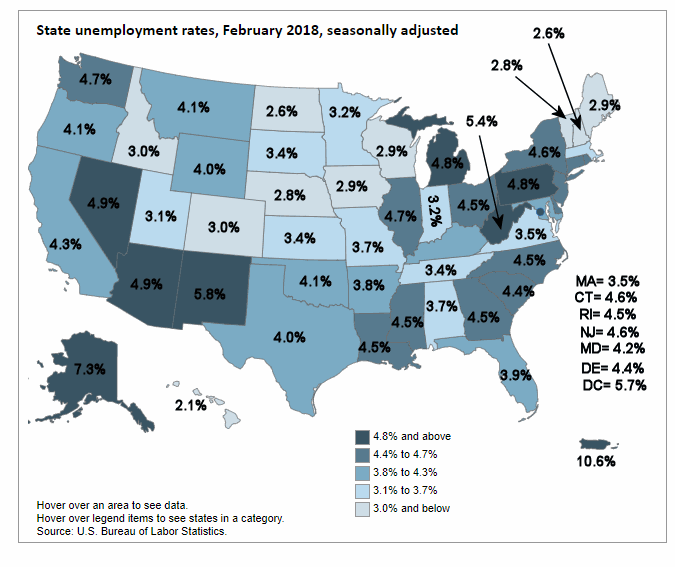
According to the U.S. Bureau of Labor Statistics’ most recent unemployment data broken down by state (released in March for the month of February), Hawaii had the lowest unemployment at 2.1% followed by  North Dakota and New Hampshire at 2.6%. Vermont and Nebraska were also at 2.8%.

The rates in California (4.3%), Maine (2.9%), Mississippi (4.5%), and Wisconsin (2.9%) set new series lows. (All state series begin in 1976.)

Although not technically a state, Puerto Rico had the highest jobless rate at 10.6% followed by Alaska at 7.3% while New Mexico had 5.8%,  the District of Columbia had 5.7% and West Virginia had 5.4%.


February Unemployment by state


The following table lists the  [Read more…] about California at 4.3% has Lowest Unemployment Since 1976

Filed Under: Unemployment Tagged With: state unemployment rates, unemployment

  • « Go to Previous Page
  • Page 1
  • Interim pages omitted …
  • Page 7
  • Page 8
  • Page 9
  • Page 10
  • Page 11
  • Interim pages omitted …
  • Page 15
  • Go to Next Page »

Primary Sidebar

Rate Any Stock In Seconds

Get a detailed stock report showing its true value, safety score, and ideal timing to buy. Plus, receive a color coded Buy, Sell, or Hold recommendation.

Get Your Free Stock Analysis Here.

Recent Posts

  • February Employment Report for January 2026
  • Unemployment Report for December 2025
  • Unemployment Report for Nov. 2025
  • Delayed September 2025 Unemployment Report Released
  • No BLS Employment Data for October 2025 But ADP Says 42K New Jobs

Search Site

Resources

  • Bureau of Labor Statistics Current Population Survey Monthly survey of households conducted by the Bureau of Census for BLS. It provides data on the labor force, employment, unemployment, etc.
  • Capital Professional Services Providing web design and development and Internet marketing services
  • Elliott Wave University Using the Elliott Wave Principle to improve investment performance
  • Financial Trend Forecaster Featuring Moore Inflation Predictor, NYSE Rate of Change and NASDAQ Rate of change
  • InflationData.com Inflation calculators, databases, etc.
  • Intergalactic Web Designers Web design and development services

Articles by Category

Articles by Date

Disclaimer

At UnemploymentData.com we are not registered investment advisors and do not provide any individualized advice. Past performance is not necessarily indicative of future performance and future accuracy and profitable results cannot be guaranteed.

Privacy & Terms of Use

Privacy Statement & Terms of Use

Do Not Sell My Information

Copyright © 2026 · News Pro on Capital Professional Services, LLC. All rights reserved · Log in