
The U.S. Bureau of Labor Statistics (BLS) released its employment / unemployment report for July on August 1st, 2025.
Employment / Unemployment
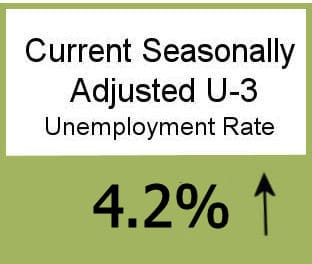
- Seasonally Adjusted U3- 4.2% Up from 4.1%
- Unadjusted U3- 4.6% Up from 4.4% in June
- Unadjusted U6- 8.3% Up from 8.1% in June
- Labor Force Participation Rate- 62.2% Down from 62.3%
- Employment- 159.227 million Down from 160.293 million
- Next data release September 5, 2025
Summary:
Total Employed decreased in July, Unadjusted Unemployment was up, as was Seasonally Adjusted Unemployment. There are a few early warning signs of a slowing Labor Market.
According to the Commissioner of the U.S. Bureau of Labor Statistics:
“Total nonfarm payroll employment changed little in July (+73,000) and has shown little change since April, the U.S. Bureau of Labor Statistics (BLS) reported today. The unemployment rate, at 4.2 percent, also changed little in July. Employment continued to trend up in health care and in social assistance. Federal government continued to lose jobs…
Federal government employment continued to decline in July (-12,000) and is down by 84,000 since reaching a peak in January. (Employees on paid leave or receiving ongoing severance pay are counted as employed in the establishment survey.)”
As usual, they are talking about “Seasonally Adjusted Jobs”.
Looking at the Unadjusted Establishment Survey report, we see…
Originally, the BLS reported employment of 160.475 million for June,
which they adjusted down to 160.293 million as of this month.
They are currently reporting 159.227 million jobs for July, which is actually a monthly decrease of 1,248,000 jobs based on their original numbers or 1,066,000 based on their new numbers.
Early Warning Signs of a Weakening Economy
Although the U3 Seasonally Adjusted Unemployment rate is only up 1/10th of a percent, and the BLS Commissioner tried to put an optimistic spin on it, the number of job openings in the U.S. fell by 275,000 to around 7.4 million last month. So, hiring is slacking off.
Unadjusted Establishment Survey jobs are down by 1,248,000 jobs based on their original June numbers.
The LFPR is down from 62.3% to 62.2%, back to November 2022 levels.
Also, the “Starbucks Indicator” created by Stansberry’s Credit Opportunities editor Mike DiBiase, which says that when Starbucks sales decline for several quarters in a row, the economy is weakening. And that’s exactly what we’re seeing today. Earlier this week, Starbucks reported same-store sales fell 2%. That marked the sixth straight quarter of falling same-store sales.
And, as the Commissioner said, since Government employees scheduled for downsizing are still being paid, they aren’t being counted as unemployed yet, but when their severance pay runs out, that will spike the unemployment rate.
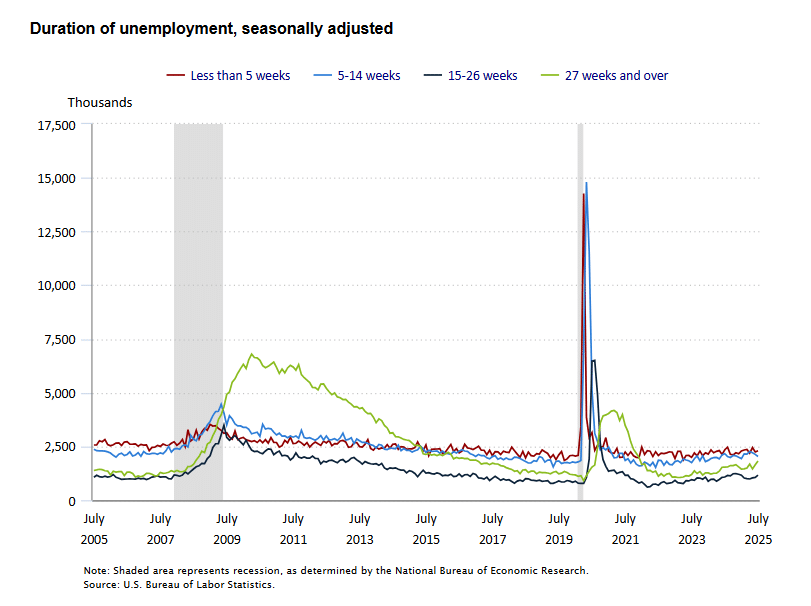
We may be seeing the beginning of an upturn in unemployment in the longer durations, i.e., it is starting to take longer to find a job, 24.9% of those unemployed have been unemployed for 27 weeks or longer.
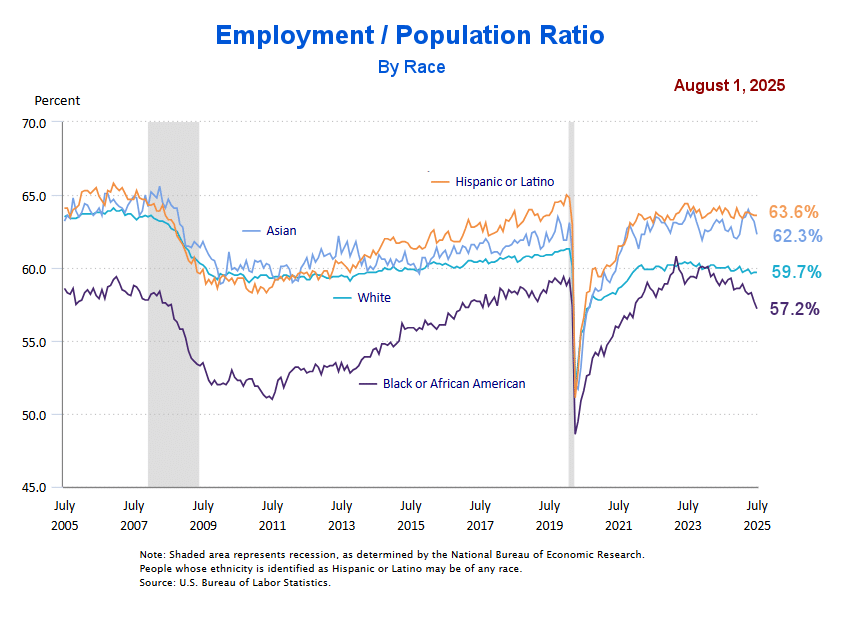
And finally, looking at the Employment / Population by Race, we see a declining trend in the Employment of Blacks (i.e., the most vulnerable segment of the population). In the chart below, we can see that it has steadily declined for almost two years now. But it sharply declined this month. On the plus side,
ADP’s Chief Economist says, “Employers have grown more optimistic”.
Weakening jobs numbers could force Powell to lower interest rates.
The exodus of illegals should open up more jobs for Americans. According to the WSJ, since mid‑2024, over 1.6 million foreign-born workers have left the U.S. labor force. During the same period, U.S.-born workers added roughly 2.5 million jobs, suggesting a shift toward domestic labor filling openings formerly held by immigrants. One Example:
Also, Trump is negotiating Billions in increased manufacturing investment in the U.S., so in the longer run, jobs should increase, but in the meantime, we may be in for a bit of a rough patch.
Despite these early signs of weakening, FED Chairman Powell didn’t reduce rates at Wednesday’s meeting, citing concerns of rising inflation. But, the market has noted the signs of weakness, and the Futures market has increased the odds of a rate cut in September, from 38% on Wednesday to 85% after Friday’s jobs report.
Current Unemployment Rate Chart
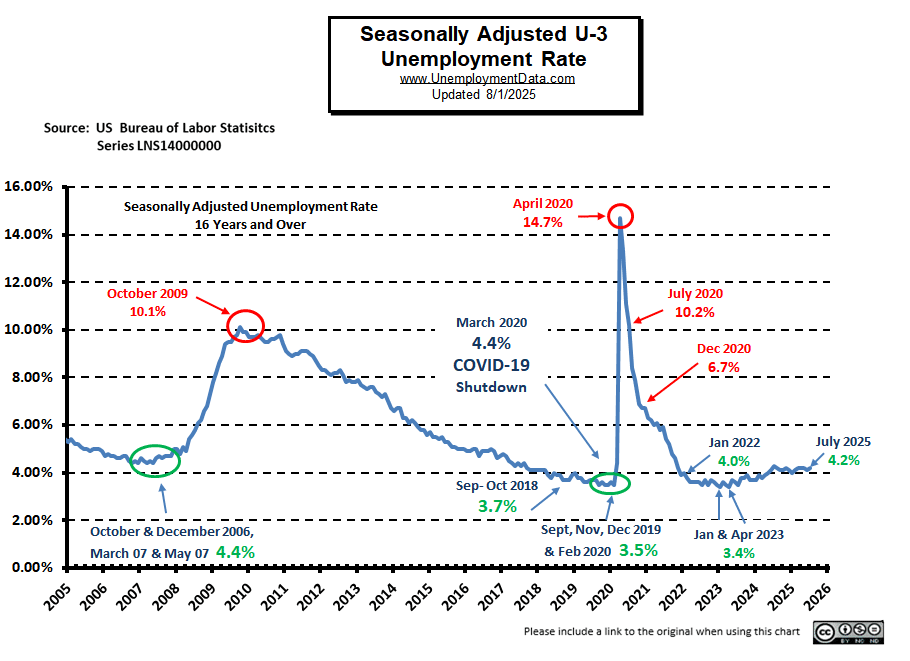
Seasonally Adjusted Unemployment is up from 4.1% to 4.2%. As we can see, unemployment is 0.8% above the January and April lows of 2023 but relatively unchanged over the last year.
Current Employment Rate
In February 2025 the BLS issued massive adjustments that created a sea of red in the Employment levels, erasing millions of supposed jobs in 2023 and 2024, while January’s numbers actually increased slightly.
| Date | Latest BLS Numbers (in Millions) |
Original BLS Numbers (in Millions) |
Change from Original |
| Jul-2025 | 159.227 | 159.227 | NA |
| Jun-2025 | 160.293 | 160.475 | -182,000 |
| May-2025 | 159.930 | 159.964 | -34,000 |
| Apr-2025 | 159.227 | 159.316 | -89,000 |
| Mar-2025 | 158.402 | 158.506 | -104,000 |
| Feb-2025 | 157.944 | 157.983 | -39,000 |
| Jan-2025 | 157.095 | 157.091 | 4,000 |
| Dec-2024 | 159.943 | 160.458 | -515,000 |
| Nov-2024 | 159.882 | 160.560 | -678,000 |
| Oct-2024 | 159.352 | 160.007 | -655,000 |
| Sep-2024 | 158.527 | 159.177 | -650,000 |
| Aug-2024 | 158.070 | 158.650 | -580,000 |
| Jul-2024 | 157.771 | 158.445 | -674,000 |
| Jun-2024 | 158.722 | 159.392 | -670,000 |
| May-2024 | 158.256 | 158.918 | -662,000 |
| Apr-2024 | 157.438 | 158.016 | -578,000 |
| Mar-2024 | 156.612 | 157.218 | -606,000 |
| Feb-2024 | 156.007 | 156.555 | -548,000 |
| Jan-2024 | 154.942 | 155.626 | -684,000 |
| Dec-2023 | 157.828 | 158.228 | -400,000 |
| Nov-2023 | 157.950 | 158.461 | -511,000 |
| Oct-2023 | 157.531 | 157.984 | -453,000 |
| Sep-2023 | 156.563 | 157.001 | -438,000 |
| Aug-2023 | 156.107 | 156.302 | -195,000 |
| July 2023 | 155.779 | 156.126 | -347,000 |
| June 2023 | 156.701 | 156.963 | -262,000 |
| May-2023 | 156.038 | 156.306 | -268,000 |
| Apr-2023 | 155.155 | 155.337 | -182,000 |
| Mar-2023 | 154.253 | 154.517 | -264,000 |
| Feb-2023 | 153.818 | 153.955 | -137,000 |
| Jan-2023 | 152.689 | 152.844 | -155,000 |
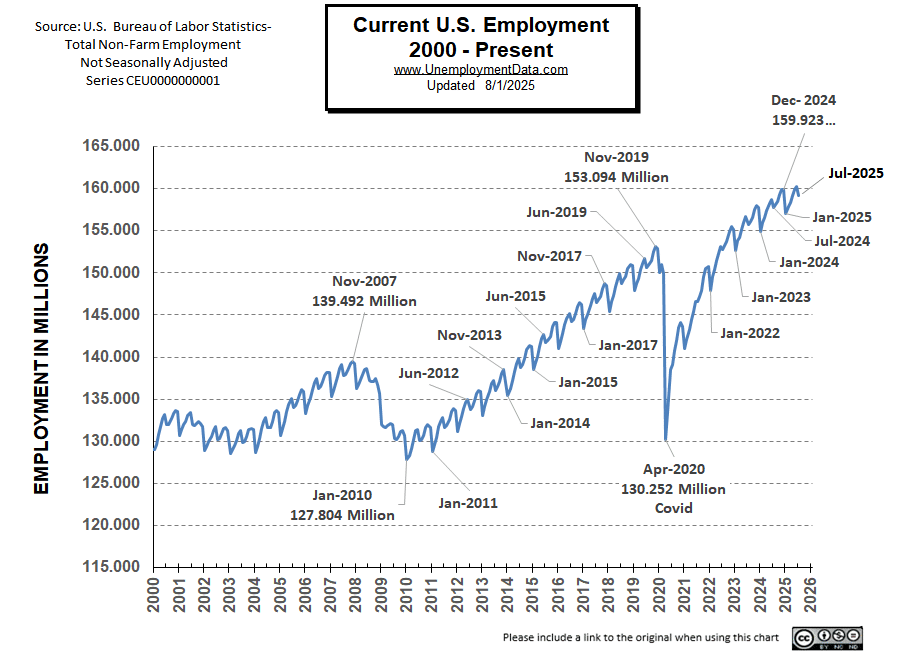
See Current Employment for more information.
BLS: July 2025 Employment by Sector
The BLS employment “bubble chart” based on the Establishment Survey Data gives us a good picture of the Seasonally Adjusted employment numbers.
The Bubble’s Size tells us the total Employment for that industry (i.e., larger bubbles mean more people are employed in that sector).
The bubble’s location on the chart tells us that there has been a change in Employment Levels over the most recent month… A bubble further to the right indicates larger job growth. A bubble’s vertical location on the chart shows the average industry salary.
Remember, these are Seasonally Adjusted Numbers, so they aren’t cumulative!
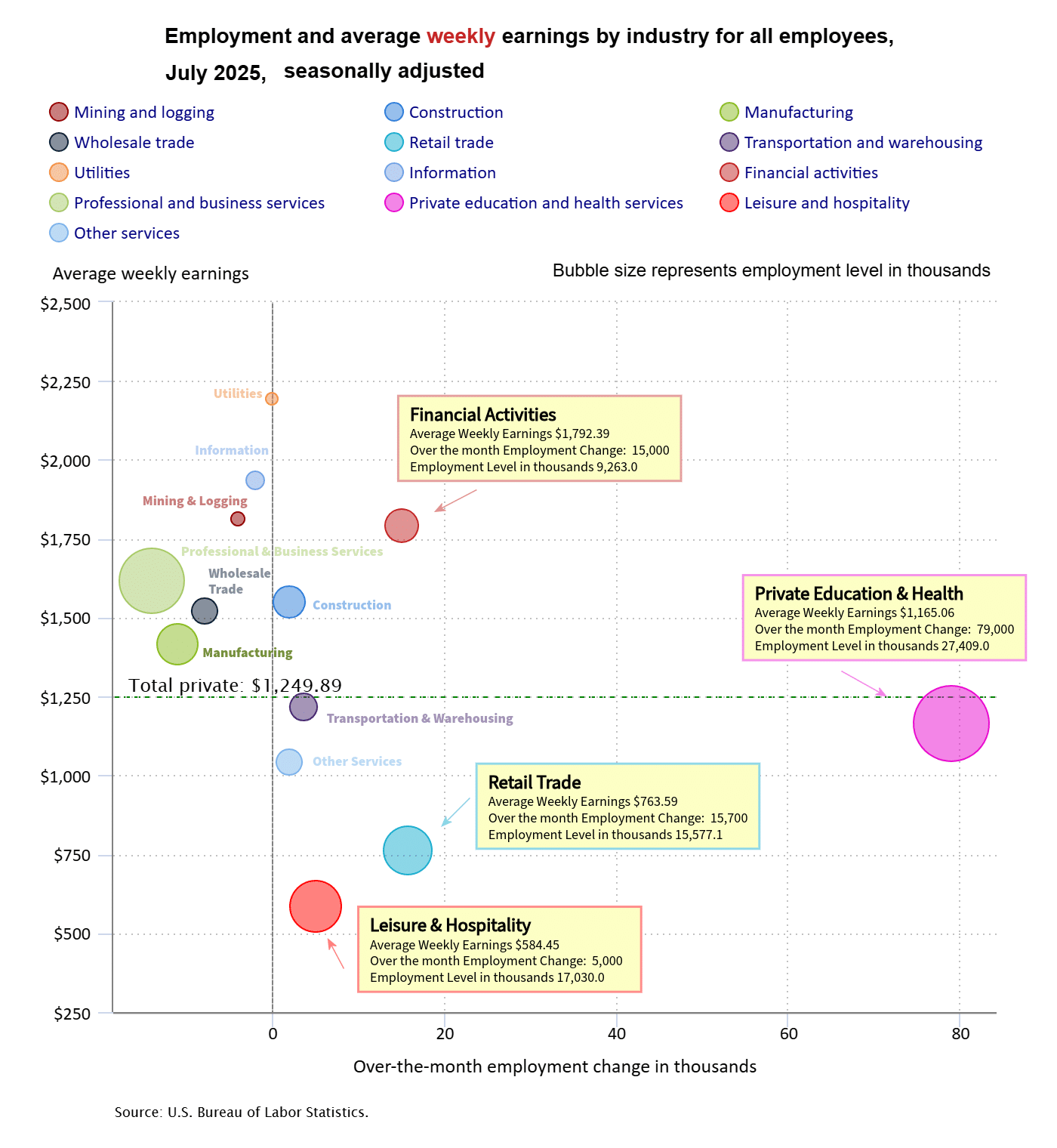 Looking at the above chart, we can see that five sectors were below zero (i.e., left of the zero line -lost workers), the same as last month.
BLS Average Weekly Wages
| Date | Average Weekly Wage |
| July 2025 | $1,249.89 |
| June 2025 | $1,241.46 |
| May 2025 | $1,243.03 |
| April 2025 | $1,236.86 |
| March 2025 | $1,231.20 |
| February 2025 | $1,225.21 |
| January 2025 | $1,223.17 |
| December 2024 | $1,224.17 |
| December 2023 | $1,175.46 |
| December 2022 | $1,125.73 |
| December 2021 | $1,086.46 |
BLS Employment and Average Weekly Earnings by Industry
July 2025, Seasonally Adjusted Employment
Note that due to “seasonal adjusting,” although they may claim that there was a “monthly increase” (or decrease), there isn’t always an actual increase; you can’t just subtract last month’s “employment level” from this month’s level. For instance, Construction was supposed to be Up by 2,000 in July. But June was 8,324,000 and July was 8,310,000 which looks like a -14,000, not +2,000.
| Industry |
Monthly |
Ave. Weekly Earnings |
July Employment Level |
June Employment Level |
| Total Private Employment | 83,000 | $1,249.89 | 135,970,000 | 136,026,000 |
| Mining and Logging | -4,000 | $1,811.26 | 617,000 | 621,000 |
| Construction | 2,000 | $1,551.88 | 8,310,000 | 8,324,000 |
| Manufacturing | -11,000 | $1,415.53 | 12,727,000 | 12,750,000 |
| Wholesale trade | -7,800 | $1,523.31 | 6,163,700 | 6,175,100 |
| Retail trade | 15,700 | $763.59 | 15,577,100 | 15,585,800 |
| Transportation and Warehousing | 3,600 | $1,216.67 | 6,738,200 | 6,746,500 |
| Utilities | -100 | $2,194.10 | 598,400 | 599,000 |
| Information | -2,000 | $1,936.05 | 2,939,000 | 2,947,000 |
| Financial Activities | 15,000 | $1,792.39 | 9,263,000 | 9,256,000 |
| Professional and Business Services | -14,000 | $1,615.70 | 22,562,000 | 22,603,000 |
| Private Education and Health | 79,000 | $1,165.06 | 27,409,000 | 27,342,000 |
| Leisure and Hospitality | 5,000 | $584.45 | 17,030,000 | 17,043,000 |
| Other Services | 2,000 | $1,043.45 | 6,036,000 | 6,034,000 |
Source: BLS
ADP® National Employment Report
ADP provides an independent (non-government) estimate of private-sector employment and pay, based on data derived from ADP client payrolls. According to ADP®, In collaboration with Stanford Digital Economy Lab. The numbers are released a few days before the BLS numbers and are often quite different.
Private employers added 104,000 jobs in July
- Hiring gains were led by a resurgence in services, with the exception of education and health, which has posted a net loss of jobs so far this year.
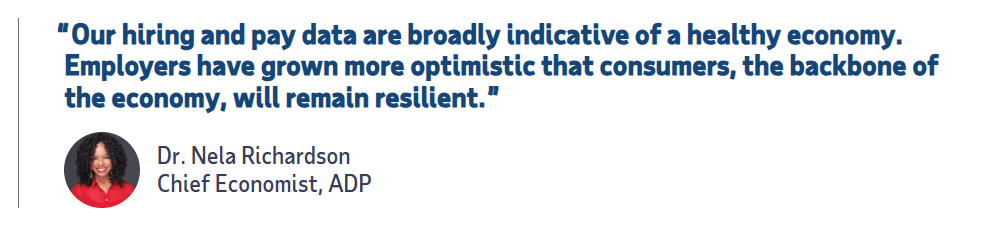
Source: ADP®
ADP Private Employment by Establishment Size
July ADP Changes:
 ADP Job Gainers / Losers
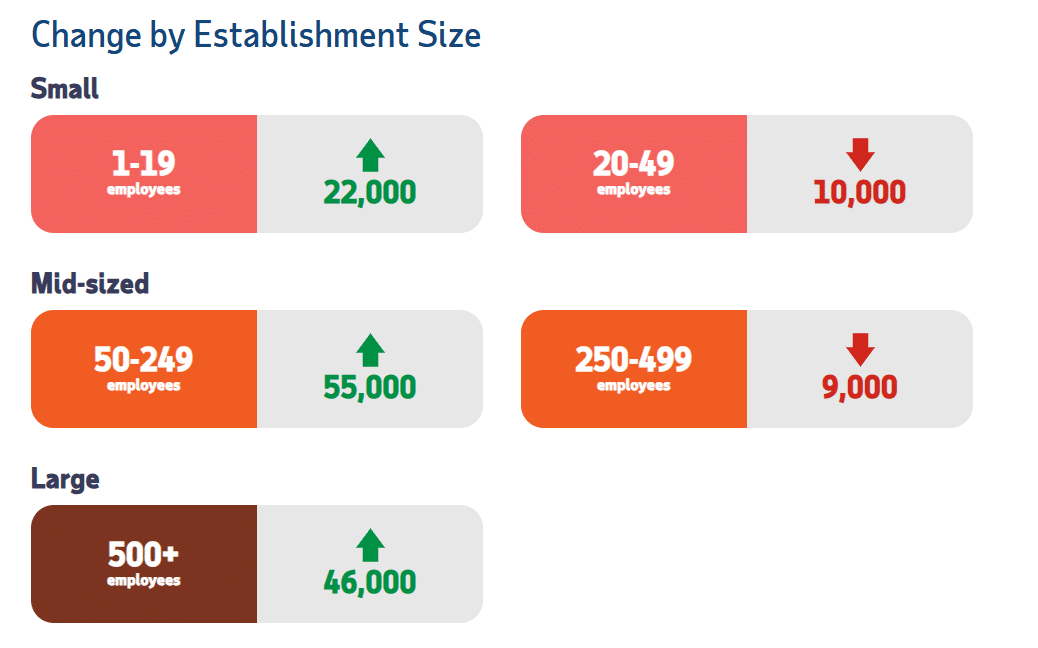
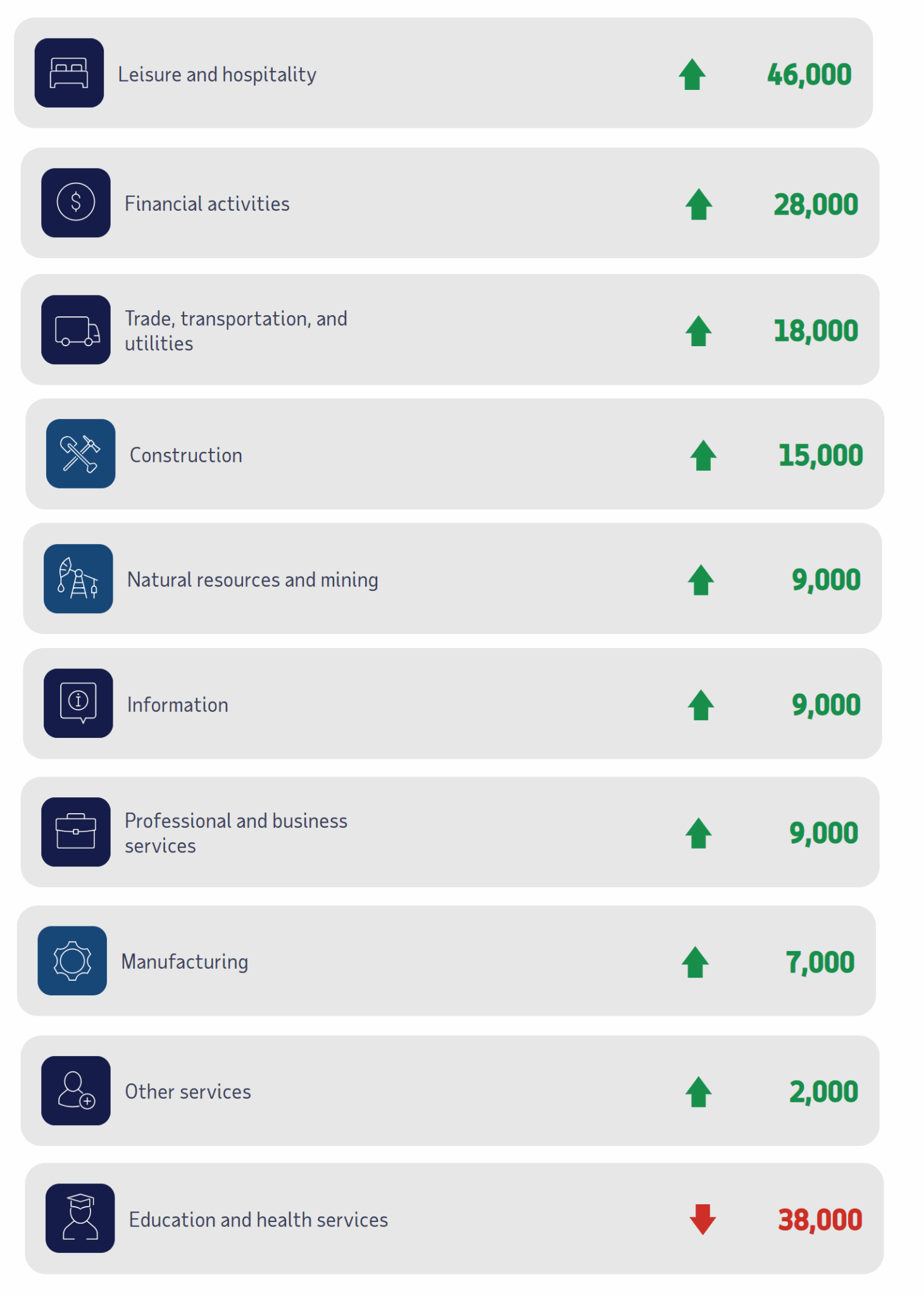
ADP provides a much more optimistic picture of the job situation compared to the BLS perspective, with only one sector losing jobs.
Labor Force Participation Rate
The LFPR is down from 62.3% to 62.2% back to November 2022 levels.
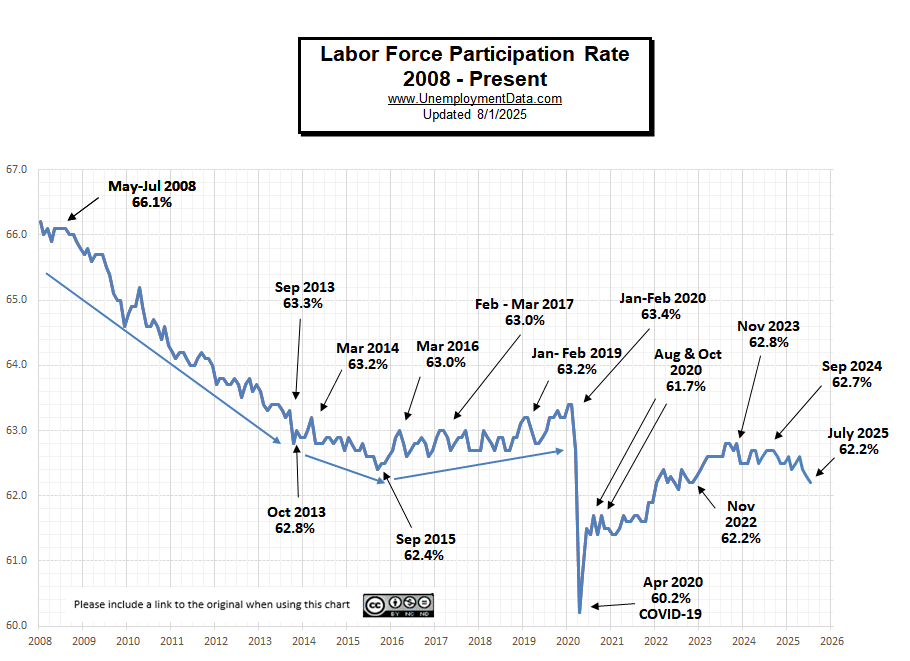
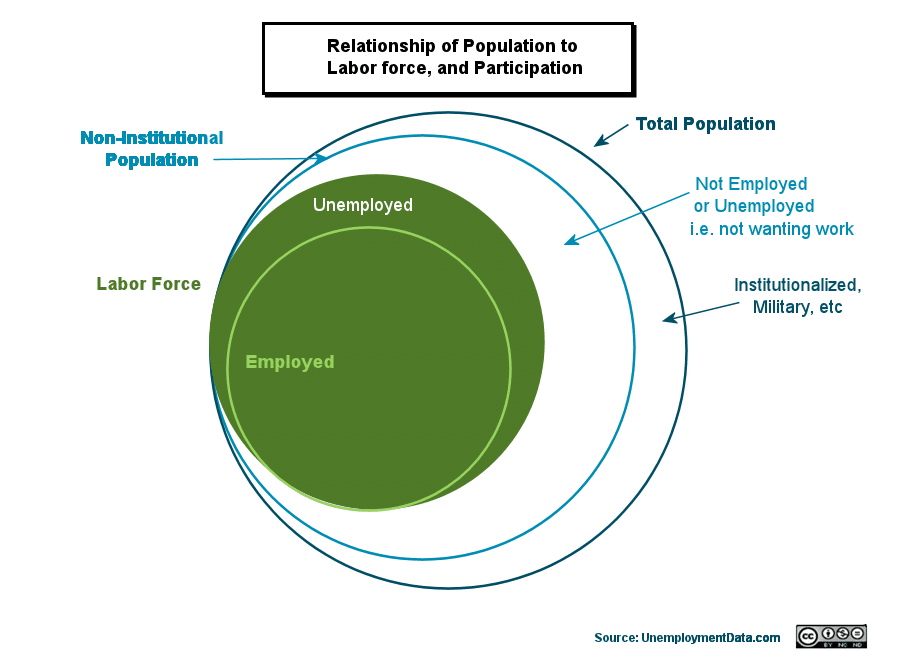
The Labor Force Participation Rate is the percentage of the Non-Institutional Population that makes up the Labor Force.
And the Employment – Population Ratio is the percentage of the Total Population that is Employed. We created a chart to help explain the difference. The Employment–Population Ratio is the percentage of the largest circle to the smallest circle in this diagram. While the LFPR is the relationship of the 2nd largest circle to the 3rd largest circle (entire green circle).
Less Than Full Employment
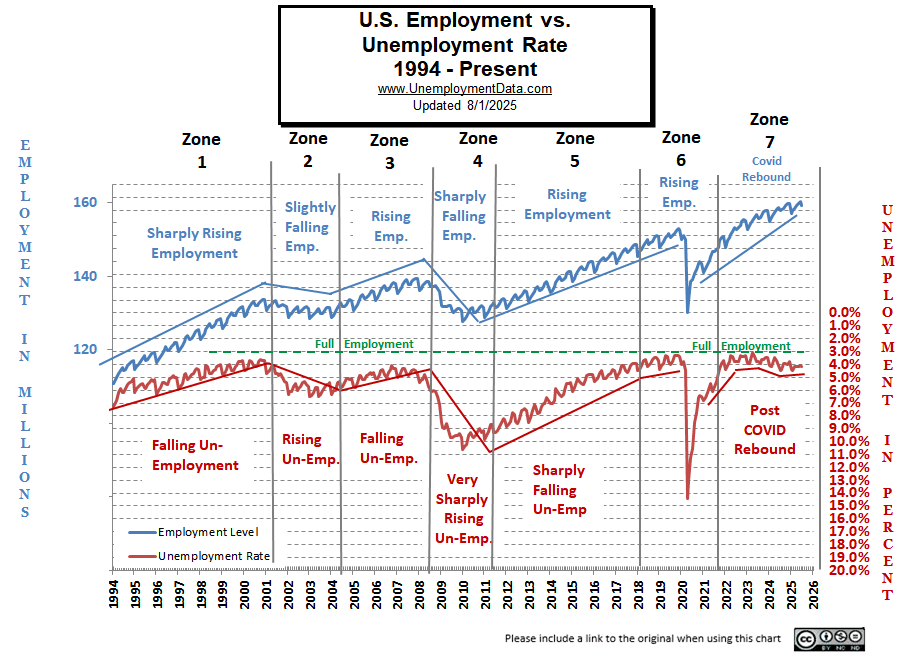
This chart compares employment levels with the (inverted) unemployment rate.
Full Employment is when everyone who wants a job has one. It is generally considered to be around 3%. After the unemployment rate almost touched the magic full employment line in April 2023, it began moving away (i.e., higher unemployment).
Note: The Unemployment rate is inverted to track the employment rate. Neither is Seasonally Adjusted. For more information see Employment vs. Unemployment.
Note: Full employment is not considered to be at zero percent because even when employers are having difficulty finding employees, some people are still unemployed due to either:
- structural unemployment (mismatch between worker skills and job requirements, i.e., not enough training) or
- frictional unemployment There will always be people who have quit or have lost a seasonal job and are in the process of getting a new job. Or Simply because they quit their job knowing it would be easy to find another (hopefully better) job.
Seasonally Adjusted U1 through U6 Unemployment Rates

Employment-Population Ratio
By Gender
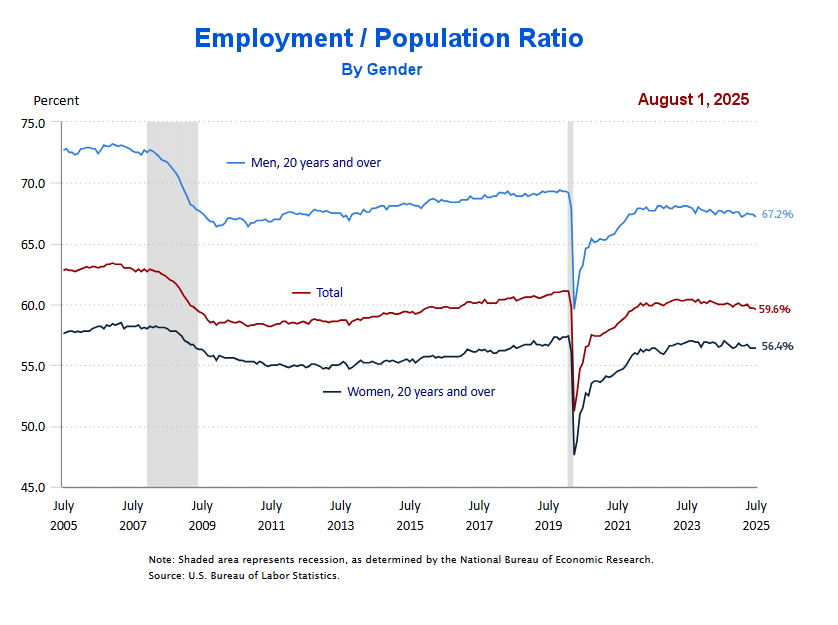
This chart shows the Employment-Population Ratio by Gender. Men make up a much larger portion of the workforce, i.e., 67.2% of men are employed, and only 56.4% of women are employed. But…
As you can see, 20 years ago, back in 2005, over 72% of men were working and 57.4% of women were working. In 2008, the Great Recession caused a massive decline in employment for both men and women. By December of 2009, only 66.4% of men were working and 55.4% of women. Over the next decade and a half, women workers rebounded much stronger than men did.
Duration of Unemployment
We may be seeing the beginning of an upturn in unemployment in the longer durations, i.e., it is starting to take longer to find a job.
Unemployed 27 Weeks or Longer
At this point, 24.9% of those unemployed have been unemployed for 27 weeks or longer.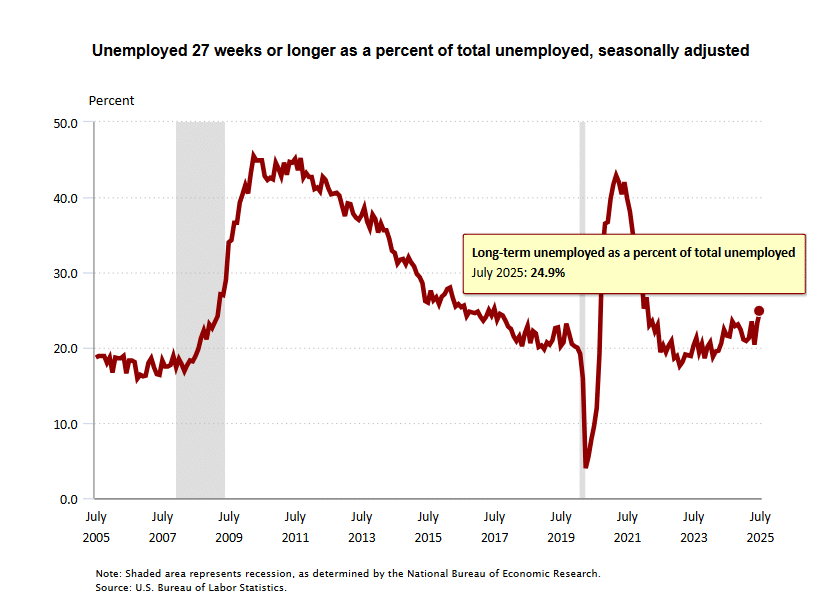
Read more on UnemploymentData.com.
- Blue-Collar Wages Surge in 2025
- Does Raising The Minimum Wage Make A Substantial Difference?
- Would More Jobs Help Social Security?
From InflationData.com
- FED’s Semiannual Monetary Policy Report
- What Is the Trimmed Mean CPI and What Is It Good For?
- May 2025 Inflation Up Slightly
- The Truth About Why Gold Is Surging
- FED Holds Steady at May Meeting
- How To Recalculate Retirement for Today’s Economy
From Financial Trend Forecaster
- Moore Inflation Predictor
- NYSE ROC
- NASDAQ ROC
- ETH and BTC Buy Signal
- AI Is Deflationary But Its Energy Demand Could Fuel Inflation
- June Inflation Up Again
- FED’s Semiannual Monetary Policy Report
- What Is the Trimmed Mean CPI and What Is It Good For?
- This Forecasting Tool Nailed the S&P Turns
- Warren Buffett isn’t buying — and that says a lot.
- Debt Ceiling Drama
- Stock Market Signal: Only 3 Times in 47 Years!
- Tesla’s Troubles — Is it Musk or is it More?
From OptioMoney
- What is a “Haircut” in Financial Terminology
- How To Protect Your Wallet When You’re Just Starting Out
- Consumer Culture Contrasting Spending Habits in the US and Europe
- Financial Considerations When Moving to Florida
From Your Family Finances
- YFF has a new editor, so we won’t be posting new links anymore.
