
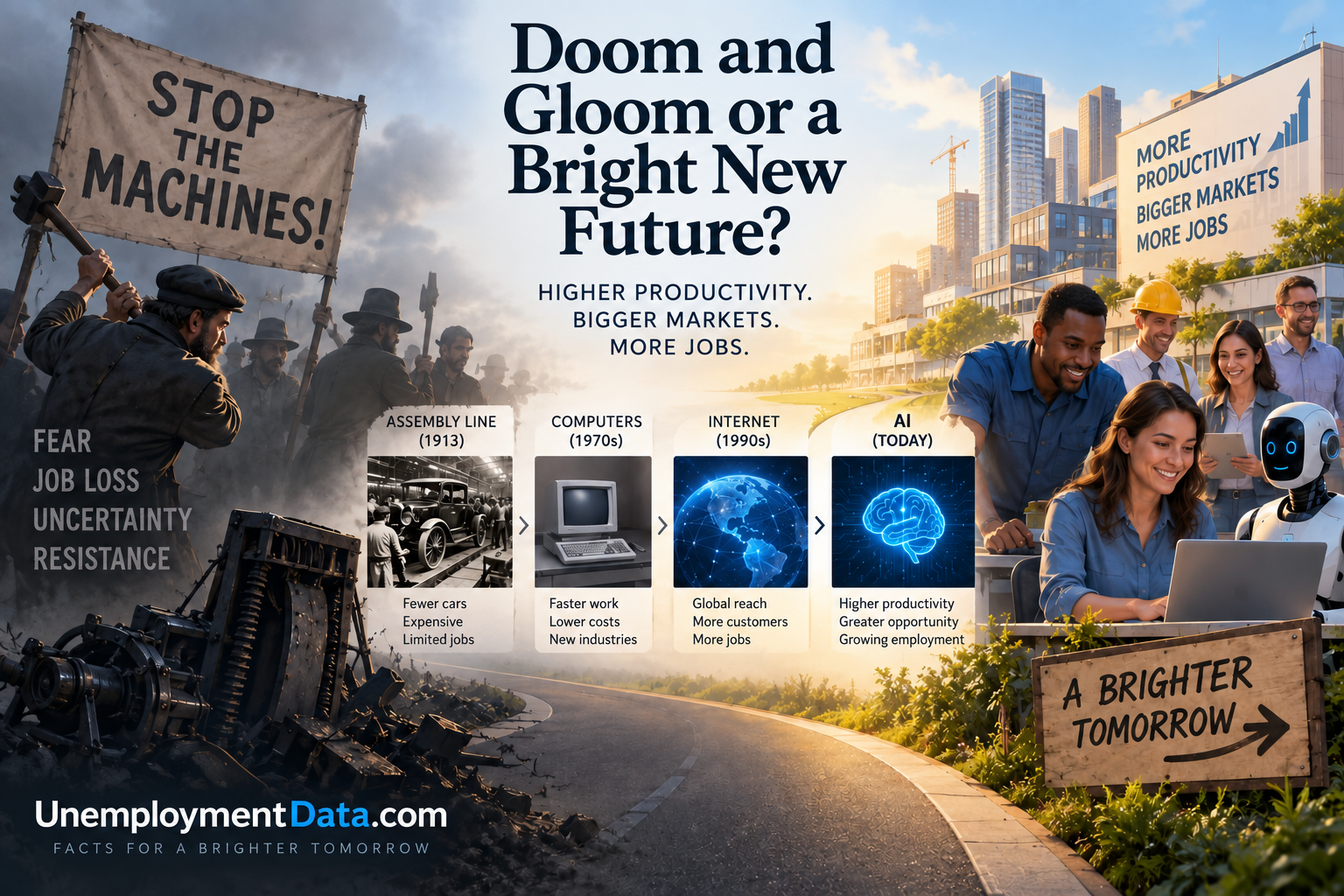
 Every new wave of technology brings predictions of doom and gloom. Across industries, people worry that AI will automate millions of roles and skyrocket unemployment. The concern is understandable, but history suggests a more complicated outcome.
These same fears appeared during the Industrial Revolution. Workers known as Luddites famously destroyed textile machinery because they believed the machines would eliminate their livelihoods. They were worried because a single machine could perform work that previously required several people and weeks of labor. Looking only at that immediate effect, job losses seemed inevitable.
What the Luddites could not foresee was the broader economic impact. While technology often eliminates specific tasks and occupations, it also increases productivity. Higher productivity lowers costs, expands demand, creates new industries, generates new forms of employment, and ultimately improves the overall standard of living. Early evidence from the AI era suggests that a similar process may be unfolding today.
The Productivity Story We Often Forget
Modern-day Luddites worry about all the jobs AI might replace. More important is what happens when workers become more productive. Businesses hire employees because those employees create more value than they cost. If technology helps workers produce more value in less time, businesses can serve more customers, reduce costs, and expand operations. Growth often leads to additional hiring rather than permanent workforce reductions.
History provides many examples. Before Henry Ford introduced assembly-line manufacturing, automobiles were largely handcrafted products. Building a car required extensive labor and specialized skills, which made cars expensive and limited demand. The automobile industry remained relatively small because few consumers could afford the product.
The assembly line dramatically increased worker productivity. Cars became cheaper, demand surged, and the overall automobile market expanded. New businesses emerged to support the auto industry. As a result, overall employment grew substantially. In other words, the assembly line didn’t reduce the long-term need for workers. It helped create a larger industry that ultimately required more workers.
The same dynamic appeared in countless other innovations. Standardization of industrial parts, mechanized farming, computers, and the internet all reduced the labor required for specific tasks. At the same time, they expanded economic activity and created opportunities that didn’t exist previously.
What Current AI Data Shows
Many predictions about AI’s labor impact rely on theoretical models. More valuable is actual business behavior. Payroll company Gusto analyzed hiring records from small businesses, comparing firms that adopted AI tools with similar firms that had not. Their findings challenge the common assumption that AI adoption automatically leads to workforce reduction.
After one year, businesses using AI experienced job growth that was 7% higher than comparable businesses that were not using AI. Simplify: If AI were primarily functioning as a direct replacement for workers, this is not the pattern you would expect. Surprisingly, the additional employees were not hired to manage AI systems. Instead, the workers contributed directly to delivering products and services.
Consider a dental office. AI can assist with some things, but it can’t clean teeth. When overhead decreases, businesses can invest in growth and add customer-facing employees. AI may reduce the amount of administrative work, while increasing demand for workers who actually provide the value customers purchase.
Why Smaller Startups Could Mean More Jobs
Some AI statistics may appear troubling at first. Gusto found that newly founded companies in AI-intensive industries started with roughly 6% fewer employees than previously. At first glance, that seems like evidence that AI is reducing employment. But…
Starting a business requires significant effort long before revenue arrives. AI can perform or accelerate many of these activities, driving startup costs down, so more people are willing to launch businesses.
A company that once required five employees to open might now begin with only three. While that business starts smaller, it also becomes more financially viable. More businesses can survive the difficult early stages of growth. As successful companies expand, their hiring grow. They may require fewer administrative staff, but they still need technicians who directly serve customers.
The result is a shift in employment rather than a reduction.
The Missing Step in the AI Narrative
Most concerns about AI follow a straightforward logic:
AI makes workers more productive → companies need fewer people → unemployment rises.
But the story doesn’t have to stop there:
AI makes workers more productive → costs go down → businesses can serve more customers → demand rises → businesses grow → businesses hire more people.
This story is not new, it has been playing out for more than two centuries. What makes AI different is the type of work it influences. Previous technological revolutions often transformed physical labor. AI is the next generation, affecting office and knowledge work, and leaving skilled labor jobs.
More Businesses, More Employment
Gusto reviewed payroll data from 400,000+ businesses and found no evidence of employment collapse. In fact, companies that used AI more extensively generally reported stronger hiring and revenue growth than those that did not.
Small businesses have historically played a major role in job creation. A company that never gets founded cannot hire anyone. If AI lowers the barriers to entrepreneurship, the economy could see more business formation, more competition, and ultimately more employment opportunities.
The long-term impact may depend less on how many jobs AI automates and more on how many new businesses it enables.
Job Losses Will Still Occur
None of this means AI will be painless. Some occupations will shrink. Some jobs will disappear entirely. Skills that command high wages today may lose value as automation improves. Workers in affected industries may face difficult transitions, retraining requirements, and periods of uncertainty.
History shows that technological change often creates disruption even when it generates long-term economic benefits. The transition can be painful when it happens quickly. The key distinction is between eliminating specific jobs and creating lasting mass unemployment.
Past technologies eliminated entire categories of work. Automobiles displaced many horse-related occupations. Computers reduced the need for large numbers of clerical workers. ATMs changed the role of bank tellers.
Yet none of these innovations produced the permanent unemployment crises that many feared. Workers gradually shifted into new roles as industries evolved and economic activity expanded. AI is likely to follow a similar path, though the adjustment period may be faster and therefore more painful than previous technological transitions.
The Bottom Line
The central question is not whether AI will eliminate jobs. It almost certainly will. The more important question is whether the productivity gains created by AI generate enough new business activity to offset those losses. The first signs suggest that the answer may be yes.
AI appears capable of helping companies start with lower costs, operate more efficiently, and scale more quickly. It may enable entrepreneurs to enter markets that once required much larger organizations. By reducing administrative burdens, it may allow businesses to devote more resources toward the employees who directly create value for customers.
The popular narrative assumes AI is primarily a job-destroying force. History offers a more nuanced lesson. Technological progress often removes some jobs while creating entirely new opportunities through greater productivity and economic growth.
The greatest risk may not be that AI eliminates too many jobs. It may be that we underestimate how many new businesses, industries, and forms of employment can emerge when technology allows people to produce more with less.
Key Takeaway
There is good reason to believe AI could create more jobs than it destroys, and the early evidence is pointing in that direction.

Leave a Reply