Charts


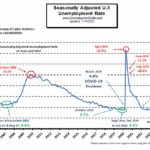
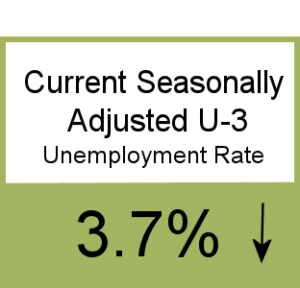
  • Unemployment Rate Chart – The seasonally adjusted unemployment rate from 1948 to the present is one of the most watched statistics. Where is it now and should you trust it?
  • U-6 Unemployment Rate- U-6 is the broadest measure of unemployment and includes all classes of Unemployed plus those ”marginally attached” and/or part-time for economic reasons.
  • Current Employment Data - How many jobs are there actually? This chart shows Employment since Jan 2000 and what the current trend is.
  • Historical Employment Data Chart- How Many People Are Actually Employed? This chart shows the actual employment rate without all the mumbo jumbo. It gives a clear picture of  the employment level in the United States from 1939 to the Present. When employment is rising the ecomomy is growing. When the employment rate levels off or declines times are not so good. Take a look and see how employment rates correspond to recessions over time.
  • Misery Index- Created by economist Arthur Okun to help gauge the level of misery the average person is suffering. It is a combination of the inflation rate and the unemployment rate.

Do You Know the Tricks to Making Money After You Lose Your Job?

Millions of consumers suffered job loss and unemployment after the recent economic meltdown in the US. The way you manage your financial situation will determine whether a job loss and unemployment is a temporary set back or it is a potentially life-changing disaster. The decisions you make now might have an immense impact on your financial future. Therefore, if you are unemployed then you should start looking for a way out to make money so that you do not incur overwhelming debt and enroll in a debt relief program.

When you are unemployed, you still have to pay rent, utilities, as well as health costs and to top it all somehow afford groceries. Unemployment benefits will not last for long, so there’s little cushion.

There are ways for the unemployed to pick up some additional money and avoid complicating their financial situation. Here are a few financial strategies to help you stay afloat and maintain your pride: Continue reading

Median Weekly Earnings $764

The U.S. Bureau of Labor Statistics (BLS) released the results of their 4th quarter 2011 wage and salary survey today. Data on usual weekly earnings are collected as part of the Current Population Survey, a nationwide sample survey of households in which respondents are asked, among other things, how much each wage and salary worker usually earns. The BLS surveyed a representative sample of the 101.5 million full-time wage and salary workers and determined that the mean (not seasonally adjusted) earnings were $764 per week. Annualized that would be  $39,728.

Wages varied by race, gender, age group and profession. As would be expected, persons employed full time in management, professional, and related occupations had the highest median weekly earnings with men earning $1,274 and women earning $946. Men and women employed in service jobs earned the least, $578 and $440, respectively.

Education also played a part in the median wages. Full-time workers age 25 and over without a high school diploma had median weekly earnings of $444, compared with $641 for high school graduates (no college) and $1,158 for those holding at least a bachelor’s degree.

Wages also varied by age with the highest wages going to those in the oldest age group. Among men, those age 55 to 64 had the highest median weekly earnings at $1,029. While those slightly younger ,45 to 54 had the second highest at $993.

Earnings by race are also tracked, with Asians having the highest median wages at $880, Whites at $786, Blacks at $621, and Hispanics at $534. These numbers do not take into consideration education, language abilities or occupation.  Women had  median weekly earnings of $688, or 81.6 percent of the $843 median for men. White women earned 81.4 percent as much as their male counterparts,  black women earned 91.1 percent as much as their male counterparts, Asian women earned 80.3 percent as much as their male counterparts and Hispanic women women earned 90.4 percent as much as their male counterparts. Interestingly if you take 80.3% of the Asian male wage you get $706 for Asian women which is more than the $621 for Black men.

The BLS uses the “Mean” rather than the average. A “Mean” determines the amount the middle person in a group makes. So if you have five people earning $10,000, $20,000, $30,000, $40,000 and $50,000 the mean would be $30,000.  In this example the average would also be $30,000. But the reason the BLS uses the mean is because it eliminates the effects of high income wage earners. For instance if you have five different wage earners earning $10,000, $20,000, $30,000, $40,000 and then you have Mitt Romney earning $21 Million. The mean is still $30,000 but the average is $4,220,000.

How DEEP Will Cuts in Government Services Go?

Plus: The check is STILL in the mail.

“Localities have chopped 535,000 positions since September 2008…”
USA Today (10/18)

Cuts in government services became conspicuous after the 2007-2009 financial crisis.

The first edition of Robert Prechter’s Conquer the Crash saw this coming, even though the book published nearly a decade ago:

“Don’t expect government services to remain at their current levels…The tax receipts that pay for roads, police and jails, fire departments, trash pickup, emergency (911) monitoring, water systems and so on will fall to such low levels that services will be restricted.” (p. 257)

Households throughout Massachusetts know exactly what Prechter is talking about. Continue reading

World-Wide Hourly Compensation Comparison

The 2010 worldwide hourly compensation cost comparison is finally in. So we can see how the wages stack up between 34 different countries. Not surprisingly many European Countries have higher employment costs than the U.S. because of their massive social programs. This of course makes them less competitive in the world market. Surprisingly, in 2010 the U.K. actually had lower total employment costs than the U.S.  Of course when it comes to standard of living, Wages and Social programs are only half of the equation. The other half of course is the cost of living. A low cost of living country doesn’t need the same wages in order to have the same standard of living.

Let’s look at the wage levels in various countries Continue reading

The Difference a Degree Makes in Unemployment Levels

We’re always told by our parents that we need a good education in order to get a good job. And that we will make more money if we have a good education. But these days we hear of unemployed college graduates camping out in New York city and protesting Wall Street because they can’t find jobs. So let’s take a look at the numbers and compare the unemployment rate based on eduation level.  In the following chart we will look at four educational levels. The first level are those people with less than a High School education. The second level are those with a High School diploma. The third level are those with some college education or an associates degree. And finally those with a Four Year College Degree.

As we can see from the chart above, obviously the unemployment rate is the highest for those with the least education… as we would expect. Logically if you were an employer you would lay off the least educated employees first because they are more readily replaceable. We can even tell by the numbers the actual difference a high school education makes. The average unemployment rate for the period from 1992 through October 2011 for High School graduates was 5.5% while the average for those who didn’t graduate from High School was 9.2%. So simply by getting a High School education you decreased your odds of being unemployed drastically with the actual difference being 3.7%.  But if you look at the chart you will see that a High School education was even more valuable than that. The real benefit of being able to get a job is when jobs are scarce, so even though the average difference was 3.7% during bad times, i.e. when the overall unemployment rate is higher the difference climbs even more.

First let’s look at the difference just a high School education makes. Continue reading

North Dakota Jobs Booming

While the unemployment rate in most of the United States hovers around 9% an unlikely sounding state is booming. The current unemployment rate in North Dakota of all places is just 3.5% according the September report of the U.S. Bureau of Labor Statistics. (Nationwide, the rate is 9.1%). An oil boom has sprung up and immunized residents from the most severe recession in decades. Wages are up, and work is plentiful. It’s almost like being on a totally different planet. People are sending resumes and getting multiple job offers within a week. Why? Continue reading

World’s Most Weird and Wonderful Jobs

By Isabella Woods


As many of us are only too aware, we spend a lot of time at work. According to the Paris-based Organization for Economic Cooperation & Development, the average Brit spends 1,530 hours a year working, while the average American spends even longer – a back-breaking, finger-hurting 1,896 hours every year.

Things are not going to get better either, according to Paul Macro of the actuaries Watson Wyatt. ‘For a long time, it was a common belief that rising prosperity would allow each generation to retire earlier than their parents,’ he says. But reality has now bitten. It means saving more or working longer.

With these sobering thoughts in mind, perhaps it’s time that we started considering how we make all those years of slog a little more interesting. Do a little digging, and it’s easy to discover some unusual, if not downright bizarre, employment opportunities.

Banana gasser

Not quite as Nazi as it appears, banana gassing is a process to help ripen the fruit ready for sale. After being picked, bananas are shipped while they are still green to help reduce the potential for bruising. On arrival, they are taken to hermetically sealed chambers where they are surrounded with an ethylene gas to encourage their ripening. The process can take three to eight days, with the gasser using a computer program to determine the volume and amount of exposure needed. Continue reading

8 Ways To Make An Impact On Your First Interview

By Ally Tobias


There’s no question that it’s a buyer’s market out there. Close to 10% of the population is unemployed and who knows how many more under-employed. How can you stand out from the hundreds, sometimes thousands, other job seekers?

Here are 8 steps most job seekers miss to make you stand out against the competition.


1. Do Your Research
Always do your research and find out as much as you can about the company you’ll be interviewing with, the role you’re interviewing for and the interviewer.

As they say, “k
nowledge is power” and it’s never truer than in this case.

Research is important because it will allow you to laser target all your preparations to that particular employer. For example, most people have one resume that they send out to 100 employers. It’s generic – and therefore weak. Is it any wonder that they don’t hear a reply?

Savvy job seekers tailor their resume for one job and they incorporate their research into it. They include experience that works to their advantage but leave out those that do not. This is crucial because you want resumes to be short and sweet but also deliver everything you want to say. Continue reading

How to Bag your Dream Job

With unemployment at a high, it’s tough out there in the job market. These days, employers are playing it cautious when it comes to advertising for jobs, and when they do decide to advertise, they’re looking for the cream of the crop in terms of potential employees, so it’s vital you’ve done your homework.

With that in mind, we’ve come up with a checklist of things you should do if you want to succeed at interview. Read on to discover what tips we think will stand you in good stead…

1. Know Your CV (Curriculum Vitae or Resume)

It might sound obvious, but for many people it isn’t. So your CV and cover letter has gotten you a job interview – great. But do you know your CV like the back of your hand?

If not, you should. It’s often the first thing employers ask you about in interviews. For instance, ‘Oh I see you worked at XXX – so what did that entail?’ It sounds like an easy question to answer but if it was a work placement that was a few years ago you’ll need to make sure you can remember what your role involved. ‘Um’s’ and ‘er’s’ don’t generally make for a convincing answer. Continue reading


Helpful Resources

Learn about CFD trading and Contracts For Difference at IG Markets and discover a smart alternative to traditional investing.

Archives